Event submissions
Published
This submission belongs to the session S6. Lasers in Dentistry of the event The 1st International Online Conference on Dentistry
Published date
02 Oct, 2026
Academic Editor
'%3e%3cpath%20d='M12.6657%2010.9104C12.4185%2010.325%2012.0599%209.79327%2011.6097%209.34482C11.1609%208.89508%2010.6293%208.5365%2010.0442%208.28888C10.0389%208.28626%2010.0337%208.28495%2010.0285%208.28233C10.8446%207.69279%2011.3752%206.73249%2011.3752%205.64904C11.3752%203.8542%209.92103%202.39999%208.1262%202.39999C6.33136%202.39999%204.87715%203.8542%204.87715%205.64904C4.87715%206.73249%205.40774%207.69279%206.22393%208.28364C6.21869%208.28626%206.21345%208.28757%206.20821%208.29019C5.62129%208.5378%205.09463%208.89284%204.64265%209.34613C4.1929%209.79493%203.83432%2010.3266%203.58671%2010.9117C3.34345%2011.4845%203.21226%2012.0987%203.20023%2012.7209C3.19988%2012.7349%203.20233%2012.7488%203.20744%2012.7619C3.21255%2012.7749%203.22022%2012.7867%203.22998%2012.7968C3.23975%2012.8068%203.25142%2012.8147%203.26431%2012.8202C3.2772%2012.8256%203.29105%2012.8284%203.30504%2012.8284H4.09109C4.14874%2012.8284%204.19459%2012.7825%204.1959%2012.7262C4.2221%2011.7148%204.62823%2010.7676%205.34617%2010.0497C6.08899%209.30683%207.0755%208.89808%208.1262%208.89808C9.17689%208.89808%2010.1634%209.30683%2010.9062%2010.0497C11.6242%2010.7676%2012.0303%2011.7148%2012.0565%2012.7262C12.0578%2012.7838%2012.1037%2012.8284%2012.1613%2012.8284H12.9474C12.9613%2012.8284%2012.9752%2012.8256%2012.9881%2012.8202C13.001%2012.8147%2013.0126%2012.8068%2013.0224%2012.7968C13.0322%2012.7867%2013.0398%2012.7749%2013.0449%2012.7619C13.0501%2012.7488%2013.0525%2012.7349%2013.0522%2012.7209C13.0391%2012.0947%2012.9094%2011.4855%2012.6657%2010.9104ZM8.1262%207.9024C7.52486%207.9024%206.9589%207.6679%206.53312%207.24211C6.10733%206.81633%205.87283%206.25037%205.87283%205.64904C5.87283%205.0477%206.10733%204.48174%206.53312%204.05596C6.9589%203.63018%207.52486%203.39567%208.1262%203.39567C8.72753%203.39567%209.29349%203.63018%209.71927%204.05596C10.1451%204.48174%2010.3796%205.0477%2010.3796%205.64904C10.3796%206.25037%2010.1451%206.81633%209.71927%207.24211C9.29349%207.6679%208.72753%207.9024%208.1262%207.9024Z'%20fill='%235D1EE1'/%3e%3c/g%3e%3c/svg%3e) Samir Nammour
Samir NammourCitation
Fabiana Pia Finzi, Giuseppe D'Albis, Marta Forte, Alexandra Artin, Saverio Capodiferro, Lasers in Periodontal Surgery: Clinical Outcomes of Adjunctive NanoYag Laser Therapy, in Proceedings of The 1st International Online Conference on Dentistry, 7 October–9 October 2026, MDPI: Basel, Switzerland
Share
Email
Facebook
Twitter
LinkedIn
Lasers in Periodontal Surgery: Clinical Outcomes of Adjunctive NanoYag Laser Therapy
'%3e%3cpath%20d='M12.6647%2010.9104C12.4176%2010.325%2012.0589%209.7933%2011.6088%209.34485C11.16%208.89511%2010.6283%208.53653%2010.0432%208.28891C10.038%208.28629%2010.0327%208.28498%2010.0275%208.28236C10.8437%207.69282%2011.3743%206.73252%2011.3743%205.64907C11.3743%203.85423%209.92005%202.40002%208.12522%202.40002C6.33038%202.40002%204.87618%203.85423%204.87618%205.64907C4.87618%206.73252%205.40677%207.69282%206.22296%208.28367C6.21772%208.28629%206.21248%208.2876%206.20724%208.29022C5.62031%208.53783%205.09365%208.89287%204.64167%209.34616C4.19192%209.79496%203.83334%2010.3266%203.58573%2010.9117C3.34247%2011.4846%203.21128%2012.0987%203.19925%2012.721C3.1989%2012.735%203.20135%2012.7489%203.20646%2012.7619C3.21157%2012.7749%203.21924%2012.7868%203.22901%2012.7968C3.23877%2012.8068%203.25045%2012.8148%203.26334%2012.8202C3.27623%2012.8256%203.29007%2012.8284%203.30406%2012.8284H4.09012C4.14776%2012.8284%204.19362%2012.7825%204.19493%2012.7262C4.22113%2011.7148%204.62726%2010.7676%205.34519%2010.0497C6.08802%209.30686%207.07452%208.89811%208.12522%208.89811C9.17592%208.89811%2010.1624%209.30686%2010.9052%2010.0497C11.6232%2010.7676%2012.0293%2011.7148%2012.0555%2012.7262C12.0568%2012.7839%2012.1027%2012.8284%2012.1603%2012.8284H12.9464C12.9604%2012.8284%2012.9742%2012.8256%2012.9871%2012.8202C13%2012.8148%2013.0117%2012.8068%2013.0214%2012.7968C13.0312%2012.7868%2013.0389%2012.7749%2013.044%2012.7619C13.0491%2012.7489%2013.0515%2012.735%2013.0512%2012.721C13.0381%2012.0947%2012.9084%2011.4856%2012.6647%2010.9104ZM8.12522%207.90243C7.52388%207.90243%206.95792%207.66793%206.53214%207.24215C6.10636%206.81636%205.87185%206.2504%205.87185%205.64907C5.87185%205.04773%206.10636%204.48177%206.53214%204.05599C6.95792%203.63021%207.52388%203.3957%208.12522%203.3957C8.72655%203.3957%209.29252%203.63021%209.7183%204.05599C10.1441%204.48177%2010.3786%205.04773%2010.3786%205.64907C10.3786%206.2504%2010.1441%206.81636%209.7183%207.24215C9.29252%207.66793%208.72655%207.90243%208.12522%207.90243Z'%20fill='%235D1EE1'/%3e%3c/g%3e%3c/svg%3e)
Fabiana Pia Finzi 1

Giuseppe D'Albis 1
Marta Forte 1
Alexandra Artin 1

Saverio Capodiferro 1
1. Department of Interdisciplinary Medicine, University of Bari “Aldo Moro”, 70121 Bari, Italy
Abstract
Introduction
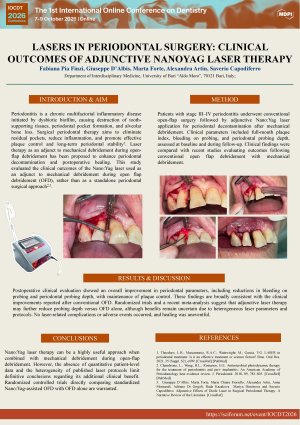
Periodontitis is a chronic multifactorial inflammatory disease initiated by dysbiotic biofilm, causing destruction of tooth-supporting tissues, periodontal pocket formation, and alveolar bone loss. Surgical periodontal therapy aims to eliminate residual pockets, reduce inflammation, and promote effective plaque control and long-term periodontal stability. Laser therapy as an adjunct to mechanical debridement during open-flap debridement has been proposed to enhance periodontal decontamination and postoperative healing. This study evaluated the clinical outcomes of the Nano:Yag laser used as an adjunct to mechanical debridement during open flap debridement (OFD), rather than as a standalone periodontal surgical approach.
Materials and Methods
Patients with stage III–IV periodontitis underwent conventional open-flap surgery followed by adjunctive Nano:Yag laser application for periodontal decontamination after mechanical debridement. Clinical parameters included full-mouth plaque index, bleeding on probing, and periodontal probing depth, assessed at baseline and during follow-up. Clinical findings were compared with recent studies evaluating outcomes following conventional open flap debridement with mechanical debridement.
Results
Postoperative clinical evaluation showed an overall improvement in periodontal parameters, including reductions in bleeding on probing and periodontal probing depth, with maintenance of plaque control. These findings are broadly consistent with the clinical improvements reported after conventional OFD. Randomized trials and a recent meta-analysis suggest that adjunctive laser therapy may further reduce probing depth versus OFD alone, although benefits remain uncertain due to heterogeneous laser parameters and protocols. No laser-related complications or adverse events occurred, and healing was uneventful.
Conclusions
Nano:Yag laser therapy can be a highly useful approach when combined with mechanical debridement during open-flap debridement. However, the absence of quantitative patient-level data and the heterogeneity of published laser protocols limit definitive conclusions regarding its additional clinical benefit. Randomized controlled trials directly comparing standardized Nano:Yag-assisted OFD with OFD alone are warranted.
Keywords
Periodontitis
NanoYag laser
Periodontal surgery
decontamination
Poster
POSTER pdf.pdf
Use of Low-Level Diode Laser Therapy in the Management of Radiation-Induced Oral Mucositis: A Prospective Clinical Study
Perception of Patients Toward Digital Dentistry in a Hospital Setting: A Cross-Sectional Study