Event submissions
Published
This submission belongs to the session S8. AI in Dentistry of the event The 1st International Online Conference on Dentistry
Published date
02 Oct, 2026
Academic Editor
'%3e%3cpath%20d='M12.6657%2010.9104C12.4185%2010.325%2012.0599%209.79327%2011.6097%209.34482C11.1609%208.89508%2010.6293%208.5365%2010.0442%208.28888C10.0389%208.28626%2010.0337%208.28495%2010.0285%208.28233C10.8446%207.69279%2011.3752%206.73249%2011.3752%205.64904C11.3752%203.8542%209.92103%202.39999%208.1262%202.39999C6.33136%202.39999%204.87715%203.8542%204.87715%205.64904C4.87715%206.73249%205.40774%207.69279%206.22393%208.28364C6.21869%208.28626%206.21345%208.28757%206.20821%208.29019C5.62129%208.5378%205.09463%208.89284%204.64265%209.34613C4.1929%209.79493%203.83432%2010.3266%203.58671%2010.9117C3.34345%2011.4845%203.21226%2012.0987%203.20023%2012.7209C3.19988%2012.7349%203.20233%2012.7488%203.20744%2012.7619C3.21255%2012.7749%203.22022%2012.7867%203.22998%2012.7968C3.23975%2012.8068%203.25142%2012.8147%203.26431%2012.8202C3.2772%2012.8256%203.29105%2012.8284%203.30504%2012.8284H4.09109C4.14874%2012.8284%204.19459%2012.7825%204.1959%2012.7262C4.2221%2011.7148%204.62823%2010.7676%205.34617%2010.0497C6.08899%209.30683%207.0755%208.89808%208.1262%208.89808C9.17689%208.89808%2010.1634%209.30683%2010.9062%2010.0497C11.6242%2010.7676%2012.0303%2011.7148%2012.0565%2012.7262C12.0578%2012.7838%2012.1037%2012.8284%2012.1613%2012.8284H12.9474C12.9613%2012.8284%2012.9752%2012.8256%2012.9881%2012.8202C13.001%2012.8147%2013.0126%2012.8068%2013.0224%2012.7968C13.0322%2012.7867%2013.0398%2012.7749%2013.0449%2012.7619C13.0501%2012.7488%2013.0525%2012.7349%2013.0522%2012.7209C13.0391%2012.0947%2012.9094%2011.4855%2012.6657%2010.9104ZM8.1262%207.9024C7.52486%207.9024%206.9589%207.6679%206.53312%207.24211C6.10733%206.81633%205.87283%206.25037%205.87283%205.64904C5.87283%205.0477%206.10733%204.48174%206.53312%204.05596C6.9589%203.63018%207.52486%203.39567%208.1262%203.39567C8.72753%203.39567%209.29349%203.63018%209.71927%204.05596C10.1451%204.48174%2010.3796%205.0477%2010.3796%205.64904C10.3796%206.25037%2010.1451%206.81633%209.71927%207.24211C9.29349%207.6679%208.72753%207.9024%208.1262%207.9024Z'%20fill='%235D1EE1'/%3e%3c/g%3e%3c/svg%3e) Christos Rahiotis
Christos RahiotisCitation
Dimitar Dimitrov, Lyubomir Stefanov, Denislav Emilov, Patient Attitudes Toward AI in Periodontal Health Promotion and Assessment, in Proceedings of The 1st International Online Conference on Dentistry, 7 October–9 October 2026, MDPI: Basel, Switzerland
Share
Email
Facebook
Twitter
LinkedIn
Patient Attitudes Toward AI in Periodontal Health Promotion and Assessment
'%3e%3cpath%20d='M12.6647%2010.9104C12.4176%2010.325%2012.0589%209.7933%2011.6088%209.34485C11.16%208.89511%2010.6283%208.53653%2010.0432%208.28891C10.038%208.28629%2010.0327%208.28498%2010.0275%208.28236C10.8437%207.69282%2011.3743%206.73252%2011.3743%205.64907C11.3743%203.85423%209.92005%202.40002%208.12522%202.40002C6.33038%202.40002%204.87618%203.85423%204.87618%205.64907C4.87618%206.73252%205.40677%207.69282%206.22296%208.28367C6.21772%208.28629%206.21248%208.2876%206.20724%208.29022C5.62031%208.53783%205.09365%208.89287%204.64167%209.34616C4.19192%209.79496%203.83334%2010.3266%203.58573%2010.9117C3.34247%2011.4846%203.21128%2012.0987%203.19925%2012.721C3.1989%2012.735%203.20135%2012.7489%203.20646%2012.7619C3.21157%2012.7749%203.21924%2012.7868%203.22901%2012.7968C3.23877%2012.8068%203.25045%2012.8148%203.26334%2012.8202C3.27623%2012.8256%203.29007%2012.8284%203.30406%2012.8284H4.09012C4.14776%2012.8284%204.19362%2012.7825%204.19493%2012.7262C4.22113%2011.7148%204.62726%2010.7676%205.34519%2010.0497C6.08802%209.30686%207.07452%208.89811%208.12522%208.89811C9.17592%208.89811%2010.1624%209.30686%2010.9052%2010.0497C11.6232%2010.7676%2012.0293%2011.7148%2012.0555%2012.7262C12.0568%2012.7839%2012.1027%2012.8284%2012.1603%2012.8284H12.9464C12.9604%2012.8284%2012.9742%2012.8256%2012.9871%2012.8202C13%2012.8148%2013.0117%2012.8068%2013.0214%2012.7968C13.0312%2012.7868%2013.0389%2012.7749%2013.044%2012.7619C13.0491%2012.7489%2013.0515%2012.735%2013.0512%2012.721C13.0381%2012.0947%2012.9084%2011.4856%2012.6647%2010.9104ZM8.12522%207.90243C7.52388%207.90243%206.95792%207.66793%206.53214%207.24215C6.10636%206.81636%205.87185%206.2504%205.87185%205.64907C5.87185%205.04773%206.10636%204.48177%206.53214%204.05599C6.95792%203.63021%207.52388%203.3957%208.12522%203.3957C8.72655%203.3957%209.29252%203.63021%209.7183%204.05599C10.1441%204.48177%2010.3786%205.04773%2010.3786%205.64907C10.3786%206.2504%2010.1441%206.81636%209.7183%207.24215C9.29252%207.66793%208.72655%207.90243%208.12522%207.90243Z'%20fill='%235D1EE1'/%3e%3c/g%3e%3c/svg%3e)
Dimitar Dimitrov 1
Lyubomir Stefanov 1
Denislav Emilov 1
1. Department of Periodontology, Faculty of Dental Medicine, Medical University - Sofia, 1431 Sofia, Bulgaria
Abstract
Introduction: Artificial intelligence (AI) has been increasingly explored in oral healthcare.
However, patient attitudes toward the use of AI in periodontology remain insufficiently
investigated. This study evaluated patient attitudes toward AI in periodontal health promotion
and assessment and identified factors associated with trust in AI.
Methods: A survey study was conducted among 334 Bulgarian patients. The questionnaire
assessed trust in AI, willingness to use AI-based periodontal assessment applications, previous
AI experience, and concerns regarding AI use in dentistry. Statistical analyses included
Pearson’s chi-squared and Fisher’s exact tests and multivariable logistic regression.
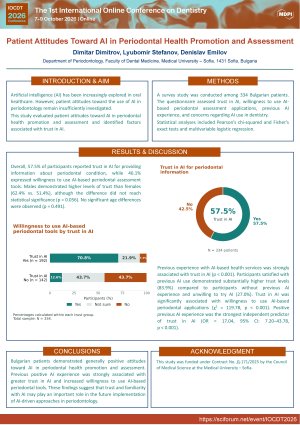
Results: Overall, 57.5% of participants reported trust in AI for providing information about
periodontal condition, while 46.1% expressed willingness to use AI-based periodontal
assessment tools. Males demonstrated higher levels of trust than females (62.4% vs. 51.4%),
although the difference did not reach statistical significance (p = 0.056). No significant age
differences were observed (p = 0.491). Previous experience with AI-based health services was
strongly associated with trust in AI (p < 0.001). Participants satisfied with previous AI use
demonstrated substantially higher trust levels (83.9%) compared to participants without
previous AI experience and unwilling to try AI (27.0%). Trust in AI was significantly associated
with willingness to use AI-based periodontal applications (χ2 = 119.78, p < 0.001). Positive
previous AI experience was the strongest independent predictor of trust in AI (OR = 17.04, 95%
CI: 7.20–43.78, p < 0.001).
Conclusions: Bulgarian patients demonstrated generally positive attitudes toward AI in
periodontal health promotion and assessment. Previous positive AI experience was strongly
associated with greater trust in AI and increased willingness to use AI-based periodontal tools.
These findings suggest that trust and familiarity with AI may play an important role in the future
implementation of AI-driven approaches in periodontology.
Keywords
AI in periodontology
periodontal diseases
trust in AI
Poster
IOCDT2026-Poster_AI trust.pdf
Virtual Surgical Planning for Removal of an Ectopic Maxillary Third Molar Associated with a Large Maxillary Sinus Cyst: A Case Report
Predictive Factors and Risk Stratification Approaches in Posterior Mandibular Implant Surgery: A Systematic Review Protocol