Event submissions
Published
This submission belongs to the session S5. Periodontics and Implant Dentistry of the event The 1st International Online Conference on Dentistry
Published date
02 Oct, 2026
Academic Editor
'%3e%3cpath%20d='M12.6657%2010.9104C12.4185%2010.325%2012.0599%209.79327%2011.6097%209.34482C11.1609%208.89508%2010.6293%208.5365%2010.0442%208.28888C10.0389%208.28626%2010.0337%208.28495%2010.0285%208.28233C10.8446%207.69279%2011.3752%206.73249%2011.3752%205.64904C11.3752%203.8542%209.92103%202.39999%208.1262%202.39999C6.33136%202.39999%204.87715%203.8542%204.87715%205.64904C4.87715%206.73249%205.40774%207.69279%206.22393%208.28364C6.21869%208.28626%206.21345%208.28757%206.20821%208.29019C5.62129%208.5378%205.09463%208.89284%204.64265%209.34613C4.1929%209.79493%203.83432%2010.3266%203.58671%2010.9117C3.34345%2011.4845%203.21226%2012.0987%203.20023%2012.7209C3.19988%2012.7349%203.20233%2012.7488%203.20744%2012.7619C3.21255%2012.7749%203.22022%2012.7867%203.22998%2012.7968C3.23975%2012.8068%203.25142%2012.8147%203.26431%2012.8202C3.2772%2012.8256%203.29105%2012.8284%203.30504%2012.8284H4.09109C4.14874%2012.8284%204.19459%2012.7825%204.1959%2012.7262C4.2221%2011.7148%204.62823%2010.7676%205.34617%2010.0497C6.08899%209.30683%207.0755%208.89808%208.1262%208.89808C9.17689%208.89808%2010.1634%209.30683%2010.9062%2010.0497C11.6242%2010.7676%2012.0303%2011.7148%2012.0565%2012.7262C12.0578%2012.7838%2012.1037%2012.8284%2012.1613%2012.8284H12.9474C12.9613%2012.8284%2012.9752%2012.8256%2012.9881%2012.8202C13.001%2012.8147%2013.0126%2012.8068%2013.0224%2012.7968C13.0322%2012.7867%2013.0398%2012.7749%2013.0449%2012.7619C13.0501%2012.7488%2013.0525%2012.7349%2013.0522%2012.7209C13.0391%2012.0947%2012.9094%2011.4855%2012.6657%2010.9104ZM8.1262%207.9024C7.52486%207.9024%206.9589%207.6679%206.53312%207.24211C6.10733%206.81633%205.87283%206.25037%205.87283%205.64904C5.87283%205.0477%206.10733%204.48174%206.53312%204.05596C6.9589%203.63018%207.52486%203.39567%208.1262%203.39567C8.72753%203.39567%209.29349%203.63018%209.71927%204.05596C10.1451%204.48174%2010.3796%205.0477%2010.3796%205.64904C10.3796%206.25037%2010.1451%206.81633%209.71927%207.24211C9.29349%207.6679%208.72753%207.9024%208.1262%207.9024Z'%20fill='%235D1EE1'/%3e%3c/g%3e%3c/svg%3e) Fawad Javed
Fawad JavedCitation
Armel G. MINKENG, Mamadou Lamine Ndiaye, Nikoletta Vargas, Jules Julien Ndjoh, Kroudia Stéphane Wasse, Predictive Factors and Risk Stratification Approaches in Posterior Mandibular Implant Surgery: A Systematic Review Protocol, in Proceedings of The 1st International Online Conference on Dentistry, 7 October–9 October 2026, MDPI: Basel, Switzerland
Share
Email
Facebook
Twitter
LinkedIn
Predictive Factors and Risk Stratification Approaches in Posterior Mandibular Implant Surgery: A Systematic Review Protocol

Armel G. MINKENG 1
'%3e%3cpath%20d='M12.6647%2010.9104C12.4176%2010.325%2012.0589%209.7933%2011.6088%209.34485C11.16%208.89511%2010.6283%208.53653%2010.0432%208.28891C10.038%208.28629%2010.0327%208.28498%2010.0275%208.28236C10.8437%207.69282%2011.3743%206.73252%2011.3743%205.64907C11.3743%203.85423%209.92005%202.40002%208.12522%202.40002C6.33038%202.40002%204.87618%203.85423%204.87618%205.64907C4.87618%206.73252%205.40677%207.69282%206.22296%208.28367C6.21772%208.28629%206.21248%208.2876%206.20724%208.29022C5.62031%208.53783%205.09365%208.89287%204.64167%209.34616C4.19192%209.79496%203.83334%2010.3266%203.58573%2010.9117C3.34247%2011.4846%203.21128%2012.0987%203.19925%2012.721C3.1989%2012.735%203.20135%2012.7489%203.20646%2012.7619C3.21157%2012.7749%203.21924%2012.7868%203.22901%2012.7968C3.23877%2012.8068%203.25045%2012.8148%203.26334%2012.8202C3.27623%2012.8256%203.29007%2012.8284%203.30406%2012.8284H4.09012C4.14776%2012.8284%204.19362%2012.7825%204.19493%2012.7262C4.22113%2011.7148%204.62726%2010.7676%205.34519%2010.0497C6.08802%209.30686%207.07452%208.89811%208.12522%208.89811C9.17592%208.89811%2010.1624%209.30686%2010.9052%2010.0497C11.6232%2010.7676%2012.0293%2011.7148%2012.0555%2012.7262C12.0568%2012.7839%2012.1027%2012.8284%2012.1603%2012.8284H12.9464C12.9604%2012.8284%2012.9742%2012.8256%2012.9871%2012.8202C13%2012.8148%2013.0117%2012.8068%2013.0214%2012.7968C13.0312%2012.7868%2013.0389%2012.7749%2013.044%2012.7619C13.0491%2012.7489%2013.0515%2012.735%2013.0512%2012.721C13.0381%2012.0947%2012.9084%2011.4856%2012.6647%2010.9104ZM8.12522%207.90243C7.52388%207.90243%206.95792%207.66793%206.53214%207.24215C6.10636%206.81636%205.87185%206.2504%205.87185%205.64907C5.87185%205.04773%206.10636%204.48177%206.53214%204.05599C6.95792%203.63021%207.52388%203.3957%208.12522%203.3957C8.72655%203.3957%209.29252%203.63021%209.7183%204.05599C10.1441%204.48177%2010.3786%205.04773%2010.3786%205.64907C10.3786%206.2504%2010.1441%206.81636%209.7183%207.24215C9.29252%207.66793%208.72655%207.90243%208.12522%207.90243Z'%20fill='%235D1EE1'/%3e%3c/g%3e%3c/svg%3e)
Mamadou Lamine Ndiaye 2
Nikoletta Vargas 3
Jules Julien Ndjoh 4
Kroudia Stéphane Wasse 5
1. Faculty of Medicine and Biomedical Sciences, University of Yaounde I, Yaoundé, P.O. Box 1364, Cameroon
2. Department of Dento-Maxillo-Facial Radiology, Faculty of Medicine, Pharmacy and Odontology (FMPO), Cheikh Anta Diop University, Dakar, P.O. Box 5005, Senegal
3. Department of Oral and Maxillofacial Surgery, Walter Reed National Military Medical Center, Bethesda, MD 20889, USA
4. Department of Implantology, Periodontology and Prosthodontics, Faculty of Medicine and Biomedical Sciences, University of Yaoundé I, Yaoundé, P.O. Box 1364, Cameroon
5. Department of Basic Sciences, Implantology and Oral Surgery, UFR of Odonto-Stomatology, Félix Houphouët-Boigny University, Abidjan, P.O. Box V34, Abidjan, Côte d’Ivoire
Abstract
Background
Implant-supported rehabilitation has become a predictable and widely accepted treatment modality for replacing missing teeth. However, implant placement in the posterior mandible remains challenging because of anatomical constraints and the proximity of critical neurovascular structures, particularly the inferior alveolar nerve. Recent advances in digital dentistry, computer-guided surgery, artificial intelligence (AI), and predictive analytics have created new opportunities for improving risk assessment and clinical decision-making.
Nevertheless, evidence regarding predictive factors and risk stratification approaches remains fragmented and heterogeneous.
Methods
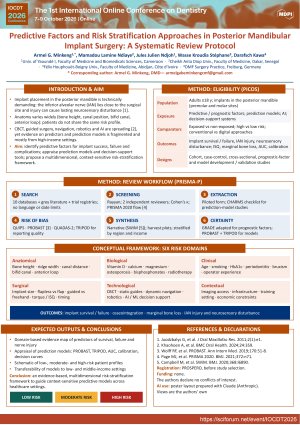
This systematic review will be conducted in accordance with the Preferred Reporting Items for Systematic Reviews and Meta-Analyses Protocols (PRISMA-P) guidelines. Electronic searches will be performed in PubMed/MEDLINE, EMBASE, Cochrane Library, Web of Science, Scopus, ScienceDirect, IEEE Xplore, LILACS, and African Index Medicus. Additional searches will be conducted in ClinicalTrials.gov, the WHO International Clinical Trials Registry Platform (ICTRP), and reference lists of eligible studies. Studies evaluating predictive factors, prognostic determinants, prediction models, artificial intelligence applications, and decision-support systems related to posterior mandibular implant surgery will be considered. Risk of bias will be assessed using the QUIPS and PROBAST tools. A narrative synthesis will be conducted.
Results
This review will provide a comprehensive synthesis of predictive factors associated with implant success, implant failure, and surgical complications in posterior mandibular implant surgery. Existing predictive models and decision-support approaches will be critically evaluated with regard to methodological quality, applicability, and clinical relevance.
Conclusion
This systematic review aims to establish an evidence-based framework for multidimensional risk stratification in posterior mandibular implant surgery and to identify future directions for the development of context-sensitive predictive models applicable across diverse healthcare settings.
Keywords
Dental implants|Posterior mandible|Risk stratification| Prediction models|Artificial intelligence|Clinical decision-making| Implant surgery
Poster
IOCDT2026_Poster_Posterior_Mandible_SR_Protocol.pdf
Patient Attitudes Toward AI in Periodontal Health Promotion and Assessment
Clinical efficacy of oxygen releasing gel as an adjunct to Scaling and root planing compared to other local drug delivery adjuncts: A systematic review and Meta analysis