Event submissions
Published
This submission belongs to the session S4. Restorative Dentistry, Endodontics, and Dental Traumatology of the event The 1st International Online Conference on Dentistry
Published date
02 Oct, 2026
Academic Editor
'%3e%3cpath%20d='M12.6657%2010.9104C12.4185%2010.325%2012.0599%209.79327%2011.6097%209.34482C11.1609%208.89508%2010.6293%208.5365%2010.0442%208.28888C10.0389%208.28626%2010.0337%208.28495%2010.0285%208.28233C10.8446%207.69279%2011.3752%206.73249%2011.3752%205.64904C11.3752%203.8542%209.92103%202.39999%208.1262%202.39999C6.33136%202.39999%204.87715%203.8542%204.87715%205.64904C4.87715%206.73249%205.40774%207.69279%206.22393%208.28364C6.21869%208.28626%206.21345%208.28757%206.20821%208.29019C5.62129%208.5378%205.09463%208.89284%204.64265%209.34613C4.1929%209.79493%203.83432%2010.3266%203.58671%2010.9117C3.34345%2011.4845%203.21226%2012.0987%203.20023%2012.7209C3.19988%2012.7349%203.20233%2012.7488%203.20744%2012.7619C3.21255%2012.7749%203.22022%2012.7867%203.22998%2012.7968C3.23975%2012.8068%203.25142%2012.8147%203.26431%2012.8202C3.2772%2012.8256%203.29105%2012.8284%203.30504%2012.8284H4.09109C4.14874%2012.8284%204.19459%2012.7825%204.1959%2012.7262C4.2221%2011.7148%204.62823%2010.7676%205.34617%2010.0497C6.08899%209.30683%207.0755%208.89808%208.1262%208.89808C9.17689%208.89808%2010.1634%209.30683%2010.9062%2010.0497C11.6242%2010.7676%2012.0303%2011.7148%2012.0565%2012.7262C12.0578%2012.7838%2012.1037%2012.8284%2012.1613%2012.8284H12.9474C12.9613%2012.8284%2012.9752%2012.8256%2012.9881%2012.8202C13.001%2012.8147%2013.0126%2012.8068%2013.0224%2012.7968C13.0322%2012.7867%2013.0398%2012.7749%2013.0449%2012.7619C13.0501%2012.7488%2013.0525%2012.7349%2013.0522%2012.7209C13.0391%2012.0947%2012.9094%2011.4855%2012.6657%2010.9104ZM8.1262%207.9024C7.52486%207.9024%206.9589%207.6679%206.53312%207.24211C6.10733%206.81633%205.87283%206.25037%205.87283%205.64904C5.87283%205.0477%206.10733%204.48174%206.53312%204.05596C6.9589%203.63018%207.52486%203.39567%208.1262%203.39567C8.72753%203.39567%209.29349%203.63018%209.71927%204.05596C10.1451%204.48174%2010.3796%205.0477%2010.3796%205.64904C10.3796%206.25037%2010.1451%206.81633%209.71927%207.24211C9.29349%207.6679%208.72753%207.9024%208.1262%207.9024Z'%20fill='%235D1EE1'/%3e%3c/g%3e%3c/svg%3e) Gianrico Spagnuolo
Gianrico SpagnuoloCitation
Kiranmayi Govula, Shilpa Gollaprolu, Swapna Sannapureddy, Maansi Jain, Influence of Silver-Doped Hydroxyapatite Nanoparticles on the Mechanical and Functional Properties of Glass Ionomer Cement, in Proceedings of The 1st International Online Conference on Dentistry, 7 October–9 October 2026, MDPI: Basel, Switzerland
Share
Email
Facebook
Twitter
LinkedIn
Influence of Silver-Doped Hydroxyapatite Nanoparticles on the Mechanical and Functional Properties of Glass Ionomer Cement
'%3e%3cpath%20d='M12.6647%2010.9104C12.4176%2010.325%2012.0589%209.7933%2011.6088%209.34485C11.16%208.89511%2010.6283%208.53653%2010.0432%208.28891C10.038%208.28629%2010.0327%208.28498%2010.0275%208.28236C10.8437%207.69282%2011.3743%206.73252%2011.3743%205.64907C11.3743%203.85423%209.92005%202.40002%208.12522%202.40002C6.33038%202.40002%204.87618%203.85423%204.87618%205.64907C4.87618%206.73252%205.40677%207.69282%206.22296%208.28367C6.21772%208.28629%206.21248%208.2876%206.20724%208.29022C5.62031%208.53783%205.09365%208.89287%204.64167%209.34616C4.19192%209.79496%203.83334%2010.3266%203.58573%2010.9117C3.34247%2011.4846%203.21128%2012.0987%203.19925%2012.721C3.1989%2012.735%203.20135%2012.7489%203.20646%2012.7619C3.21157%2012.7749%203.21924%2012.7868%203.22901%2012.7968C3.23877%2012.8068%203.25045%2012.8148%203.26334%2012.8202C3.27623%2012.8256%203.29007%2012.8284%203.30406%2012.8284H4.09012C4.14776%2012.8284%204.19362%2012.7825%204.19493%2012.7262C4.22113%2011.7148%204.62726%2010.7676%205.34519%2010.0497C6.08802%209.30686%207.07452%208.89811%208.12522%208.89811C9.17592%208.89811%2010.1624%209.30686%2010.9052%2010.0497C11.6232%2010.7676%2012.0293%2011.7148%2012.0555%2012.7262C12.0568%2012.7839%2012.1027%2012.8284%2012.1603%2012.8284H12.9464C12.9604%2012.8284%2012.9742%2012.8256%2012.9871%2012.8202C13%2012.8148%2013.0117%2012.8068%2013.0214%2012.7968C13.0312%2012.7868%2013.0389%2012.7749%2013.044%2012.7619C13.0491%2012.7489%2013.0515%2012.735%2013.0512%2012.721C13.0381%2012.0947%2012.9084%2011.4856%2012.6647%2010.9104ZM8.12522%207.90243C7.52388%207.90243%206.95792%207.66793%206.53214%207.24215C6.10636%206.81636%205.87185%206.2504%205.87185%205.64907C5.87185%205.04773%206.10636%204.48177%206.53214%204.05599C6.95792%203.63021%207.52388%203.3957%208.12522%203.3957C8.72655%203.3957%209.29252%203.63021%209.7183%204.05599C10.1441%204.48177%2010.3786%205.04773%2010.3786%205.64907C10.3786%206.2504%2010.1441%206.81636%209.7183%207.24215C9.29252%207.66793%208.72655%207.90243%208.12522%207.90243Z'%20fill='%235D1EE1'/%3e%3c/g%3e%3c/svg%3e)
Kiranmayi Govula 1
Shilpa Gollaprolu 1
Swapna Sannapureddy 1
Maansi Jain 1
1. Department of Conservative Dentistry and Endodontics, Narayana Dental College and Hospital, affiliated to NTR University of Health Sciences, Chintareddypalem, Nellore, Pin 524002, India
Abstract
Abstract
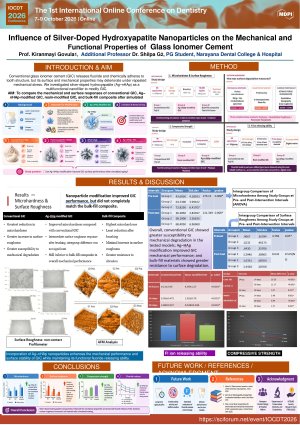
Background: Glass ionomer cement (GIC) is widely used in restorative dentistry because of its chemical adhesion to tooth structure, fluoride release, and biocompatibility. However, its relatively lower mechanical strength and wear resistance limit its long-term clinical performance in stress-bearing areas. Incorporation of bioactive nanoparticles has emerged as a promising strategy to improve the functional properties of GIC.
Aim: To evaluate the influence of silver-doped hydroxyapatite nanoparticles on the surface roughness, microhardness, fluoride release, and compressive strength of glass ionomer cement.
Materials and Methods: In this in vitro study, sixty specimens were prepared and randomly divided into three groups (n = 20): Group I – conventional GIC, Group II – silver-doped hydroxyapatite nanoparticle-modified GIC, and Group III – bulk-fill composite resin. Silver-doped hydroxyapatite nanoparticles were incorporated into conventional GIC powder to obtain a homogeneous modified restorative material. Standardized specimens were fabricated using stainless steel molds. Surface microhardness was assessed using a Vickers hardness tester following simulated toothbrushing of 10,000 cycles. Surface roughness was evaluated using a non-contact profilometer, and representative specimens were analyzed using atomic force microscopy. Fluoride release was measured at predetermined intervals using an ion-selective method. Compressive strength was determined using a universal testing machine. Data were analyzed using one-way ANOVA and post hoc tests with significance set at p < 0.05.
Results: The silver-doped hydroxyapatite modified GIC demonstrated improved microhardness and compressive strength compared with conventional GIC. Surface characteristics showed favorable roughness values after brushing simulation. Fluoride release was maintained/enhanced in the modified group. Statistically significant differences were observed among the groups (p < 0.05).
Conclusion: Incorporation of silver-doped hydroxyapatite nanoparticles enhanced the mechanical and functional properties of GIC while preserving its fluoride-releasing potential. This modified material may serve as a promising restorative option for improved clinical performance.
Keywords
Silver-doped hydroxyapatite nanoparticles
Glass ionomer cement
Microhardness
Surface roughness
Fluoride release
Compressive strength
Nanomodified restorative material
Biomaterials.
Poster
Kiranmayi.pdf
Guided Endodontics in Contemporary Practice: An Overview of Static and Dynamic Navigation.
Artificial Intelligence in Precision Dentistry: In Silico Development of DNA Aptamers Targeting Oral Cancer Biomarkers