Event submissions
Published

This submission belongs to the session A. Atmospheric Physics of the event The 1st International Electronic Conference on Atmospheric Sciences
Published date
15 Jul, 2016
Citation
Robert M. Manning, Average Path Profile of Atmospheric Temperature and Humidity Structure Parameters from a Microwave Profiling Radiometer, in Proceedings of The 1st International Electronic Conference on Atmospheric Sciences, 16 July–31 July 2016, MDPI: Basel, Switzerland, doi: 10.3390/ecas2016-A001
Share
Email
Facebook
Twitter
LinkedIn
Average Path Profile of Atmospheric Temperature and Humidity Structure Parameters from a Microwave Profiling Radiometer
'%3e%3cpath%20d='M12.6647%2010.9104C12.4176%2010.325%2012.0589%209.7933%2011.6088%209.34485C11.16%208.89511%2010.6283%208.53653%2010.0432%208.28891C10.038%208.28629%2010.0327%208.28498%2010.0275%208.28236C10.8437%207.69282%2011.3743%206.73252%2011.3743%205.64907C11.3743%203.85423%209.92005%202.40002%208.12522%202.40002C6.33038%202.40002%204.87618%203.85423%204.87618%205.64907C4.87618%206.73252%205.40677%207.69282%206.22296%208.28367C6.21772%208.28629%206.21248%208.2876%206.20724%208.29022C5.62031%208.53783%205.09365%208.89287%204.64167%209.34616C4.19192%209.79496%203.83334%2010.3266%203.58573%2010.9117C3.34247%2011.4846%203.21128%2012.0987%203.19925%2012.721C3.1989%2012.735%203.20135%2012.7489%203.20646%2012.7619C3.21157%2012.7749%203.21924%2012.7868%203.22901%2012.7968C3.23877%2012.8068%203.25045%2012.8148%203.26334%2012.8202C3.27623%2012.8256%203.29007%2012.8284%203.30406%2012.8284H4.09012C4.14776%2012.8284%204.19362%2012.7825%204.19493%2012.7262C4.22113%2011.7148%204.62726%2010.7676%205.34519%2010.0497C6.08802%209.30686%207.07452%208.89811%208.12522%208.89811C9.17592%208.89811%2010.1624%209.30686%2010.9052%2010.0497C11.6232%2010.7676%2012.0293%2011.7148%2012.0555%2012.7262C12.0568%2012.7839%2012.1027%2012.8284%2012.1603%2012.8284H12.9464C12.9604%2012.8284%2012.9742%2012.8256%2012.9871%2012.8202C13%2012.8148%2013.0117%2012.8068%2013.0214%2012.7968C13.0312%2012.7868%2013.0389%2012.7749%2013.044%2012.7619C13.0491%2012.7489%2013.0515%2012.735%2013.0512%2012.721C13.0381%2012.0947%2012.9084%2011.4856%2012.6647%2010.9104ZM8.12522%207.90243C7.52388%207.90243%206.95792%207.66793%206.53214%207.24215C6.10636%206.81636%205.87185%206.2504%205.87185%205.64907C5.87185%205.04773%206.10636%204.48177%206.53214%204.05599C6.95792%203.63021%207.52388%203.3957%208.12522%203.3957C8.72655%203.3957%209.29252%203.63021%209.7183%204.05599C10.1441%204.48177%2010.3786%205.04773%2010.3786%205.64907C10.3786%206.2504%2010.1441%206.81636%209.7183%207.24215C9.29252%207.66793%208.72655%207.90243%208.12522%207.90243Z'%20fill='%235D1EE1'/%3e%3c/g%3e%3c/svg%3e)
Robert M. Manning 1
1. National Aeronautics and Space Administration, Glenn Research Center, Cleveland, OH 44135
Abstract
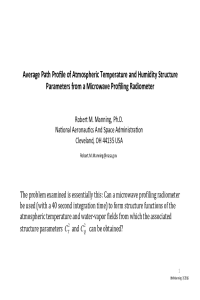
The values of the key atmospheric turbulence parameters (structure constants) for temperature and water vapor, i.e., CT2, and CQ2, are highly dependent upon the vertical height within the atmosphere thus making it necessary to specify profiles of these values along the atmospheric propagation path. The remote sensing method suggested and described in this work makes use of a rapidly integrating microwave profiling radiometer to capture profiles of temperature and humidity through the atmosphere. The integration times of currently available profiling radiometers are such that they are approaching the temporal intervals over which one can possibly make meaningful assessments of these key atmospheric parameters. These integration times, coupled with the boundary effects of the Earth’s surface are, however, unconventional for turbulence characterization; the classical Kolmogorov turbulence theory and related 2/3 law for structure functions prevalent in the inertial sub-range are no longer appropriate. An alternative to this classical approach is derived from first principles to account for the nuances of turbulent mechanics met with using radiometer sensing, i.e., the large-scale turbulence driven by the various possible boundary conditions within the buoyancy sub-range. Analytical expressions connecting the measured structure functions to the corresponding structure parameters are obtained. The theory is then applied to an experimental scenario involving radiometric profile measurements of temperature and shows very good results.
Keywords
temperature structure constant
humidity structure constant
path profiles
remote sensing
atmospheric turbulence theory
profiling radiometer
Manuscript
ProfilingRadiometerPaperFixed-done.pdf
Poster
ecas2016_33f291693f52d493d4de2616f2bca48c_RadiometerProfilingPresentation.pdf
Impact of Wildfires on Atmospheric Ammonia Concentrations in the US: Coupling Satellite and Ground Based Measurements
Time Series Clustering to Estimate Particulate Matter Contributions from Deserts