Event submissions
Published
This submission belongs to the session S1. Preventive Dentistry and Oral Hygiene of the event The 1st International Online Conference on Dentistry
Published date
02 Oct, 2026
Academic Editor
'%3e%3cpath%20d='M12.6657%2010.9104C12.4185%2010.325%2012.0599%209.79327%2011.6097%209.34482C11.1609%208.89508%2010.6293%208.5365%2010.0442%208.28888C10.0389%208.28626%2010.0337%208.28495%2010.0285%208.28233C10.8446%207.69279%2011.3752%206.73249%2011.3752%205.64904C11.3752%203.8542%209.92103%202.39999%208.1262%202.39999C6.33136%202.39999%204.87715%203.8542%204.87715%205.64904C4.87715%206.73249%205.40774%207.69279%206.22393%208.28364C6.21869%208.28626%206.21345%208.28757%206.20821%208.29019C5.62129%208.5378%205.09463%208.89284%204.64265%209.34613C4.1929%209.79493%203.83432%2010.3266%203.58671%2010.9117C3.34345%2011.4845%203.21226%2012.0987%203.20023%2012.7209C3.19988%2012.7349%203.20233%2012.7488%203.20744%2012.7619C3.21255%2012.7749%203.22022%2012.7867%203.22998%2012.7968C3.23975%2012.8068%203.25142%2012.8147%203.26431%2012.8202C3.2772%2012.8256%203.29105%2012.8284%203.30504%2012.8284H4.09109C4.14874%2012.8284%204.19459%2012.7825%204.1959%2012.7262C4.2221%2011.7148%204.62823%2010.7676%205.34617%2010.0497C6.08899%209.30683%207.0755%208.89808%208.1262%208.89808C9.17689%208.89808%2010.1634%209.30683%2010.9062%2010.0497C11.6242%2010.7676%2012.0303%2011.7148%2012.0565%2012.7262C12.0578%2012.7838%2012.1037%2012.8284%2012.1613%2012.8284H12.9474C12.9613%2012.8284%2012.9752%2012.8256%2012.9881%2012.8202C13.001%2012.8147%2013.0126%2012.8068%2013.0224%2012.7968C13.0322%2012.7867%2013.0398%2012.7749%2013.0449%2012.7619C13.0501%2012.7488%2013.0525%2012.7349%2013.0522%2012.7209C13.0391%2012.0947%2012.9094%2011.4855%2012.6657%2010.9104ZM8.1262%207.9024C7.52486%207.9024%206.9589%207.6679%206.53312%207.24211C6.10733%206.81633%205.87283%206.25037%205.87283%205.64904C5.87283%205.0477%206.10733%204.48174%206.53312%204.05596C6.9589%203.63018%207.52486%203.39567%208.1262%203.39567C8.72753%203.39567%209.29349%203.63018%209.71927%204.05596C10.1451%204.48174%2010.3796%205.0477%2010.3796%205.64904C10.3796%206.25037%2010.1451%206.81633%209.71927%207.24211C9.29349%207.6679%208.72753%207.9024%208.1262%207.9024Z'%20fill='%235D1EE1'/%3e%3c/g%3e%3c/svg%3e) Chun Hung Chu
Chun Hung ChuCitation
Kanupriya Rathore, Sushil Kumar Choudhary, Which professionally applied topical fluoride agent is most effective for caries prevention in children and adolescents?, in Proceedings of The 1st International Online Conference on Dentistry, 7 October–9 October 2026, MDPI: Basel, Switzerland
Share
Email
Facebook
Twitter
LinkedIn
Which professionally applied topical fluoride agent is most effective for caries prevention in children and adolescents?
'%3e%3cpath%20d='M12.6647%2010.9104C12.4176%2010.325%2012.0589%209.7933%2011.6088%209.34485C11.16%208.89511%2010.6283%208.53653%2010.0432%208.28891C10.038%208.28629%2010.0327%208.28498%2010.0275%208.28236C10.8437%207.69282%2011.3743%206.73252%2011.3743%205.64907C11.3743%203.85423%209.92005%202.40002%208.12522%202.40002C6.33038%202.40002%204.87618%203.85423%204.87618%205.64907C4.87618%206.73252%205.40677%207.69282%206.22296%208.28367C6.21772%208.28629%206.21248%208.2876%206.20724%208.29022C5.62031%208.53783%205.09365%208.89287%204.64167%209.34616C4.19192%209.79496%203.83334%2010.3266%203.58573%2010.9117C3.34247%2011.4846%203.21128%2012.0987%203.19925%2012.721C3.1989%2012.735%203.20135%2012.7489%203.20646%2012.7619C3.21157%2012.7749%203.21924%2012.7868%203.22901%2012.7968C3.23877%2012.8068%203.25045%2012.8148%203.26334%2012.8202C3.27623%2012.8256%203.29007%2012.8284%203.30406%2012.8284H4.09012C4.14776%2012.8284%204.19362%2012.7825%204.19493%2012.7262C4.22113%2011.7148%204.62726%2010.7676%205.34519%2010.0497C6.08802%209.30686%207.07452%208.89811%208.12522%208.89811C9.17592%208.89811%2010.1624%209.30686%2010.9052%2010.0497C11.6232%2010.7676%2012.0293%2011.7148%2012.0555%2012.7262C12.0568%2012.7839%2012.1027%2012.8284%2012.1603%2012.8284H12.9464C12.9604%2012.8284%2012.9742%2012.8256%2012.9871%2012.8202C13%2012.8148%2013.0117%2012.8068%2013.0214%2012.7968C13.0312%2012.7868%2013.0389%2012.7749%2013.044%2012.7619C13.0491%2012.7489%2013.0515%2012.735%2013.0512%2012.721C13.0381%2012.0947%2012.9084%2011.4856%2012.6647%2010.9104ZM8.12522%207.90243C7.52388%207.90243%206.95792%207.66793%206.53214%207.24215C6.10636%206.81636%205.87185%206.2504%205.87185%205.64907C5.87185%205.04773%206.10636%204.48177%206.53214%204.05599C6.95792%203.63021%207.52388%203.3957%208.12522%203.3957C8.72655%203.3957%209.29252%203.63021%209.7183%204.05599C10.1441%204.48177%2010.3786%205.04773%2010.3786%205.64907C10.3786%206.2504%2010.1441%206.81636%209.7183%207.24215C9.29252%207.66793%208.72655%207.90243%208.12522%207.90243Z'%20fill='%235D1EE1'/%3e%3c/g%3e%3c/svg%3e)
Kanupriya Rathore 1
Sushil Kumar Choudhary 2
1. Model Early Intervention Center, Department of Neonatology, All India Institute of Medical Science, Jodhpur, 342005, India
2. Department of Neonatology, All India Institute of Medical Science, Jodhpur, 342005, India
Abstract
Objectives
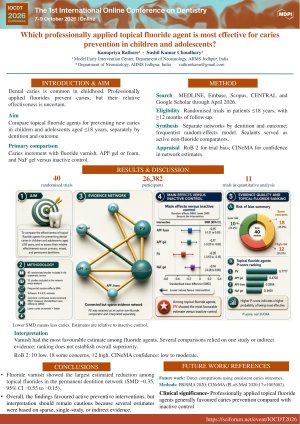
To evaluate, through a systematic review and network meta-analysis, the effectiveness of professionally applied topical fluoride agents in preventing dental caries in children and adolescents aged ≤18 years with a minimum follow-up of 1 year.
Methods
A network meta-analysis was conducted using data from randomised controlled trials evaluating professionally applied topical fluoride agents for caries prevention in children and adolescents, using a frequentist random-effects model. Interventions included fluoride varnish, gel, foam, SDF, and fissure sealant, with the latter retained as an active non-fluoride comparator. Separate networks were constructed by outcome and dentition type. Risk of bias was assessed using the RoB 2. Sensitivity analysis was performed. Confidence in network estimates was assessed using CINeMA.
Results
Forty randomized trials involving 26,724 participants were included, of which 11 studies contributed to at least one network or supplementary quantitative analysis. High risk of bias was assessed in 12 trials. In the permanent dentition, fluoride varnish demonstrated the largest reduction in caries increment versus inactive control among topical fluoride agents, followed by APF gel. Fissure sealant ranked highest overall but was interpreted separately as a non-fluoride comparator. CINeMA confidence ranged from low- to-moderate.
Conclusions
Among topical fluoride agents, FV showed the most favourable estimate compared with inactive control in the permanent dentition/first permanent molar continuous CINeMA. Overall, the findings favoured active preventive interventions, but interpretation should remain cautious because several estimates were based on sparse, single-study, or indirect evidence
Clinical significance
Professionally applied topical fluoride agents generally favoured caries prevention compared with inactive control.
Keywords
Dental caries
topical fluoride
fluoride varnish
children
prevention
network meta-analysis
randomized controlled trials
Poster
IOCDT2026_Which professionally applied topical fluoride agent is most effective for caries .pdf
Comparative Analysis of Two Esthetic Clinical Cases Treated with Lithium Disilicate and Feldspathic Ceramic Veneers: The Impact of Digital Smile Design on Preparation Planning and Esthetic Outcomes
From Image Analysis to Intelligent Decision-Making: The Application of Artificial Intelligence and Multimodal Fusion in Orthodontic Diagnosis and Treatment