Event submissions
Published
This submission belongs to the session S8. AI in Dentistry of the event The 1st International Online Conference on Dentistry
Published date
02 Oct, 2026
Academic Editor
'%3e%3cpath%20d='M12.6657%2010.9104C12.4185%2010.325%2012.0599%209.79327%2011.6097%209.34482C11.1609%208.89508%2010.6293%208.5365%2010.0442%208.28888C10.0389%208.28626%2010.0337%208.28495%2010.0285%208.28233C10.8446%207.69279%2011.3752%206.73249%2011.3752%205.64904C11.3752%203.8542%209.92103%202.39999%208.1262%202.39999C6.33136%202.39999%204.87715%203.8542%204.87715%205.64904C4.87715%206.73249%205.40774%207.69279%206.22393%208.28364C6.21869%208.28626%206.21345%208.28757%206.20821%208.29019C5.62129%208.5378%205.09463%208.89284%204.64265%209.34613C4.1929%209.79493%203.83432%2010.3266%203.58671%2010.9117C3.34345%2011.4845%203.21226%2012.0987%203.20023%2012.7209C3.19988%2012.7349%203.20233%2012.7488%203.20744%2012.7619C3.21255%2012.7749%203.22022%2012.7867%203.22998%2012.7968C3.23975%2012.8068%203.25142%2012.8147%203.26431%2012.8202C3.2772%2012.8256%203.29105%2012.8284%203.30504%2012.8284H4.09109C4.14874%2012.8284%204.19459%2012.7825%204.1959%2012.7262C4.2221%2011.7148%204.62823%2010.7676%205.34617%2010.0497C6.08899%209.30683%207.0755%208.89808%208.1262%208.89808C9.17689%208.89808%2010.1634%209.30683%2010.9062%2010.0497C11.6242%2010.7676%2012.0303%2011.7148%2012.0565%2012.7262C12.0578%2012.7838%2012.1037%2012.8284%2012.1613%2012.8284H12.9474C12.9613%2012.8284%2012.9752%2012.8256%2012.9881%2012.8202C13.001%2012.8147%2013.0126%2012.8068%2013.0224%2012.7968C13.0322%2012.7867%2013.0398%2012.7749%2013.0449%2012.7619C13.0501%2012.7488%2013.0525%2012.7349%2013.0522%2012.7209C13.0391%2012.0947%2012.9094%2011.4855%2012.6657%2010.9104ZM8.1262%207.9024C7.52486%207.9024%206.9589%207.6679%206.53312%207.24211C6.10733%206.81633%205.87283%206.25037%205.87283%205.64904C5.87283%205.0477%206.10733%204.48174%206.53312%204.05596C6.9589%203.63018%207.52486%203.39567%208.1262%203.39567C8.72753%203.39567%209.29349%203.63018%209.71927%204.05596C10.1451%204.48174%2010.3796%205.0477%2010.3796%205.64904C10.3796%206.25037%2010.1451%206.81633%209.71927%207.24211C9.29349%207.6679%208.72753%207.9024%208.1262%207.9024Z'%20fill='%235D1EE1'/%3e%3c/g%3e%3c/svg%3e) Christos Rahiotis
Christos RahiotisCitation
Zhe Chen, Qianru Li, Zimeng Chen, Yue Xu, From Image Analysis to Intelligent Decision-Making: The Application of Artificial Intelligence and Multimodal Fusion in Orthodontic Diagnosis and Treatment, in Proceedings of The 1st International Online Conference on Dentistry, 7 October–9 October 2026, MDPI: Basel, Switzerland
Share
Email
Facebook
Twitter
LinkedIn
From Image Analysis to Intelligent Decision-Making: The Application of Artificial Intelligence and Multimodal Fusion in Orthodontic Diagnosis and Treatment
'%3e%3cpath%20d='M12.6647%2010.9104C12.4176%2010.325%2012.0589%209.7933%2011.6088%209.34485C11.16%208.89511%2010.6283%208.53653%2010.0432%208.28891C10.038%208.28629%2010.0327%208.28498%2010.0275%208.28236C10.8437%207.69282%2011.3743%206.73252%2011.3743%205.64907C11.3743%203.85423%209.92005%202.40002%208.12522%202.40002C6.33038%202.40002%204.87618%203.85423%204.87618%205.64907C4.87618%206.73252%205.40677%207.69282%206.22296%208.28367C6.21772%208.28629%206.21248%208.2876%206.20724%208.29022C5.62031%208.53783%205.09365%208.89287%204.64167%209.34616C4.19192%209.79496%203.83334%2010.3266%203.58573%2010.9117C3.34247%2011.4846%203.21128%2012.0987%203.19925%2012.721C3.1989%2012.735%203.20135%2012.7489%203.20646%2012.7619C3.21157%2012.7749%203.21924%2012.7868%203.22901%2012.7968C3.23877%2012.8068%203.25045%2012.8148%203.26334%2012.8202C3.27623%2012.8256%203.29007%2012.8284%203.30406%2012.8284H4.09012C4.14776%2012.8284%204.19362%2012.7825%204.19493%2012.7262C4.22113%2011.7148%204.62726%2010.7676%205.34519%2010.0497C6.08802%209.30686%207.07452%208.89811%208.12522%208.89811C9.17592%208.89811%2010.1624%209.30686%2010.9052%2010.0497C11.6232%2010.7676%2012.0293%2011.7148%2012.0555%2012.7262C12.0568%2012.7839%2012.1027%2012.8284%2012.1603%2012.8284H12.9464C12.9604%2012.8284%2012.9742%2012.8256%2012.9871%2012.8202C13%2012.8148%2013.0117%2012.8068%2013.0214%2012.7968C13.0312%2012.7868%2013.0389%2012.7749%2013.044%2012.7619C13.0491%2012.7489%2013.0515%2012.735%2013.0512%2012.721C13.0381%2012.0947%2012.9084%2011.4856%2012.6647%2010.9104ZM8.12522%207.90243C7.52388%207.90243%206.95792%207.66793%206.53214%207.24215C6.10636%206.81636%205.87185%206.2504%205.87185%205.64907C5.87185%205.04773%206.10636%204.48177%206.53214%204.05599C6.95792%203.63021%207.52388%203.3957%208.12522%203.3957C8.72655%203.3957%209.29252%203.63021%209.7183%204.05599C10.1441%204.48177%2010.3786%205.04773%2010.3786%205.64907C10.3786%206.2504%2010.1441%206.81636%209.7183%207.24215C9.29252%207.66793%208.72655%207.90243%208.12522%207.90243Z'%20fill='%235D1EE1'/%3e%3c/g%3e%3c/svg%3e)
Zhe Chen 1
Qianru Li 2
Zimeng Chen 3
Yue Xu 1
1. Department of Stomatology, Huashan Hospital, Fudan University, Shanghai, China
2. Department of Stomatology, Xiang'an Hospital Affiliated to Xiamen University, Xiamen, China
3. Division of Applied Oral Sciences & Community Dental Care, Faculty of Dentistry, The University of Hong Kong, , Hong Kong, China.
Abstract
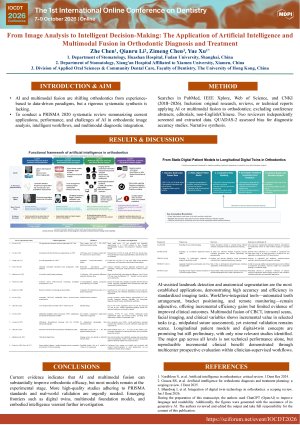
Background: AI and multimodal fusion are shifting orthodontics from experience-based to data-driven paradigms, but a rigorous systematic synthesis is lacking.
Objective: To conduct a PRISMA 2020 systematic review summarizing current applications, performance, and challenges of AI in orthodontic image analysis, intelligent workflows, and multimodal diagnostic integration.
Methods: Searches in PubMed, IEEE Xplore, Web of Science, and CNKI (2018–2026). Inclusion: original research, reviews, or technical reports applying AI or multimodal fusion to orthodontics; excluding conference abstracts, editorials, non-English/Chinese. Two reviewers independently screened and extracted data. QUADAS-2 assessed bias for diagnostic accuracy studies. Narrative synthesis.
Results: Thirty-one representative studies (including two systematic reviews) were included. In image analysis, deep learning-based automated cephalometric landmark detection (mean radial error 0.8–1.2 mm for 2D landmarks, 87% acceptance within 2 mm), 3D CBCT segmentation (tooth Dice >0.94), and cervical vertebral bone age assessment (accuracy 95%) have achieved levels approaching or comparable to clinical experts. Within intelligent workflows, automated tooth arrangement (reinforcement learning reducing round-tripping by 30%), bracket positioning (PointNet accuracy 98.93%, 2.9 ms per tooth), and full-cycle management systems including chatbot-based remote monitoring have markedly enhanced efficiency and precision. Multimodal fusion frameworks integrating imaging, intraoral scanning, clinical text, and biomechanical data (e.g., DeepMSM for midpalatal suture assessment with 93.75% accuracy) demonstrated diagnostic capabilities beyond unimodal approaches. Persistent challenges include data heterogeneity, limited interpretability, and lack of external clinical validation.
Conclusions: Current evidence indicates that AI and multimodal fusion can substantially improve orthodontic efficacy, but most models remain at the experimental stage. More high-quality studies adhering to PRISMA standards and real-world validation are urgently needed. Emerging frontiers such as digital twins, multimodal foundation models, and embodied intelligence warrant further investigation.
Keywords
Keywords: Artificial intelligence
Multimodal fusion
Orthodontics
Digital diagnosis and treatment
Intelligent workflow
Digital twin
Poster
poster.pdf
Which professionally applied topical fluoride agent is most effective for caries prevention in children and adolescents?
Evaluation of an AI-Based Model for Proximal Caries Detection on Bitewing