Event submissions
Published
This submission belongs to the session S1. Preventive Dentistry and Oral Hygiene of the event The 1st International Online Conference on Dentistry
Published date
02 Oct, 2026
Academic Editor
'%3e%3cpath%20d='M12.6657%2010.9104C12.4185%2010.325%2012.0599%209.79327%2011.6097%209.34482C11.1609%208.89508%2010.6293%208.5365%2010.0442%208.28888C10.0389%208.28626%2010.0337%208.28495%2010.0285%208.28233C10.8446%207.69279%2011.3752%206.73249%2011.3752%205.64904C11.3752%203.8542%209.92103%202.39999%208.1262%202.39999C6.33136%202.39999%204.87715%203.8542%204.87715%205.64904C4.87715%206.73249%205.40774%207.69279%206.22393%208.28364C6.21869%208.28626%206.21345%208.28757%206.20821%208.29019C5.62129%208.5378%205.09463%208.89284%204.64265%209.34613C4.1929%209.79493%203.83432%2010.3266%203.58671%2010.9117C3.34345%2011.4845%203.21226%2012.0987%203.20023%2012.7209C3.19988%2012.7349%203.20233%2012.7488%203.20744%2012.7619C3.21255%2012.7749%203.22022%2012.7867%203.22998%2012.7968C3.23975%2012.8068%203.25142%2012.8147%203.26431%2012.8202C3.2772%2012.8256%203.29105%2012.8284%203.30504%2012.8284H4.09109C4.14874%2012.8284%204.19459%2012.7825%204.1959%2012.7262C4.2221%2011.7148%204.62823%2010.7676%205.34617%2010.0497C6.08899%209.30683%207.0755%208.89808%208.1262%208.89808C9.17689%208.89808%2010.1634%209.30683%2010.9062%2010.0497C11.6242%2010.7676%2012.0303%2011.7148%2012.0565%2012.7262C12.0578%2012.7838%2012.1037%2012.8284%2012.1613%2012.8284H12.9474C12.9613%2012.8284%2012.9752%2012.8256%2012.9881%2012.8202C13.001%2012.8147%2013.0126%2012.8068%2013.0224%2012.7968C13.0322%2012.7867%2013.0398%2012.7749%2013.0449%2012.7619C13.0501%2012.7488%2013.0525%2012.7349%2013.0522%2012.7209C13.0391%2012.0947%2012.9094%2011.4855%2012.6657%2010.9104ZM8.1262%207.9024C7.52486%207.9024%206.9589%207.6679%206.53312%207.24211C6.10733%206.81633%205.87283%206.25037%205.87283%205.64904C5.87283%205.0477%206.10733%204.48174%206.53312%204.05596C6.9589%203.63018%207.52486%203.39567%208.1262%203.39567C8.72753%203.39567%209.29349%203.63018%209.71927%204.05596C10.1451%204.48174%2010.3796%205.0477%2010.3796%205.64904C10.3796%206.25037%2010.1451%206.81633%209.71927%207.24211C9.29349%207.6679%208.72753%207.9024%208.1262%207.9024Z'%20fill='%235D1EE1'/%3e%3c/g%3e%3c/svg%3e) Chun Hung Chu
Chun Hung ChuCitation
Adora Shpati, Adela Alushi, Alba Kamberi, Estela Halimi, Aida Meto, Dental Drug-Drug Interaction Knowledge Gap: Confidence vs Objective Competence, in Proceedings of The 1st International Online Conference on Dentistry, 7 October–9 October 2026, MDPI: Basel, Switzerland
Share
Email
Facebook
Twitter
LinkedIn
Dental Drug-Drug Interaction Knowledge Gap: Confidence vs Objective Competence
'%3e%3cpath%20d='M12.6647%2010.9104C12.4176%2010.325%2012.0589%209.7933%2011.6088%209.34485C11.16%208.89511%2010.6283%208.53653%2010.0432%208.28891C10.038%208.28629%2010.0327%208.28498%2010.0275%208.28236C10.8437%207.69282%2011.3743%206.73252%2011.3743%205.64907C11.3743%203.85423%209.92005%202.40002%208.12522%202.40002C6.33038%202.40002%204.87618%203.85423%204.87618%205.64907C4.87618%206.73252%205.40677%207.69282%206.22296%208.28367C6.21772%208.28629%206.21248%208.2876%206.20724%208.29022C5.62031%208.53783%205.09365%208.89287%204.64167%209.34616C4.19192%209.79496%203.83334%2010.3266%203.58573%2010.9117C3.34247%2011.4846%203.21128%2012.0987%203.19925%2012.721C3.1989%2012.735%203.20135%2012.7489%203.20646%2012.7619C3.21157%2012.7749%203.21924%2012.7868%203.22901%2012.7968C3.23877%2012.8068%203.25045%2012.8148%203.26334%2012.8202C3.27623%2012.8256%203.29007%2012.8284%203.30406%2012.8284H4.09012C4.14776%2012.8284%204.19362%2012.7825%204.19493%2012.7262C4.22113%2011.7148%204.62726%2010.7676%205.34519%2010.0497C6.08802%209.30686%207.07452%208.89811%208.12522%208.89811C9.17592%208.89811%2010.1624%209.30686%2010.9052%2010.0497C11.6232%2010.7676%2012.0293%2011.7148%2012.0555%2012.7262C12.0568%2012.7839%2012.1027%2012.8284%2012.1603%2012.8284H12.9464C12.9604%2012.8284%2012.9742%2012.8256%2012.9871%2012.8202C13%2012.8148%2013.0117%2012.8068%2013.0214%2012.7968C13.0312%2012.7868%2013.0389%2012.7749%2013.044%2012.7619C13.0491%2012.7489%2013.0515%2012.735%2013.0512%2012.721C13.0381%2012.0947%2012.9084%2011.4856%2012.6647%2010.9104ZM8.12522%207.90243C7.52388%207.90243%206.95792%207.66793%206.53214%207.24215C6.10636%206.81636%205.87185%206.2504%205.87185%205.64907C5.87185%205.04773%206.10636%204.48177%206.53214%204.05599C6.95792%203.63021%207.52388%203.3957%208.12522%203.3957C8.72655%203.3957%209.29252%203.63021%209.7183%204.05599C10.1441%204.48177%2010.3786%205.04773%2010.3786%205.64907C10.3786%206.2504%2010.1441%206.81636%209.7183%207.24215C9.29252%207.66793%208.72655%207.90243%208.12522%207.90243Z'%20fill='%235D1EE1'/%3e%3c/g%3e%3c/svg%3e)
Adora Shpati 1
Adela Alushi 2
Alba Kamberi 1,3
Estela Halimi 1,3

Aida Meto 1,4,5
1. Department of Dentistry, Faculty of Dental Sciences, Aldent University, Tirana, Albania
2. Advanced Technology in Medicine & Dentistry, “Gabriele D’Annunzio” University, 66100 Chieti, Italy
3. Faculty of Dental Medicine, University of Medicine, Tirana, Albania
4. Department of Surgery, Medicine, Dentistry and Morphological Sciences with Interest in Transplant, Oncology and Regenerative Medicine, University of Modena and Reggio Emilia, 41125 Modena, Italy
5. Department of Dental Research Cell, Dr. D. Y. Patil Dental College and Hospital, Dr. D. Y. Patil Vidyapeeth, Pune, India
Abstract
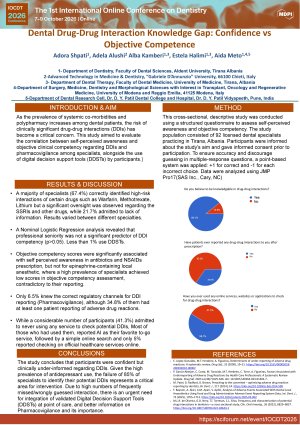
Introduction: As the prevalence of systemic co-morbidities and polypharmacy increases among dental patients, the risk of clinically significant drug-drug interactions (DDIs) has become a critical concern. This study aimed to evaluate the correlation between self-perceived awareness and objective clinical competency regarding DDIs and pharmacovigilance among specialists, alongside the use of digital decision support tools (DDSTs) by participants.
Methods: This cross-sectional, descriptive study was conducted using a structured questionnaire to assess self-perceived awareness and objective competency. The study population consisted of 92 licensed dental specialists practicing in Tirana, Albania. Participants were informed about the study's aim and gave informed consent prior to participation. To ensure accuracy and discourage guessing in multiple-response questions, a
point-based system was applied: +1 for correct and -1 for each incorrect choice. Data were analyzed using JMP Pro17(SAS Inc., Cary, NC).
Results: A majority of specialists (67.4%) correctly identified high-risk interactions of certain drugs such as Warfarin, Methotrexate, Lithium but a significant oversight was observed regarding the SSRIs and other drugs, while 21.7% admitted to lack of information. Results varied between different specialties. A Nominal Logistic Regression analysis revealed that professional seniority was not a significant predictor of DDI competency
(p>0.05). Less than 1% use DDSTs. Objective competency scores were significantly associated with self perceived awareness in antibiotics and NSAIDs prescription, but not for epinephrine-containing local anesthetic, where specialists achieved low scores in objective competency assessment,
contradictory to their reporting. Only 6.5% knew the correct regulatory channels for DDI reporting.
Conclusions: The study concludes that participants were confident but clinically under-informed regarding DDIs. Given the high prevalence of antidepressant use, the failure of 85% of specialists to identify their potential DDIs represents a critical area for intervention. Due to frequently missed/wrongly guessed interaction, there is an urgent need for integration of validated DDSTs at point of care.
Keywords
Drug-drug interaction
Dental Care
Pharmacovigilance
Adverse Drug Reactions
Poster
IOCDT2026-Poster A. Shpati et al.pdf
Accuracy of a Commercially Available AI Software for Immediate Implant
Optimization and evaluation of pomegranate’s astringent properties: Traditional Indian medicine versus imported synthetic alternatives