Event submissions
Published
This submission belongs to the session S3. Pediatric Dentistry and Orthodontics of the event The 1st International Online Conference on Dentistry
Published date
02 Oct, 2026
Academic Editor
'%3e%3cpath%20d='M12.6657%2010.9104C12.4185%2010.325%2012.0599%209.79327%2011.6097%209.34482C11.1609%208.89508%2010.6293%208.5365%2010.0442%208.28888C10.0389%208.28626%2010.0337%208.28495%2010.0285%208.28233C10.8446%207.69279%2011.3752%206.73249%2011.3752%205.64904C11.3752%203.8542%209.92103%202.39999%208.1262%202.39999C6.33136%202.39999%204.87715%203.8542%204.87715%205.64904C4.87715%206.73249%205.40774%207.69279%206.22393%208.28364C6.21869%208.28626%206.21345%208.28757%206.20821%208.29019C5.62129%208.5378%205.09463%208.89284%204.64265%209.34613C4.1929%209.79493%203.83432%2010.3266%203.58671%2010.9117C3.34345%2011.4845%203.21226%2012.0987%203.20023%2012.7209C3.19988%2012.7349%203.20233%2012.7488%203.20744%2012.7619C3.21255%2012.7749%203.22022%2012.7867%203.22998%2012.7968C3.23975%2012.8068%203.25142%2012.8147%203.26431%2012.8202C3.2772%2012.8256%203.29105%2012.8284%203.30504%2012.8284H4.09109C4.14874%2012.8284%204.19459%2012.7825%204.1959%2012.7262C4.2221%2011.7148%204.62823%2010.7676%205.34617%2010.0497C6.08899%209.30683%207.0755%208.89808%208.1262%208.89808C9.17689%208.89808%2010.1634%209.30683%2010.9062%2010.0497C11.6242%2010.7676%2012.0303%2011.7148%2012.0565%2012.7262C12.0578%2012.7838%2012.1037%2012.8284%2012.1613%2012.8284H12.9474C12.9613%2012.8284%2012.9752%2012.8256%2012.9881%2012.8202C13.001%2012.8147%2013.0126%2012.8068%2013.0224%2012.7968C13.0322%2012.7867%2013.0398%2012.7749%2013.0449%2012.7619C13.0501%2012.7488%2013.0525%2012.7349%2013.0522%2012.7209C13.0391%2012.0947%2012.9094%2011.4855%2012.6657%2010.9104ZM8.1262%207.9024C7.52486%207.9024%206.9589%207.6679%206.53312%207.24211C6.10733%206.81633%205.87283%206.25037%205.87283%205.64904C5.87283%205.0477%206.10733%204.48174%206.53312%204.05596C6.9589%203.63018%207.52486%203.39567%208.1262%203.39567C8.72753%203.39567%209.29349%203.63018%209.71927%204.05596C10.1451%204.48174%2010.3796%205.0477%2010.3796%205.64904C10.3796%206.25037%2010.1451%206.81633%209.71927%207.24211C9.29349%207.6679%208.72753%207.9024%208.1262%207.9024Z'%20fill='%235D1EE1'/%3e%3c/g%3e%3c/svg%3e) Gianrico Spagnuolo
Gianrico SpagnuoloCitation
Alba Kamberi, Enida Petro, Olja Tanellari, Brunilda Koçi, Sara Ghanim, Oral Health Changes During Fixed Orthodontic Treatment: A Longitudinal Assessment, in Proceedings of The 1st International Online Conference on Dentistry, 7 October–9 October 2026, MDPI: Basel, Switzerland
Share
Email
Facebook
Twitter
LinkedIn
Oral Health Changes During Fixed Orthodontic Treatment: A Longitudinal Assessment
'%3e%3cpath%20d='M12.6647%2010.9104C12.4176%2010.325%2012.0589%209.7933%2011.6088%209.34485C11.16%208.89511%2010.6283%208.53653%2010.0432%208.28891C10.038%208.28629%2010.0327%208.28498%2010.0275%208.28236C10.8437%207.69282%2011.3743%206.73252%2011.3743%205.64907C11.3743%203.85423%209.92005%202.40002%208.12522%202.40002C6.33038%202.40002%204.87618%203.85423%204.87618%205.64907C4.87618%206.73252%205.40677%207.69282%206.22296%208.28367C6.21772%208.28629%206.21248%208.2876%206.20724%208.29022C5.62031%208.53783%205.09365%208.89287%204.64167%209.34616C4.19192%209.79496%203.83334%2010.3266%203.58573%2010.9117C3.34247%2011.4846%203.21128%2012.0987%203.19925%2012.721C3.1989%2012.735%203.20135%2012.7489%203.20646%2012.7619C3.21157%2012.7749%203.21924%2012.7868%203.22901%2012.7968C3.23877%2012.8068%203.25045%2012.8148%203.26334%2012.8202C3.27623%2012.8256%203.29007%2012.8284%203.30406%2012.8284H4.09012C4.14776%2012.8284%204.19362%2012.7825%204.19493%2012.7262C4.22113%2011.7148%204.62726%2010.7676%205.34519%2010.0497C6.08802%209.30686%207.07452%208.89811%208.12522%208.89811C9.17592%208.89811%2010.1624%209.30686%2010.9052%2010.0497C11.6232%2010.7676%2012.0293%2011.7148%2012.0555%2012.7262C12.0568%2012.7839%2012.1027%2012.8284%2012.1603%2012.8284H12.9464C12.9604%2012.8284%2012.9742%2012.8256%2012.9871%2012.8202C13%2012.8148%2013.0117%2012.8068%2013.0214%2012.7968C13.0312%2012.7868%2013.0389%2012.7749%2013.044%2012.7619C13.0491%2012.7489%2013.0515%2012.735%2013.0512%2012.721C13.0381%2012.0947%2012.9084%2011.4856%2012.6647%2010.9104ZM8.12522%207.90243C7.52388%207.90243%206.95792%207.66793%206.53214%207.24215C6.10636%206.81636%205.87185%206.2504%205.87185%205.64907C5.87185%205.04773%206.10636%204.48177%206.53214%204.05599C6.95792%203.63021%207.52388%203.3957%208.12522%203.3957C8.72655%203.3957%209.29252%203.63021%209.7183%204.05599C10.1441%204.48177%2010.3786%205.04773%2010.3786%205.64907C10.3786%206.2504%2010.1441%206.81636%209.7183%207.24215C9.29252%207.66793%208.72655%207.90243%208.12522%207.90243Z'%20fill='%235D1EE1'/%3e%3c/g%3e%3c/svg%3e)
Alba Kamberi 1,2
Enida Petro 1
Olja Tanellari 3
Brunilda Koçi 3
Sara Ghanim 4
1. Department of Dental Therapy, Faculty of Dental Medicine, University of Medicine, 1005 Tirana
2. Department of Dentistry, Faculty of Dental Sciences, Aldent University, 1000 Tirana, Albania
3. Department of Dentistry, Faculty of Dental Sciences, Aldent University, 1000 Tirana
4. Orthodontic Unit, University College London Eastman Dental Institute, London, UK
Abstract
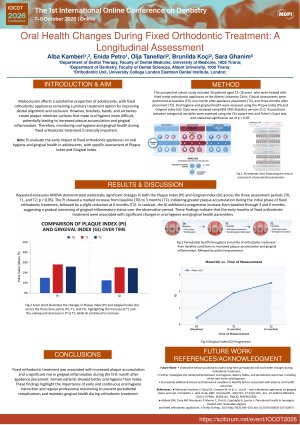
Background: Good oral health is essential during fixed orthodontic treatment, as brackets, bands, and archwires alter the oral environment. These appliances promote plaque retention and make oral hygiene more difficult, increasing the risk of gingival inflammation and periodontal complications. If not controlled, these changes may negatively affect oral health and orthodontic outcomes. Therefore, monitoring oral hygiene and gingival status during treatment is clinically important.
Aim: To evaluate changes in gingival health and plaque accumulation during early fixed orthodontic treatment.
Materials and Methods: A total of 30 patients undergoing fixed orthodontic treatment at the Aldent University Clinic were included. Gingival health was assessed at baseline (T0), one month after appliance placement (T1), and three months after placement (T2). Plaque accumulation and gingival status were measured using the Orthodontic Plaque Index (OPI) and Gingival Index (GI). Statistical analysis was performed using IBM SPSS Statistics version 21.0. Associations between categorical variables were tested using the Chi-square test and Fisher’s Exact test, with significance set at p < 0.05.
Results: Plaque accumulation increased significantly after appliance placement, with higher OPI scores at T1 and T2 compared to T0. Gingival inflammation also increased significantly during the first month and remained elevated at T2. A statistically significant association was found between gender and oral hygiene status (χ²(1)=6.58, p=0.010; Fisher’s Exact Test p=0.016), with females demonstrating better oral hygiene than males.
Conclusion: Fixed orthodontic treatment was associated with increased plaque accumulation and a significant rise in gingival inflammation during the first month after appliance placement. Female patients showed better oral hygiene than males. These findings highlight the importance of early and continuous oral hygiene instruction and regular professional monitoring to prevent periodontal complications and maintain gingival health during orthodontic treatment.
Keywords
Fixed orthodontic treatment
Plaque accumulation
Gingival inflammation
Oral hygiene
Orthodontic Plaque Index (OPI)
Gingival Index (GI)
Poster
IOCDT2026-Poster Alba_Kamberi.pdf
ACCURACY OF STATIC, DYNAMIC, AND ROBOTIC COMPUTER-ASSISTED IMPLANT SURGERY: A PRISMA 2020-BASED SYSTEMATIC REVIEW
Role of Porphyromonas gingivalis infection in the development of autism