Event submissions
Published
This submission belongs to the session S1. Preventive Dentistry and Oral Hygiene of the event The 1st International Online Conference on Dentistry
Published date
02 Oct, 2026
Academic Editor
'%3e%3cpath%20d='M12.6657%2010.9104C12.4185%2010.325%2012.0599%209.79327%2011.6097%209.34482C11.1609%208.89508%2010.6293%208.5365%2010.0442%208.28888C10.0389%208.28626%2010.0337%208.28495%2010.0285%208.28233C10.8446%207.69279%2011.3752%206.73249%2011.3752%205.64904C11.3752%203.8542%209.92103%202.39999%208.1262%202.39999C6.33136%202.39999%204.87715%203.8542%204.87715%205.64904C4.87715%206.73249%205.40774%207.69279%206.22393%208.28364C6.21869%208.28626%206.21345%208.28757%206.20821%208.29019C5.62129%208.5378%205.09463%208.89284%204.64265%209.34613C4.1929%209.79493%203.83432%2010.3266%203.58671%2010.9117C3.34345%2011.4845%203.21226%2012.0987%203.20023%2012.7209C3.19988%2012.7349%203.20233%2012.7488%203.20744%2012.7619C3.21255%2012.7749%203.22022%2012.7867%203.22998%2012.7968C3.23975%2012.8068%203.25142%2012.8147%203.26431%2012.8202C3.2772%2012.8256%203.29105%2012.8284%203.30504%2012.8284H4.09109C4.14874%2012.8284%204.19459%2012.7825%204.1959%2012.7262C4.2221%2011.7148%204.62823%2010.7676%205.34617%2010.0497C6.08899%209.30683%207.0755%208.89808%208.1262%208.89808C9.17689%208.89808%2010.1634%209.30683%2010.9062%2010.0497C11.6242%2010.7676%2012.0303%2011.7148%2012.0565%2012.7262C12.0578%2012.7838%2012.1037%2012.8284%2012.1613%2012.8284H12.9474C12.9613%2012.8284%2012.9752%2012.8256%2012.9881%2012.8202C13.001%2012.8147%2013.0126%2012.8068%2013.0224%2012.7968C13.0322%2012.7867%2013.0398%2012.7749%2013.0449%2012.7619C13.0501%2012.7488%2013.0525%2012.7349%2013.0522%2012.7209C13.0391%2012.0947%2012.9094%2011.4855%2012.6657%2010.9104ZM8.1262%207.9024C7.52486%207.9024%206.9589%207.6679%206.53312%207.24211C6.10733%206.81633%205.87283%206.25037%205.87283%205.64904C5.87283%205.0477%206.10733%204.48174%206.53312%204.05596C6.9589%203.63018%207.52486%203.39567%208.1262%203.39567C8.72753%203.39567%209.29349%203.63018%209.71927%204.05596C10.1451%204.48174%2010.3796%205.0477%2010.3796%205.64904C10.3796%206.25037%2010.1451%206.81633%209.71927%207.24211C9.29349%207.6679%208.72753%207.9024%208.1262%207.9024Z'%20fill='%235D1EE1'/%3e%3c/g%3e%3c/svg%3e) Chun Hung Chu
Chun Hung ChuCitation
Asif K, Rittik Raj, Sindhura h, Efficacy of dentifrice containing active oxygen on plaque and gingival status in patients with gingivitis-A clinic microbiological study., in Proceedings of The 1st International Online Conference on Dentistry, 7 October–9 October 2026, MDPI: Basel, Switzerland
Share
Email
Facebook
Twitter
LinkedIn
Efficacy of dentifrice containing active oxygen on plaque and gingival status in patients with gingivitis-A clinic microbiological study.
'%3e%3cpath%20d='M12.6647%2010.9104C12.4176%2010.325%2012.0589%209.7933%2011.6088%209.34485C11.16%208.89511%2010.6283%208.53653%2010.0432%208.28891C10.038%208.28629%2010.0327%208.28498%2010.0275%208.28236C10.8437%207.69282%2011.3743%206.73252%2011.3743%205.64907C11.3743%203.85423%209.92005%202.40002%208.12522%202.40002C6.33038%202.40002%204.87618%203.85423%204.87618%205.64907C4.87618%206.73252%205.40677%207.69282%206.22296%208.28367C6.21772%208.28629%206.21248%208.2876%206.20724%208.29022C5.62031%208.53783%205.09365%208.89287%204.64167%209.34616C4.19192%209.79496%203.83334%2010.3266%203.58573%2010.9117C3.34247%2011.4846%203.21128%2012.0987%203.19925%2012.721C3.1989%2012.735%203.20135%2012.7489%203.20646%2012.7619C3.21157%2012.7749%203.21924%2012.7868%203.22901%2012.7968C3.23877%2012.8068%203.25045%2012.8148%203.26334%2012.8202C3.27623%2012.8256%203.29007%2012.8284%203.30406%2012.8284H4.09012C4.14776%2012.8284%204.19362%2012.7825%204.19493%2012.7262C4.22113%2011.7148%204.62726%2010.7676%205.34519%2010.0497C6.08802%209.30686%207.07452%208.89811%208.12522%208.89811C9.17592%208.89811%2010.1624%209.30686%2010.9052%2010.0497C11.6232%2010.7676%2012.0293%2011.7148%2012.0555%2012.7262C12.0568%2012.7839%2012.1027%2012.8284%2012.1603%2012.8284H12.9464C12.9604%2012.8284%2012.9742%2012.8256%2012.9871%2012.8202C13%2012.8148%2013.0117%2012.8068%2013.0214%2012.7968C13.0312%2012.7868%2013.0389%2012.7749%2013.044%2012.7619C13.0491%2012.7489%2013.0515%2012.735%2013.0512%2012.721C13.0381%2012.0947%2012.9084%2011.4856%2012.6647%2010.9104ZM8.12522%207.90243C7.52388%207.90243%206.95792%207.66793%206.53214%207.24215C6.10636%206.81636%205.87185%206.2504%205.87185%205.64907C5.87185%205.04773%206.10636%204.48177%206.53214%204.05599C6.95792%203.63021%207.52388%203.3957%208.12522%203.3957C8.72655%203.3957%209.29252%203.63021%209.7183%204.05599C10.1441%204.48177%2010.3786%205.04773%2010.3786%205.64907C10.3786%206.2504%2010.1441%206.81636%209.7183%207.24215C9.29252%207.66793%208.72655%207.90243%208.12522%207.90243Z'%20fill='%235D1EE1'/%3e%3c/g%3e%3c/svg%3e)
Asif K 1
Rittik Raj 1
Sindhura h 1
1. Department of Periodontology, Navodaya Dental College (Affiliated to Rajiv Gandhi University of Health Sciences), Mantralaya Road, Raichur, Karnataka 584101, India
Abstract
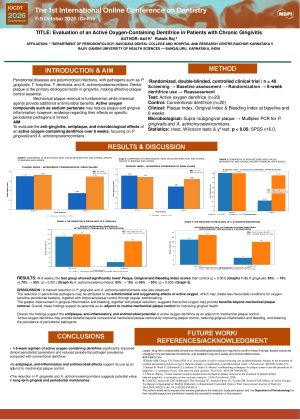
Active oxygen has recently been formulated into a dentifrice and has demonstrated strong antimicrobial property. While the exact mechanisms of the anti-microbial activity have not been fully established. The objective of this clinic-microbiological study was to evaluate the anti-gingivitis and anti-plaque effects of a dentifrice containing active oxygen compared with a dentifrice without active oxygen in a 6 weeks clinical and microbiological study.
MATERIALS AND METHODS: This study design was a randomized, double-blinded, controlled clinical trial on the clinical and microbiological efficacy of active oxygen in the treatment of gingivitis. 40 subjects with age 18 to 70 years of both genders with chronic gingivitis were included. The protocol was approved by the ethical committee. Following supragingival prophylaxis, subjects were instructed to brush with their assigned dentifrice and toothbrush. The Plaque(Silness and Loe) , Gingival( Silness and Loe) and Bleeding indices(Ainamo et al) were determined for the baseline and 6 weeks. The data were analysed using independent sample t test for gingival index, plaque index and microbiological counts (porphyromonas gingivalis and aggregatibacteractinomycetamcomitans) between the groups by polymerase chain reaction Paired sample t test for with in the groups Chi-square test will be applied for bleeding index to check the association between the groups.
RESULTS: The PI (baseline= 1.75±0.42, 6weeks = 0.86±0.2) GI(baseline = 1.16±0.22, 6 weeks= 0.78±0.17) and BI(baseline = 40.25±3.39, 6 weeks=11.05±3.25) were significantly reduced, respectively, over the 6 weeks period in the test group (p value ≤0.001). Reduction of Porphyromonas gingivalis and Aggregatibacteractinomycetamcomitans was statistically significant in the case group (p value≤0.001) compared with control group at 6 weeks compared to baseline.
CONCLUSION: This study demonstrated that a dentifrice containing active oxygen significantly improves oral heath as measured by a reduction in porphyromonasgingvalis and Aggregatibacteractinomycetecomitans bacterial count compared with a negative dentifrice over the 6week study period
Keywords
gingivitis
oxygen releasing toothpaste,p gingivalis
Aggregatibacteractinomycetamcomitans
Poster
IOCDT2026-octtober 2026 1111111.pdf
Failure Modes of a Light weight Instance-Segmentation Model for Radiographic Caries Detection: A Clinically Grounded Analysis
Impacted Maxillary Canine Associated Cyst: Keratocyst?