Event submissions
Published
This submission belongs to the session S3. Pediatric Dentistry and Orthodontics of the event The 1st International Online Conference on Dentistry
Published date
02 Oct, 2026
Academic Editor
'%3e%3cpath%20d='M12.6657%2010.9104C12.4185%2010.325%2012.0599%209.79327%2011.6097%209.34482C11.1609%208.89508%2010.6293%208.5365%2010.0442%208.28888C10.0389%208.28626%2010.0337%208.28495%2010.0285%208.28233C10.8446%207.69279%2011.3752%206.73249%2011.3752%205.64904C11.3752%203.8542%209.92103%202.39999%208.1262%202.39999C6.33136%202.39999%204.87715%203.8542%204.87715%205.64904C4.87715%206.73249%205.40774%207.69279%206.22393%208.28364C6.21869%208.28626%206.21345%208.28757%206.20821%208.29019C5.62129%208.5378%205.09463%208.89284%204.64265%209.34613C4.1929%209.79493%203.83432%2010.3266%203.58671%2010.9117C3.34345%2011.4845%203.21226%2012.0987%203.20023%2012.7209C3.19988%2012.7349%203.20233%2012.7488%203.20744%2012.7619C3.21255%2012.7749%203.22022%2012.7867%203.22998%2012.7968C3.23975%2012.8068%203.25142%2012.8147%203.26431%2012.8202C3.2772%2012.8256%203.29105%2012.8284%203.30504%2012.8284H4.09109C4.14874%2012.8284%204.19459%2012.7825%204.1959%2012.7262C4.2221%2011.7148%204.62823%2010.7676%205.34617%2010.0497C6.08899%209.30683%207.0755%208.89808%208.1262%208.89808C9.17689%208.89808%2010.1634%209.30683%2010.9062%2010.0497C11.6242%2010.7676%2012.0303%2011.7148%2012.0565%2012.7262C12.0578%2012.7838%2012.1037%2012.8284%2012.1613%2012.8284H12.9474C12.9613%2012.8284%2012.9752%2012.8256%2012.9881%2012.8202C13.001%2012.8147%2013.0126%2012.8068%2013.0224%2012.7968C13.0322%2012.7867%2013.0398%2012.7749%2013.0449%2012.7619C13.0501%2012.7488%2013.0525%2012.7349%2013.0522%2012.7209C13.0391%2012.0947%2012.9094%2011.4855%2012.6657%2010.9104ZM8.1262%207.9024C7.52486%207.9024%206.9589%207.6679%206.53312%207.24211C6.10733%206.81633%205.87283%206.25037%205.87283%205.64904C5.87283%205.0477%206.10733%204.48174%206.53312%204.05596C6.9589%203.63018%207.52486%203.39567%208.1262%203.39567C8.72753%203.39567%209.29349%203.63018%209.71927%204.05596C10.1451%204.48174%2010.3796%205.0477%2010.3796%205.64904C10.3796%206.25037%2010.1451%206.81633%209.71927%207.24211C9.29349%207.6679%208.72753%207.9024%208.1262%207.9024Z'%20fill='%235D1EE1'/%3e%3c/g%3e%3c/svg%3e) Gianrico Spagnuolo
Gianrico SpagnuoloCitation
ARUNA DOKKU, Saravanan Pichai, From Function to Form: Functional Orthopaedic Interventions for Craniofacial Growth Modification: A case series, in Proceedings of The 1st International Online Conference on Dentistry, 7 October–9 October 2026, MDPI: Basel, Switzerland
Share
Email
Facebook
Twitter
LinkedIn
From Function to Form: Functional Orthopaedic Interventions for Craniofacial Growth Modification: A case series
'%3e%3cpath%20d='M12.6647%2010.9104C12.4176%2010.325%2012.0589%209.7933%2011.6088%209.34485C11.16%208.89511%2010.6283%208.53653%2010.0432%208.28891C10.038%208.28629%2010.0327%208.28498%2010.0275%208.28236C10.8437%207.69282%2011.3743%206.73252%2011.3743%205.64907C11.3743%203.85423%209.92005%202.40002%208.12522%202.40002C6.33038%202.40002%204.87618%203.85423%204.87618%205.64907C4.87618%206.73252%205.40677%207.69282%206.22296%208.28367C6.21772%208.28629%206.21248%208.2876%206.20724%208.29022C5.62031%208.53783%205.09365%208.89287%204.64167%209.34616C4.19192%209.79496%203.83334%2010.3266%203.58573%2010.9117C3.34247%2011.4846%203.21128%2012.0987%203.19925%2012.721C3.1989%2012.735%203.20135%2012.7489%203.20646%2012.7619C3.21157%2012.7749%203.21924%2012.7868%203.22901%2012.7968C3.23877%2012.8068%203.25045%2012.8148%203.26334%2012.8202C3.27623%2012.8256%203.29007%2012.8284%203.30406%2012.8284H4.09012C4.14776%2012.8284%204.19362%2012.7825%204.19493%2012.7262C4.22113%2011.7148%204.62726%2010.7676%205.34519%2010.0497C6.08802%209.30686%207.07452%208.89811%208.12522%208.89811C9.17592%208.89811%2010.1624%209.30686%2010.9052%2010.0497C11.6232%2010.7676%2012.0293%2011.7148%2012.0555%2012.7262C12.0568%2012.7839%2012.1027%2012.8284%2012.1603%2012.8284H12.9464C12.9604%2012.8284%2012.9742%2012.8256%2012.9871%2012.8202C13%2012.8148%2013.0117%2012.8068%2013.0214%2012.7968C13.0312%2012.7868%2013.0389%2012.7749%2013.044%2012.7619C13.0491%2012.7489%2013.0515%2012.735%2013.0512%2012.721C13.0381%2012.0947%2012.9084%2011.4856%2012.6647%2010.9104ZM8.12522%207.90243C7.52388%207.90243%206.95792%207.66793%206.53214%207.24215C6.10636%206.81636%205.87185%206.2504%205.87185%205.64907C5.87185%205.04773%206.10636%204.48177%206.53214%204.05599C6.95792%203.63021%207.52388%203.3957%208.12522%203.3957C8.72655%203.3957%209.29252%203.63021%209.7183%204.05599C10.1441%204.48177%2010.3786%205.04773%2010.3786%205.64907C10.3786%206.2504%2010.1441%206.81636%209.7183%207.24215C9.29252%207.66793%208.72655%207.90243%208.12522%207.90243Z'%20fill='%235D1EE1'/%3e%3c/g%3e%3c/svg%3e)
ARUNA DOKKU 1
Saravanan Pichai 1
1. Department of Orthodontics, Sibar Institute of Dental Sciences, Guntur, India
Abstract
Background:
Craniofacial growth is profoundly shaped by the functional balance of soft tissues, notably the tongue and lips. Aberrant tongue posture, mouth breathing, and hyperactive perioral musculature can redirect growth toward vertical and transverse discrepancies. Functional orthopaedics targets these dysfunctions through selective appliances, harmonizing muscle activity to favourably alter growth trajectories.
Objective:
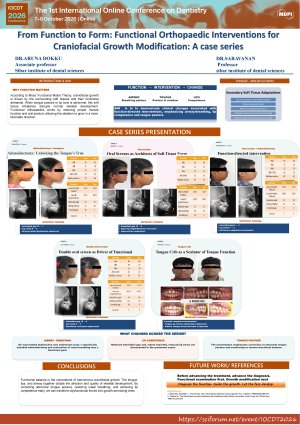
To illustrate, through clinical cases, how diverse functional orthopaedic strategies high-pull headgear with adenoidectomy, oral screen, double oral screen and tongue crib tame tongue and lip dysfunctions and produce measurable modifications in craniofacial growth patterns.
Case description:
This series presents growing patients with distinct functional disturbances impacting craniofacial growth, each managed with targeted functional orthopedic appliances.
Case 1 involved a patient with vertical growth tendency and airway obstruction. Adenoidectomy was combined with high-pull headgear to improve airway volume, elevate tongue posture, and restrict maxillary vertical excess, aiming to redirect growth toward a horizontal pattern.
Cases 2,3 and 4 presented with mouth breathing, severely proclined anteriors, and tongue thrust habit. A double oral screen was used to block tongue thrust, encourage nasal breathing, and enhance lip competence, thereby improving arch form and vertical overlap.
Case 5 had persistent anterior tongue thrust with proclined maxillary incisors and open bite, managed using a tongue crib to retrain tongue posture and facilitate bite closure.
All cases showed improved lip competence and tongue-to-palate resting posture, demonstrating how functional appliances can redirect growth by correcting tongue and lip dysfunction.
Discussion:
Despite mechanical differences, each appliance acted by retraining dysfunctional muscle patterns and reestablishing nasal breathing, thereby harnessing neuromuscular and epigenetic pathways to modify craniofacial growth. Cephalometric improvements reflect not merely dental changes, but genuine skeletal adaptation driven by functional correction.
Conclusion:
Early identification and targeted intervention offer the potential to redirect craniofacial growth toward harmony and stability.
Keywords
Functional Orthopaedics
Orofacial Muscular Dysfunction
Craniofacial Growth Modification
Growth Guidance
Myofunctional Therapy
Poster
IOCDT2026-Poster final.pdf
Comparative Evaluation of Color Stability of Monochromatic and Nanofilled Resin Composites After Exposure to Two Different Beverages using a Spectrophotometer—An in Vitro Study
Deep learning models for determining the relationship between mandibular third molars and inferior alveolar canal: a systematic review and meta-analysis