Event submissions
Published
This submission belongs to the session S7. Digital Dentistry of the event The 1st International Online Conference on Dentistry
Published date
02 Oct, 2026
Academic Editor
'%3e%3cpath%20d='M12.6657%2010.9104C12.4185%2010.325%2012.0599%209.79327%2011.6097%209.34482C11.1609%208.89508%2010.6293%208.5365%2010.0442%208.28888C10.0389%208.28626%2010.0337%208.28495%2010.0285%208.28233C10.8446%207.69279%2011.3752%206.73249%2011.3752%205.64904C11.3752%203.8542%209.92103%202.39999%208.1262%202.39999C6.33136%202.39999%204.87715%203.8542%204.87715%205.64904C4.87715%206.73249%205.40774%207.69279%206.22393%208.28364C6.21869%208.28626%206.21345%208.28757%206.20821%208.29019C5.62129%208.5378%205.09463%208.89284%204.64265%209.34613C4.1929%209.79493%203.83432%2010.3266%203.58671%2010.9117C3.34345%2011.4845%203.21226%2012.0987%203.20023%2012.7209C3.19988%2012.7349%203.20233%2012.7488%203.20744%2012.7619C3.21255%2012.7749%203.22022%2012.7867%203.22998%2012.7968C3.23975%2012.8068%203.25142%2012.8147%203.26431%2012.8202C3.2772%2012.8256%203.29105%2012.8284%203.30504%2012.8284H4.09109C4.14874%2012.8284%204.19459%2012.7825%204.1959%2012.7262C4.2221%2011.7148%204.62823%2010.7676%205.34617%2010.0497C6.08899%209.30683%207.0755%208.89808%208.1262%208.89808C9.17689%208.89808%2010.1634%209.30683%2010.9062%2010.0497C11.6242%2010.7676%2012.0303%2011.7148%2012.0565%2012.7262C12.0578%2012.7838%2012.1037%2012.8284%2012.1613%2012.8284H12.9474C12.9613%2012.8284%2012.9752%2012.8256%2012.9881%2012.8202C13.001%2012.8147%2013.0126%2012.8068%2013.0224%2012.7968C13.0322%2012.7867%2013.0398%2012.7749%2013.0449%2012.7619C13.0501%2012.7488%2013.0525%2012.7349%2013.0522%2012.7209C13.0391%2012.0947%2012.9094%2011.4855%2012.6657%2010.9104ZM8.1262%207.9024C7.52486%207.9024%206.9589%207.6679%206.53312%207.24211C6.10733%206.81633%205.87283%206.25037%205.87283%205.64904C5.87283%205.0477%206.10733%204.48174%206.53312%204.05596C6.9589%203.63018%207.52486%203.39567%208.1262%203.39567C8.72753%203.39567%209.29349%203.63018%209.71927%204.05596C10.1451%204.48174%2010.3796%205.0477%2010.3796%205.64904C10.3796%206.25037%2010.1451%206.81633%209.71927%207.24211C9.29349%207.6679%208.72753%207.9024%208.1262%207.9024Z'%20fill='%235D1EE1'/%3e%3c/g%3e%3c/svg%3e) Georgios Romanos
Georgios RomanosCitation
Samiya Riaz, Ahmed Badruddin Ghazali, Johari Yap Abdullah, Teeth: Our personal ID, in Proceedings of The 1st International Online Conference on Dentistry, 7 October–9 October 2026, MDPI: Basel, Switzerland
Share
Email
Facebook
Twitter
LinkedIn
Teeth: Our personal ID
'%3e%3cpath%20d='M12.6647%2010.9104C12.4176%2010.325%2012.0589%209.7933%2011.6088%209.34485C11.16%208.89511%2010.6283%208.53653%2010.0432%208.28891C10.038%208.28629%2010.0327%208.28498%2010.0275%208.28236C10.8437%207.69282%2011.3743%206.73252%2011.3743%205.64907C11.3743%203.85423%209.92005%202.40002%208.12522%202.40002C6.33038%202.40002%204.87618%203.85423%204.87618%205.64907C4.87618%206.73252%205.40677%207.69282%206.22296%208.28367C6.21772%208.28629%206.21248%208.2876%206.20724%208.29022C5.62031%208.53783%205.09365%208.89287%204.64167%209.34616C4.19192%209.79496%203.83334%2010.3266%203.58573%2010.9117C3.34247%2011.4846%203.21128%2012.0987%203.19925%2012.721C3.1989%2012.735%203.20135%2012.7489%203.20646%2012.7619C3.21157%2012.7749%203.21924%2012.7868%203.22901%2012.7968C3.23877%2012.8068%203.25045%2012.8148%203.26334%2012.8202C3.27623%2012.8256%203.29007%2012.8284%203.30406%2012.8284H4.09012C4.14776%2012.8284%204.19362%2012.7825%204.19493%2012.7262C4.22113%2011.7148%204.62726%2010.7676%205.34519%2010.0497C6.08802%209.30686%207.07452%208.89811%208.12522%208.89811C9.17592%208.89811%2010.1624%209.30686%2010.9052%2010.0497C11.6232%2010.7676%2012.0293%2011.7148%2012.0555%2012.7262C12.0568%2012.7839%2012.1027%2012.8284%2012.1603%2012.8284H12.9464C12.9604%2012.8284%2012.9742%2012.8256%2012.9871%2012.8202C13%2012.8148%2013.0117%2012.8068%2013.0214%2012.7968C13.0312%2012.7868%2013.0389%2012.7749%2013.044%2012.7619C13.0491%2012.7489%2013.0515%2012.735%2013.0512%2012.721C13.0381%2012.0947%2012.9084%2011.4856%2012.6647%2010.9104ZM8.12522%207.90243C7.52388%207.90243%206.95792%207.66793%206.53214%207.24215C6.10636%206.81636%205.87185%206.2504%205.87185%205.64907C5.87185%205.04773%206.10636%204.48177%206.53214%204.05599C6.95792%203.63021%207.52388%203.3957%208.12522%203.3957C8.72655%203.3957%209.29252%203.63021%209.7183%204.05599C10.1441%204.48177%2010.3786%205.04773%2010.3786%205.64907C10.3786%206.2504%2010.1441%206.81636%209.7183%207.24215C9.29252%207.66793%208.72655%207.90243%208.12522%207.90243Z'%20fill='%235D1EE1'/%3e%3c/g%3e%3c/svg%3e)
Samiya Riaz 1
Ahmed Badruddin Ghazali 2

Johari Yap Abdullah 3
1. Unit of Oral Biology, Fundamental Dental and Medical Sciences, Kulliyyah of Dentistry, International Islamic University Malaysia, 25200, Kuantan, Pahang, Malaysia
2. Unit of Oral Radiology, Department of Oral and Maxillofacial Surgery, Kulliyyah of Dentistry, International Islamic University Malaysia, 25200, Kuantan, Pahang, Malaysia
3. Unit of Craniofacial Imaging, School of Dental Sciences, Health Campus, Universiti Sains Malaysia, 15140, Kota Bharu, Kelantan, Malaysia
Abstract
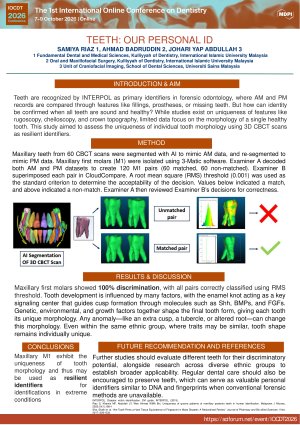
Introduction: In forensic odontology, individuality or unique features are important concepts for antemortem (AM) and post-mortem (PM) dental record comparisons. There are various studies on the individuality of soft tissue and hard tissue structures like rugoscopy, cheiloscopy, enamel rod patterns, etc. However, the data is scarce for studies specifically based on the individuality of single tooth morphology. Objective: To determine the individuality of morphology of the maxillary first and second premolars (PM1 and PM2) using AI segmented three-dimensional (3D) CBCT scans. Methodology: Sixty CBCT scans (30 male and 30 female) were selected for segmentation. Inclusion criteria were healthy fully developed PM1 and PM2. Exclusion criteria were teeth with any anomaly or trauma obscuring the tooth morphology, restored teeth, and distorted scans. Maxillary arch teeth were segmented from the remaining CBCT scan using AI segmentation tool and saved as STL files, mimicking AM data. The same CBCT scans were then segmented again to mimic PM data. Next, PM1 and PM2 were segmented from the STL files using 3-Matic software. The AM and PM sets of scans were decoded by examiner A. One hundred and twenty pairs of each PM1and PM2 were made by examiner A and superimposed by examiner B using CloudCompare software. The pairs included 60 matched and 60 non-matched pairs for each tooth type. The decision for the pairs was based on root mean square (RMS) values calculated. Results: There was statistically significant difference between the RMS of matched and non-matched pairs for both PM1 and PM2. Based on the threshold of RMS value, Examiner B gave the correct decision for all the pairs, and PM1 and PM2 showed 100% uniqueness of their morphology. Conclusions: Maxillary PM1 and PM2 exhibit the uniqueness of tooth morphology and thus may be used for human identification.
Keywords
AI
superimposition
maxillary premolars
tooth morphology
uniqueness
Poster
Sciforum-193787_IOCDT2026.pdf
Efficacy of low-intensity laser therapy in accelerating the rate of orthodontic tooth movement - A clinical investigation
TO EVALUATE THE VARIABILITY OF TORQUE VALUES OF DIFFERENT COMMERCIALLY AVAILABLE BRACKET SYSTEMS