Event submissions
Published
This submission belongs to the session S3. Pediatric Dentistry and Orthodontics of the event The 1st International Online Conference on Dentistry
Published date
02 Oct, 2026
Academic Editor
'%3e%3cpath%20d='M12.6657%2010.9104C12.4185%2010.325%2012.0599%209.79327%2011.6097%209.34482C11.1609%208.89508%2010.6293%208.5365%2010.0442%208.28888C10.0389%208.28626%2010.0337%208.28495%2010.0285%208.28233C10.8446%207.69279%2011.3752%206.73249%2011.3752%205.64904C11.3752%203.8542%209.92103%202.39999%208.1262%202.39999C6.33136%202.39999%204.87715%203.8542%204.87715%205.64904C4.87715%206.73249%205.40774%207.69279%206.22393%208.28364C6.21869%208.28626%206.21345%208.28757%206.20821%208.29019C5.62129%208.5378%205.09463%208.89284%204.64265%209.34613C4.1929%209.79493%203.83432%2010.3266%203.58671%2010.9117C3.34345%2011.4845%203.21226%2012.0987%203.20023%2012.7209C3.19988%2012.7349%203.20233%2012.7488%203.20744%2012.7619C3.21255%2012.7749%203.22022%2012.7867%203.22998%2012.7968C3.23975%2012.8068%203.25142%2012.8147%203.26431%2012.8202C3.2772%2012.8256%203.29105%2012.8284%203.30504%2012.8284H4.09109C4.14874%2012.8284%204.19459%2012.7825%204.1959%2012.7262C4.2221%2011.7148%204.62823%2010.7676%205.34617%2010.0497C6.08899%209.30683%207.0755%208.89808%208.1262%208.89808C9.17689%208.89808%2010.1634%209.30683%2010.9062%2010.0497C11.6242%2010.7676%2012.0303%2011.7148%2012.0565%2012.7262C12.0578%2012.7838%2012.1037%2012.8284%2012.1613%2012.8284H12.9474C12.9613%2012.8284%2012.9752%2012.8256%2012.9881%2012.8202C13.001%2012.8147%2013.0126%2012.8068%2013.0224%2012.7968C13.0322%2012.7867%2013.0398%2012.7749%2013.0449%2012.7619C13.0501%2012.7488%2013.0525%2012.7349%2013.0522%2012.7209C13.0391%2012.0947%2012.9094%2011.4855%2012.6657%2010.9104ZM8.1262%207.9024C7.52486%207.9024%206.9589%207.6679%206.53312%207.24211C6.10733%206.81633%205.87283%206.25037%205.87283%205.64904C5.87283%205.0477%206.10733%204.48174%206.53312%204.05596C6.9589%203.63018%207.52486%203.39567%208.1262%203.39567C8.72753%203.39567%209.29349%203.63018%209.71927%204.05596C10.1451%204.48174%2010.3796%205.0477%2010.3796%205.64904C10.3796%206.25037%2010.1451%206.81633%209.71927%207.24211C9.29349%207.6679%208.72753%207.9024%208.1262%207.9024Z'%20fill='%235D1EE1'/%3e%3c/g%3e%3c/svg%3e) Gianrico Spagnuolo
Gianrico SpagnuoloCitation
Dr.Deepthi Nirmal Gavarraju, Dr.Raja Satish Prathigudupu, Dr.Sridevi Enuganti, Artificial intelligence–based predictive models for caries risk assessment in children: A systematic review, in Proceedings of The 1st International Online Conference on Dentistry, 7 October–9 October 2026, MDPI: Basel, Switzerland
Share
Email
Facebook
Twitter
LinkedIn
Artificial intelligence–based predictive models for caries risk assessment in children: A systematic review
'%3e%3cpath%20d='M12.6647%2010.9104C12.4176%2010.325%2012.0589%209.7933%2011.6088%209.34485C11.16%208.89511%2010.6283%208.53653%2010.0432%208.28891C10.038%208.28629%2010.0327%208.28498%2010.0275%208.28236C10.8437%207.69282%2011.3743%206.73252%2011.3743%205.64907C11.3743%203.85423%209.92005%202.40002%208.12522%202.40002C6.33038%202.40002%204.87618%203.85423%204.87618%205.64907C4.87618%206.73252%205.40677%207.69282%206.22296%208.28367C6.21772%208.28629%206.21248%208.2876%206.20724%208.29022C5.62031%208.53783%205.09365%208.89287%204.64167%209.34616C4.19192%209.79496%203.83334%2010.3266%203.58573%2010.9117C3.34247%2011.4846%203.21128%2012.0987%203.19925%2012.721C3.1989%2012.735%203.20135%2012.7489%203.20646%2012.7619C3.21157%2012.7749%203.21924%2012.7868%203.22901%2012.7968C3.23877%2012.8068%203.25045%2012.8148%203.26334%2012.8202C3.27623%2012.8256%203.29007%2012.8284%203.30406%2012.8284H4.09012C4.14776%2012.8284%204.19362%2012.7825%204.19493%2012.7262C4.22113%2011.7148%204.62726%2010.7676%205.34519%2010.0497C6.08802%209.30686%207.07452%208.89811%208.12522%208.89811C9.17592%208.89811%2010.1624%209.30686%2010.9052%2010.0497C11.6232%2010.7676%2012.0293%2011.7148%2012.0555%2012.7262C12.0568%2012.7839%2012.1027%2012.8284%2012.1603%2012.8284H12.9464C12.9604%2012.8284%2012.9742%2012.8256%2012.9871%2012.8202C13%2012.8148%2013.0117%2012.8068%2013.0214%2012.7968C13.0312%2012.7868%2013.0389%2012.7749%2013.044%2012.7619C13.0491%2012.7489%2013.0515%2012.735%2013.0512%2012.721C13.0381%2012.0947%2012.9084%2011.4856%2012.6647%2010.9104ZM8.12522%207.90243C7.52388%207.90243%206.95792%207.66793%206.53214%207.24215C6.10636%206.81636%205.87185%206.2504%205.87185%205.64907C5.87185%205.04773%206.10636%204.48177%206.53214%204.05599C6.95792%203.63021%207.52388%203.3957%208.12522%203.3957C8.72655%203.3957%209.29252%203.63021%209.7183%204.05599C10.1441%204.48177%2010.3786%205.04773%2010.3786%205.64907C10.3786%206.2504%2010.1441%206.81636%209.7183%207.24215C9.29252%207.66793%208.72655%207.90243%208.12522%207.90243Z'%20fill='%235D1EE1'/%3e%3c/g%3e%3c/svg%3e)
Dr.Deepthi Nirmal Gavarraju 1
Dr.Raja Satish Prathigudupu 2
Dr.Sridevi Enuganti 1
1. Department of pediatric and preventive dentistry, Sibar Institute of Dental Sciences, Andhra Pradesh, India
2. Department of Oral and maxillofacial surgery, Sibar institute of dental sciences, Andhra pradesh, India
Abstract
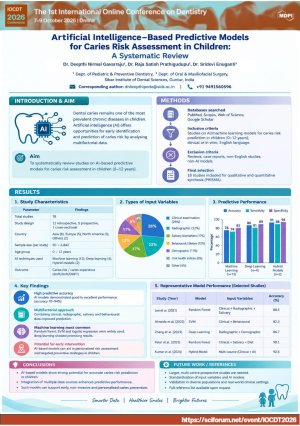
Introduction: Dental caries remains one of the most prevalent chronic diseases in children, with early childhood caries contributing significantly to global oral health burden. Conventional caries risk assessment methods rely on clinical judgment and static risk indicators, which often lack predictive accuracy. Artificial intelligence (AI) and machine learning (ML)–based predictive models have emerged as promising tools for individualized caries risk estimation. However, evidence regarding their performance in children remains fragmented and has not been comprehensively synthesized.
Methods: A systematic literature search will be performed in PubMed, Scopus, Web of Science, Embase, and Google Scholar for studies published up to 2026. Studies involving children aged 0–12 years that developed or validated AI/ML-based predictive models for dental caries risk will be included. Study selection, data extraction, and synthesis will follow PRISMA 2020 guidelines. Extracted data will include study characteristics, model type, input variables, and performance metrics such as accuracy, sensitivity, specificity, and area under the curve (AUC).
Results: This review will synthesize evidence on AI/ML-based models incorporating clinical, dietary, microbiological, and behavioral predictors for caries risk estimation in children. Existing literature suggests that AI-based models may demonstrate improved predictive performance compared to conventional methods; however, heterogeneity in datasets, model architectures, and validation approaches may limit comparability.
Conclusion: AI-based predictive models show significant potential for improving early identification of children at high risk of dental caries. However, standardization of methodologies and robust external validation are essential before clinical implementation. This review will provide an evidence-based synthesis to guide future research and support development of reliable AI-driven pediatric caries risk prediction tools.
Keywords
Artificial intelligence
caries risk assessment
children
early childhood caries
machine learning
pediatric dentistry
predictive models
systematic review
Poster
IOCDT POSTER- 193934.pdf
Measuring More Than Mass: BMI’s Influence on Dental and Skeletal Growth
PREDICTING CLEAR ALIGNER TREATMENT OUTCOMES USING ARTIFICIAL INTELLIGENCE : A SYSTEMATIC REVIEW