Event submissions
Published
This submission belongs to the session S3. Pediatric Dentistry and Orthodontics of the event The 1st International Online Conference on Dentistry
Published date
02 Oct, 2026
Academic Editor
'%3e%3cpath%20d='M12.6657%2010.9104C12.4185%2010.325%2012.0599%209.79327%2011.6097%209.34482C11.1609%208.89508%2010.6293%208.5365%2010.0442%208.28888C10.0389%208.28626%2010.0337%208.28495%2010.0285%208.28233C10.8446%207.69279%2011.3752%206.73249%2011.3752%205.64904C11.3752%203.8542%209.92103%202.39999%208.1262%202.39999C6.33136%202.39999%204.87715%203.8542%204.87715%205.64904C4.87715%206.73249%205.40774%207.69279%206.22393%208.28364C6.21869%208.28626%206.21345%208.28757%206.20821%208.29019C5.62129%208.5378%205.09463%208.89284%204.64265%209.34613C4.1929%209.79493%203.83432%2010.3266%203.58671%2010.9117C3.34345%2011.4845%203.21226%2012.0987%203.20023%2012.7209C3.19988%2012.7349%203.20233%2012.7488%203.20744%2012.7619C3.21255%2012.7749%203.22022%2012.7867%203.22998%2012.7968C3.23975%2012.8068%203.25142%2012.8147%203.26431%2012.8202C3.2772%2012.8256%203.29105%2012.8284%203.30504%2012.8284H4.09109C4.14874%2012.8284%204.19459%2012.7825%204.1959%2012.7262C4.2221%2011.7148%204.62823%2010.7676%205.34617%2010.0497C6.08899%209.30683%207.0755%208.89808%208.1262%208.89808C9.17689%208.89808%2010.1634%209.30683%2010.9062%2010.0497C11.6242%2010.7676%2012.0303%2011.7148%2012.0565%2012.7262C12.0578%2012.7838%2012.1037%2012.8284%2012.1613%2012.8284H12.9474C12.9613%2012.8284%2012.9752%2012.8256%2012.9881%2012.8202C13.001%2012.8147%2013.0126%2012.8068%2013.0224%2012.7968C13.0322%2012.7867%2013.0398%2012.7749%2013.0449%2012.7619C13.0501%2012.7488%2013.0525%2012.7349%2013.0522%2012.7209C13.0391%2012.0947%2012.9094%2011.4855%2012.6657%2010.9104ZM8.1262%207.9024C7.52486%207.9024%206.9589%207.6679%206.53312%207.24211C6.10733%206.81633%205.87283%206.25037%205.87283%205.64904C5.87283%205.0477%206.10733%204.48174%206.53312%204.05596C6.9589%203.63018%207.52486%203.39567%208.1262%203.39567C8.72753%203.39567%209.29349%203.63018%209.71927%204.05596C10.1451%204.48174%2010.3796%205.0477%2010.3796%205.64904C10.3796%206.25037%2010.1451%206.81633%209.71927%207.24211C9.29349%207.6679%208.72753%207.9024%208.1262%207.9024Z'%20fill='%235D1EE1'/%3e%3c/g%3e%3c/svg%3e) Gianrico Spagnuolo
Gianrico SpagnuoloCitation
Nika Moghadamnia, Pegah Hosseinzadeh, Soheil Shahbazi, PREDICTING CLEAR ALIGNER TREATMENT OUTCOMES USING ARTIFICIAL INTELLIGENCE : A SYSTEMATIC REVIEW, in Proceedings of The 1st International Online Conference on Dentistry, 7 October–9 October 2026, MDPI: Basel, Switzerland
Share
Email
Facebook
Twitter
LinkedIn
PREDICTING CLEAR ALIGNER TREATMENT OUTCOMES USING ARTIFICIAL INTELLIGENCE : A SYSTEMATIC REVIEW
'%3e%3cpath%20d='M12.6647%2010.9104C12.4176%2010.325%2012.0589%209.7933%2011.6088%209.34485C11.16%208.89511%2010.6283%208.53653%2010.0432%208.28891C10.038%208.28629%2010.0327%208.28498%2010.0275%208.28236C10.8437%207.69282%2011.3743%206.73252%2011.3743%205.64907C11.3743%203.85423%209.92005%202.40002%208.12522%202.40002C6.33038%202.40002%204.87618%203.85423%204.87618%205.64907C4.87618%206.73252%205.40677%207.69282%206.22296%208.28367C6.21772%208.28629%206.21248%208.2876%206.20724%208.29022C5.62031%208.53783%205.09365%208.89287%204.64167%209.34616C4.19192%209.79496%203.83334%2010.3266%203.58573%2010.9117C3.34247%2011.4846%203.21128%2012.0987%203.19925%2012.721C3.1989%2012.735%203.20135%2012.7489%203.20646%2012.7619C3.21157%2012.7749%203.21924%2012.7868%203.22901%2012.7968C3.23877%2012.8068%203.25045%2012.8148%203.26334%2012.8202C3.27623%2012.8256%203.29007%2012.8284%203.30406%2012.8284H4.09012C4.14776%2012.8284%204.19362%2012.7825%204.19493%2012.7262C4.22113%2011.7148%204.62726%2010.7676%205.34519%2010.0497C6.08802%209.30686%207.07452%208.89811%208.12522%208.89811C9.17592%208.89811%2010.1624%209.30686%2010.9052%2010.0497C11.6232%2010.7676%2012.0293%2011.7148%2012.0555%2012.7262C12.0568%2012.7839%2012.1027%2012.8284%2012.1603%2012.8284H12.9464C12.9604%2012.8284%2012.9742%2012.8256%2012.9871%2012.8202C13%2012.8148%2013.0117%2012.8068%2013.0214%2012.7968C13.0312%2012.7868%2013.0389%2012.7749%2013.044%2012.7619C13.0491%2012.7489%2013.0515%2012.735%2013.0512%2012.721C13.0381%2012.0947%2012.9084%2011.4856%2012.6647%2010.9104ZM8.12522%207.90243C7.52388%207.90243%206.95792%207.66793%206.53214%207.24215C6.10636%206.81636%205.87185%206.2504%205.87185%205.64907C5.87185%205.04773%206.10636%204.48177%206.53214%204.05599C6.95792%203.63021%207.52388%203.3957%208.12522%203.3957C8.72655%203.3957%209.29252%203.63021%209.7183%204.05599C10.1441%204.48177%2010.3786%205.04773%2010.3786%205.64907C10.3786%206.2504%2010.1441%206.81636%209.7183%207.24215C9.29252%207.66793%208.72655%207.90243%208.12522%207.90243Z'%20fill='%235D1EE1'/%3e%3c/g%3e%3c/svg%3e)
Nika Moghadamnia 1
Pegah Hosseinzadeh 1
Soheil Shahbazi 2
1. Department of Orthodontics, School of Dentistry, Semnan University of Medical Sciences, Semnan, N/A, Iran
2. School of Dentistry, University of California Los Angeles, Los Angeles, 90025, USA
Abstract
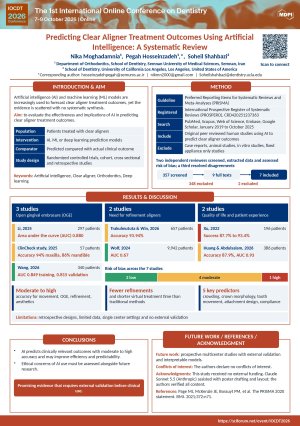
Objectives: This study aims to evaluate the effectiveness and implications of Artificial Intelligence (AI) in predicting clear aligner treatment outcomes. Methods: This systematic review was conducted according to PRISMA guidelines and registered on PROSPERO (CRD420251237363). A systematic search of PubMed, Scopus, Web of Science, Embase, and Google Scholar was performed for records published from January 2019 to October 2025. Manual searches of reference lists were also conducted. Eligible studies were original, peer-reviewed articles involving human subjects undergoing clear aligner therapy, where artificial intelligence (AI) was applied to predict treatment outcomes. Studies were excluded if they were case reports, animal/in vitro studies, or research exclusively investigated fixed appliances. Study screening, data extraction, and risk-of-bias assessment were performed independently by two reviewers. Disagreements were resolved by a third reviewer. Results: Of 357 screened records, 7 studies met the inclusion criteria. Synthesis of these studies indicates AI models can predict clinically relevant outcomes with moderate to high accuracy. These include tooth movements, the risk of open gingival embrasures, the need for refinement aligners and post-treatment aesthetics. Furthermore, AI implementation was consistently associated with reductions in both virtual treatment time and refinement frequency compared to traditional methods. Key predictive factors were pretreatment crowding, crown morphology, prescribed tooth movement, attachment design, and compliance. The assessed risk of bias was primarily attributed to the retrospective designs and limited data of the included studies. Conclusions: Current evidence strongly supports that AI has the potential to enhance accuracy, efficiency, and predictability in clear aligner therapy with clinically meaningful benefits. Although the translation of AI into routine practice requires future research to prioritize external validation, prospective multicenter designs, and the development of interpretable models. This effort must be alongside assessing the ethical concerns of the use of AI.
Keywords
Artificial intelligence
Clear aligner
Orthodontics
Deep learning
Poster
IOCDT2026_Poster_Moghadamnia-1.pdf
Artificial intelligence–based predictive models for caries risk assessment in children: A systematic review
Assessment of oral hygiene knowledge, attitudes, and practices among the Albanian population: A cross-sectional Study