Event submissions
Published
This submission belongs to the session S2. Dental Materials of the event The 1st International Online Conference on Dentistry
Published date
02 Oct, 2026
Academic Editor
'%3e%3cpath%20d='M12.6657%2010.9104C12.4185%2010.325%2012.0599%209.79327%2011.6097%209.34482C11.1609%208.89508%2010.6293%208.5365%2010.0442%208.28888C10.0389%208.28626%2010.0337%208.28495%2010.0285%208.28233C10.8446%207.69279%2011.3752%206.73249%2011.3752%205.64904C11.3752%203.8542%209.92103%202.39999%208.1262%202.39999C6.33136%202.39999%204.87715%203.8542%204.87715%205.64904C4.87715%206.73249%205.40774%207.69279%206.22393%208.28364C6.21869%208.28626%206.21345%208.28757%206.20821%208.29019C5.62129%208.5378%205.09463%208.89284%204.64265%209.34613C4.1929%209.79493%203.83432%2010.3266%203.58671%2010.9117C3.34345%2011.4845%203.21226%2012.0987%203.20023%2012.7209C3.19988%2012.7349%203.20233%2012.7488%203.20744%2012.7619C3.21255%2012.7749%203.22022%2012.7867%203.22998%2012.7968C3.23975%2012.8068%203.25142%2012.8147%203.26431%2012.8202C3.2772%2012.8256%203.29105%2012.8284%203.30504%2012.8284H4.09109C4.14874%2012.8284%204.19459%2012.7825%204.1959%2012.7262C4.2221%2011.7148%204.62823%2010.7676%205.34617%2010.0497C6.08899%209.30683%207.0755%208.89808%208.1262%208.89808C9.17689%208.89808%2010.1634%209.30683%2010.9062%2010.0497C11.6242%2010.7676%2012.0303%2011.7148%2012.0565%2012.7262C12.0578%2012.7838%2012.1037%2012.8284%2012.1613%2012.8284H12.9474C12.9613%2012.8284%2012.9752%2012.8256%2012.9881%2012.8202C13.001%2012.8147%2013.0126%2012.8068%2013.0224%2012.7968C13.0322%2012.7867%2013.0398%2012.7749%2013.0449%2012.7619C13.0501%2012.7488%2013.0525%2012.7349%2013.0522%2012.7209C13.0391%2012.0947%2012.9094%2011.4855%2012.6657%2010.9104ZM8.1262%207.9024C7.52486%207.9024%206.9589%207.6679%206.53312%207.24211C6.10733%206.81633%205.87283%206.25037%205.87283%205.64904C5.87283%205.0477%206.10733%204.48174%206.53312%204.05596C6.9589%203.63018%207.52486%203.39567%208.1262%203.39567C8.72753%203.39567%209.29349%203.63018%209.71927%204.05596C10.1451%204.48174%2010.3796%205.0477%2010.3796%205.64904C10.3796%206.25037%2010.1451%206.81633%209.71927%207.24211C9.29349%207.6679%208.72753%207.9024%208.1262%207.9024Z'%20fill='%235D1EE1'/%3e%3c/g%3e%3c/svg%3e) Gianrico Spagnuolo
Gianrico SpagnuoloCitation
Md Sofiqul Islam, Smriti Aryal A C, Vivek Padmanabhan, Fiza Javed, Suad Ahmed, Muhammed Mustahsen Rahman, In Vitro Efficacy of Single-Shade Composite on Masking Discolored Tooth Structure, in Proceedings of The 1st International Online Conference on Dentistry, 7 October–9 October 2026, MDPI: Basel, Switzerland
Share
Email
Facebook
Twitter
LinkedIn
In Vitro Efficacy of Single-Shade Composite on Masking Discolored Tooth Structure

Md Sofiqul Islam 1
'%3e%3cpath%20d='M12.6647%2010.9104C12.4176%2010.325%2012.0589%209.7933%2011.6088%209.34485C11.16%208.89511%2010.6283%208.53653%2010.0432%208.28891C10.038%208.28629%2010.0327%208.28498%2010.0275%208.28236C10.8437%207.69282%2011.3743%206.73252%2011.3743%205.64907C11.3743%203.85423%209.92005%202.40002%208.12522%202.40002C6.33038%202.40002%204.87618%203.85423%204.87618%205.64907C4.87618%206.73252%205.40677%207.69282%206.22296%208.28367C6.21772%208.28629%206.21248%208.2876%206.20724%208.29022C5.62031%208.53783%205.09365%208.89287%204.64167%209.34616C4.19192%209.79496%203.83334%2010.3266%203.58573%2010.9117C3.34247%2011.4846%203.21128%2012.0987%203.19925%2012.721C3.1989%2012.735%203.20135%2012.7489%203.20646%2012.7619C3.21157%2012.7749%203.21924%2012.7868%203.22901%2012.7968C3.23877%2012.8068%203.25045%2012.8148%203.26334%2012.8202C3.27623%2012.8256%203.29007%2012.8284%203.30406%2012.8284H4.09012C4.14776%2012.8284%204.19362%2012.7825%204.19493%2012.7262C4.22113%2011.7148%204.62726%2010.7676%205.34519%2010.0497C6.08802%209.30686%207.07452%208.89811%208.12522%208.89811C9.17592%208.89811%2010.1624%209.30686%2010.9052%2010.0497C11.6232%2010.7676%2012.0293%2011.7148%2012.0555%2012.7262C12.0568%2012.7839%2012.1027%2012.8284%2012.1603%2012.8284H12.9464C12.9604%2012.8284%2012.9742%2012.8256%2012.9871%2012.8202C13%2012.8148%2013.0117%2012.8068%2013.0214%2012.7968C13.0312%2012.7868%2013.0389%2012.7749%2013.044%2012.7619C13.0491%2012.7489%2013.0515%2012.735%2013.0512%2012.721C13.0381%2012.0947%2012.9084%2011.4856%2012.6647%2010.9104ZM8.12522%207.90243C7.52388%207.90243%206.95792%207.66793%206.53214%207.24215C6.10636%206.81636%205.87185%206.2504%205.87185%205.64907C5.87185%205.04773%206.10636%204.48177%206.53214%204.05599C6.95792%203.63021%207.52388%203.3957%208.12522%203.3957C8.72655%203.3957%209.29252%203.63021%209.7183%204.05599C10.1441%204.48177%2010.3786%205.04773%2010.3786%205.64907C10.3786%206.2504%2010.1441%206.81636%209.7183%207.24215C9.29252%207.66793%208.72655%207.90243%208.12522%207.90243Z'%20fill='%235D1EE1'/%3e%3c/g%3e%3c/svg%3e)
Smriti Aryal A C 2
Vivek Padmanabhan 3
Fiza Javed 4
Suad Ahmed 4
Muhammed Mustahsen Rahman 5
1. Associate Professor, RAK College of Dental Sciences, RAK Medical and Health Sciences University, Ras Al Khaimah, United Arab Emirates
2. Department of Oral and Craniofacial Health Sciences, College of Dental Medicine, University of Sharjah, P.O Box: 27272 Sharjah, United Arab Emirates
3. Department of Pediatric Dentistry, RAK College of Dental Sciences, RAK Medical and Health Sciences University, P.O Box: 12973, Ras Al-Khaimah, United Arab Emirates
4. Department of Operative Dentistry, RAK College of Dental Sciences, RAK Medical and Health Sciences University, P.O Box: 12973, Ras Al-Khaimah, United Arab Emirates
5. Department of Periodontology, RAK College of Dental Sciences, RAK Medical and Health Sciences University, P.O Box: 12973, Ras Al-Khaimah, United Arab Emirates
Abstract
Introduction: Intrinsic tooth discoloration is often challenging to mask using conventional composites due to difficulties in shade matching. Single-shade composites, however, can blend with multiple shades. The objective of this in vitro study was to evaluate the efficacy of single-shade composite materials in masking discolored tooth structures.
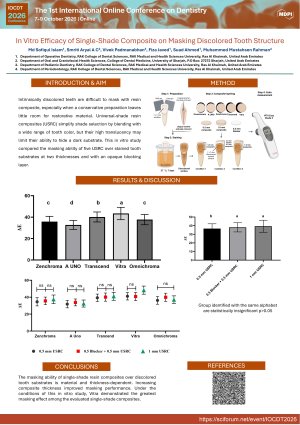
Methods: Ten extracted bovine teeth were prepared by removing the lingual enamel and polishing the labial surface with 1000-1500-grit silicon carbide paper to create a 7×7 mm testing area. Intrinsic discoloration was induced by immersing the specimens in a tea solution at 37°C for 7 days. Five single-shade resin composites, Omnichroma, A-UNO, Zenchroma, Transcend, and Vitra were evaluated. For each material, ten 0.5-mm and ten 1.0-mm-thick composite disks were prepared. Masking performance was evaluated using a 0.5-mm composite disk, a 0.5-mm composite disk combined with a 0.5-mm blocking layer, and a 1.0-mm composite disk. Color differences (ΔE) were determined using CIELAB color coordinates.
Results: Two-way ANOVA demonstrated that both composite material and thickness significantly influenced the masking of discolored tooth substrates (p<0.05). Masking performance generally improves with increasing composite thickness. The addition of a 0.5-mm blocking layer did not produce significant improvement for most materials, except Omnichroma (p<0.05). The 1.0-mm composite condition demonstrated the greatest overall masking effect. Significant differences were also observed among the tested materials (p<0.05). Vittra demonstrated the highest ΔE value (43.40), followed by Transcend (40.17), Omnichroma (37.74), Zenchroma (35.88), and A-UNO (32.73). Vittra exhibited significantly greater masking performance than the other tested materials.
Conclusion: The masking ability of single-shade resin composites over discolored tooth substrates is material and thickness-dependent. Increasing composite thickness improved masking performance. Under the conditions of this in vitro study, Vittra demonstrated the greatest masking effect among the evaluated single-shade composites.
Keywords
Single shade composite
Tooth discoloration
Masking
Omnichroma
A-UNO
Zenchroma
Tanscend
Vittra
∆Eab
Poster
IOCDT2026-Poster template.ppt.pdf
Chair-side aMMP-8 Point-of-Care Testing for Periodontal Inflammation Screening in Patients with Nasopharyngeal Cancer: A Cross-Sectional Study
DNA Hydrogels Enhance Peri-Implant Bone Repair and Show Potential as a Drug Delivery Platform.