Event submissions
Published
This submission belongs to the session S4. Restorative Dentistry, Endodontics, and Dental Traumatology of the event The 1st International Online Conference on Dentistry
Published date
02 Oct, 2026
Academic Editor
'%3e%3cpath%20d='M12.6657%2010.9104C12.4185%2010.325%2012.0599%209.79327%2011.6097%209.34482C11.1609%208.89508%2010.6293%208.5365%2010.0442%208.28888C10.0389%208.28626%2010.0337%208.28495%2010.0285%208.28233C10.8446%207.69279%2011.3752%206.73249%2011.3752%205.64904C11.3752%203.8542%209.92103%202.39999%208.1262%202.39999C6.33136%202.39999%204.87715%203.8542%204.87715%205.64904C4.87715%206.73249%205.40774%207.69279%206.22393%208.28364C6.21869%208.28626%206.21345%208.28757%206.20821%208.29019C5.62129%208.5378%205.09463%208.89284%204.64265%209.34613C4.1929%209.79493%203.83432%2010.3266%203.58671%2010.9117C3.34345%2011.4845%203.21226%2012.0987%203.20023%2012.7209C3.19988%2012.7349%203.20233%2012.7488%203.20744%2012.7619C3.21255%2012.7749%203.22022%2012.7867%203.22998%2012.7968C3.23975%2012.8068%203.25142%2012.8147%203.26431%2012.8202C3.2772%2012.8256%203.29105%2012.8284%203.30504%2012.8284H4.09109C4.14874%2012.8284%204.19459%2012.7825%204.1959%2012.7262C4.2221%2011.7148%204.62823%2010.7676%205.34617%2010.0497C6.08899%209.30683%207.0755%208.89808%208.1262%208.89808C9.17689%208.89808%2010.1634%209.30683%2010.9062%2010.0497C11.6242%2010.7676%2012.0303%2011.7148%2012.0565%2012.7262C12.0578%2012.7838%2012.1037%2012.8284%2012.1613%2012.8284H12.9474C12.9613%2012.8284%2012.9752%2012.8256%2012.9881%2012.8202C13.001%2012.8147%2013.0126%2012.8068%2013.0224%2012.7968C13.0322%2012.7867%2013.0398%2012.7749%2013.0449%2012.7619C13.0501%2012.7488%2013.0525%2012.7349%2013.0522%2012.7209C13.0391%2012.0947%2012.9094%2011.4855%2012.6657%2010.9104ZM8.1262%207.9024C7.52486%207.9024%206.9589%207.6679%206.53312%207.24211C6.10733%206.81633%205.87283%206.25037%205.87283%205.64904C5.87283%205.0477%206.10733%204.48174%206.53312%204.05596C6.9589%203.63018%207.52486%203.39567%208.1262%203.39567C8.72753%203.39567%209.29349%203.63018%209.71927%204.05596C10.1451%204.48174%2010.3796%205.0477%2010.3796%205.64904C10.3796%206.25037%2010.1451%206.81633%209.71927%207.24211C9.29349%207.6679%208.72753%207.9024%208.1262%207.9024Z'%20fill='%235D1EE1'/%3e%3c/g%3e%3c/svg%3e) Georgios Romanos
Georgios RomanosCitation
kallala Rim, Nissaf Daouahi, yosra Gassara, sarra Nasri, Zohra Nouira, Jilani Saafi, Contemporary Clinical Approaches for Esthetic Rehabilitation in Cleft Lip and Palate: A Case Series Study, in Proceedings of The 1st International Online Conference on Dentistry, 7 October–9 October 2026, MDPI: Basel, Switzerland
Share
Email
Facebook
Twitter
LinkedIn
Contemporary Clinical Approaches for Esthetic Rehabilitation in Cleft Lip and Palate: A Case Series Study
'%3e%3cpath%20d='M12.6647%2010.9104C12.4176%2010.325%2012.0589%209.7933%2011.6088%209.34485C11.16%208.89511%2010.6283%208.53653%2010.0432%208.28891C10.038%208.28629%2010.0327%208.28498%2010.0275%208.28236C10.8437%207.69282%2011.3743%206.73252%2011.3743%205.64907C11.3743%203.85423%209.92005%202.40002%208.12522%202.40002C6.33038%202.40002%204.87618%203.85423%204.87618%205.64907C4.87618%206.73252%205.40677%207.69282%206.22296%208.28367C6.21772%208.28629%206.21248%208.2876%206.20724%208.29022C5.62031%208.53783%205.09365%208.89287%204.64167%209.34616C4.19192%209.79496%203.83334%2010.3266%203.58573%2010.9117C3.34247%2011.4846%203.21128%2012.0987%203.19925%2012.721C3.1989%2012.735%203.20135%2012.7489%203.20646%2012.7619C3.21157%2012.7749%203.21924%2012.7868%203.22901%2012.7968C3.23877%2012.8068%203.25045%2012.8148%203.26334%2012.8202C3.27623%2012.8256%203.29007%2012.8284%203.30406%2012.8284H4.09012C4.14776%2012.8284%204.19362%2012.7825%204.19493%2012.7262C4.22113%2011.7148%204.62726%2010.7676%205.34519%2010.0497C6.08802%209.30686%207.07452%208.89811%208.12522%208.89811C9.17592%208.89811%2010.1624%209.30686%2010.9052%2010.0497C11.6232%2010.7676%2012.0293%2011.7148%2012.0555%2012.7262C12.0568%2012.7839%2012.1027%2012.8284%2012.1603%2012.8284H12.9464C12.9604%2012.8284%2012.9742%2012.8256%2012.9871%2012.8202C13%2012.8148%2013.0117%2012.8068%2013.0214%2012.7968C13.0312%2012.7868%2013.0389%2012.7749%2013.044%2012.7619C13.0491%2012.7489%2013.0515%2012.735%2013.0512%2012.721C13.0381%2012.0947%2012.9084%2011.4856%2012.6647%2010.9104ZM8.12522%207.90243C7.52388%207.90243%206.95792%207.66793%206.53214%207.24215C6.10636%206.81636%205.87185%206.2504%205.87185%205.64907C5.87185%205.04773%206.10636%204.48177%206.53214%204.05599C6.95792%203.63021%207.52388%203.3957%208.12522%203.3957C8.72655%203.3957%209.29252%203.63021%209.7183%204.05599C10.1441%204.48177%2010.3786%205.04773%2010.3786%205.64907C10.3786%206.2504%2010.1441%206.81636%209.7183%207.24215C9.29252%207.66793%208.72655%207.90243%208.12522%207.90243Z'%20fill='%235D1EE1'/%3e%3c/g%3e%3c/svg%3e)
kallala Rim 1
Nissaf Daouahi 1
yosra Gassara 1
sarra Nasri 1
Zohra Nouira 1
Jilani Saafi 1
1. Department of fixed prostheses, Faculty of Dental Medicine, University of Monastir, Monastir, 5000, Tunisia
Abstract
Introduction:
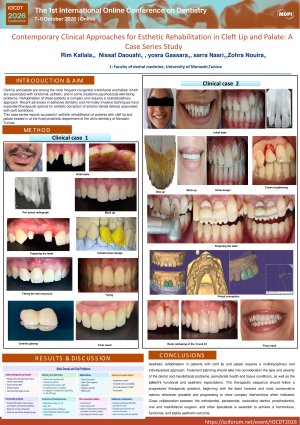
Cleft lip and palate are among the most frequent congenital craniofacial anomalies, which are associated with functional, esthetic, and in some situations psychosocial well-being problems. Rehabilitation of these patients is complex and requires a multidisciplinary approach. Recent advances in adhesive dentistry and minimally invasive techniques have expanded therapeutic options for esthetic correction of anterior dental defects associated with cleft conditions.
Materials and Methods:
This case series reports the esthetic rehabilitation of patients with cleft lip and/or palate treated in at the fixed prosthetic department of the clinic dentistry of Monastir, Tunisia. Patients presented with anterior dental disharmony, including discoloration, spacing, tooth malposition, and shape anomalies. Treatment plans were individualized based on the severity of the defect and the remaining tooth structure. Contemporary adhesive procedures were used, including direct composite resin restorations, ceramic veneers, and indirect adhesive restorations. All treatments followed a minimally invasive approach, preserving sound tooth structure and optimizing esthetic integration.
Results:
All cases demonstrated significant improvement in smile esthetics, tooth proportions, and overall facial harmony. Patients reported high levels of satisfaction with the functional and esthetic outcomes. No biological complications or restoration failures were observed during the follow-up period.
Conclusion:
Esthetic rehabilitation in cleft lip and palate patients using contemporary adhesive and minimally invasive techniques provides predictable and satisfactory outcomes. Treatment success depends on individualized planning, the severity of dental defects, and interdisciplinary coordination. These approaches represent a reliable option for improving esthetics while preserving tooth structure in cleft-related dental rehabilitation.
Keywords
Cleft lip and palate
esthetic
veneers
crown
shape
peg shaped incisors
ceramic
dental anomalies
Poster
poster rim kallala.pdf
Radiomics on 2D Profilometry Images to Evaluate Dental Enamel Modified by Nd:YAG Laser Irradiation and Acidulated Phosphate Fluoride (APF)
Open-Source Digital Software as an Objective Assessment Tool for Monitoring Clinical Progress in Complete Removable Denture Prosthodontics