Event submissions
Published
This submission belongs to the session S7. Digital Dentistry of the event The 1st International Online Conference on Dentistry
Published date
02 Oct, 2026
Academic Editor
'%3e%3cpath%20d='M12.6657%2010.9104C12.4185%2010.325%2012.0599%209.79327%2011.6097%209.34482C11.1609%208.89508%2010.6293%208.5365%2010.0442%208.28888C10.0389%208.28626%2010.0337%208.28495%2010.0285%208.28233C10.8446%207.69279%2011.3752%206.73249%2011.3752%205.64904C11.3752%203.8542%209.92103%202.39999%208.1262%202.39999C6.33136%202.39999%204.87715%203.8542%204.87715%205.64904C4.87715%206.73249%205.40774%207.69279%206.22393%208.28364C6.21869%208.28626%206.21345%208.28757%206.20821%208.29019C5.62129%208.5378%205.09463%208.89284%204.64265%209.34613C4.1929%209.79493%203.83432%2010.3266%203.58671%2010.9117C3.34345%2011.4845%203.21226%2012.0987%203.20023%2012.7209C3.19988%2012.7349%203.20233%2012.7488%203.20744%2012.7619C3.21255%2012.7749%203.22022%2012.7867%203.22998%2012.7968C3.23975%2012.8068%203.25142%2012.8147%203.26431%2012.8202C3.2772%2012.8256%203.29105%2012.8284%203.30504%2012.8284H4.09109C4.14874%2012.8284%204.19459%2012.7825%204.1959%2012.7262C4.2221%2011.7148%204.62823%2010.7676%205.34617%2010.0497C6.08899%209.30683%207.0755%208.89808%208.1262%208.89808C9.17689%208.89808%2010.1634%209.30683%2010.9062%2010.0497C11.6242%2010.7676%2012.0303%2011.7148%2012.0565%2012.7262C12.0578%2012.7838%2012.1037%2012.8284%2012.1613%2012.8284H12.9474C12.9613%2012.8284%2012.9752%2012.8256%2012.9881%2012.8202C13.001%2012.8147%2013.0126%2012.8068%2013.0224%2012.7968C13.0322%2012.7867%2013.0398%2012.7749%2013.0449%2012.7619C13.0501%2012.7488%2013.0525%2012.7349%2013.0522%2012.7209C13.0391%2012.0947%2012.9094%2011.4855%2012.6657%2010.9104ZM8.1262%207.9024C7.52486%207.9024%206.9589%207.6679%206.53312%207.24211C6.10733%206.81633%205.87283%206.25037%205.87283%205.64904C5.87283%205.0477%206.10733%204.48174%206.53312%204.05596C6.9589%203.63018%207.52486%203.39567%208.1262%203.39567C8.72753%203.39567%209.29349%203.63018%209.71927%204.05596C10.1451%204.48174%2010.3796%205.0477%2010.3796%205.64904C10.3796%206.25037%2010.1451%206.81633%209.71927%207.24211C9.29349%207.6679%208.72753%207.9024%208.1262%207.9024Z'%20fill='%235D1EE1'/%3e%3c/g%3e%3c/svg%3e) Parisa Soltani
Parisa SoltaniCitation
Pablo Benitez Sellan, Antonio Lanata, Thiago Gamba, Open-Source Digital Software as an Objective Assessment Tool for Monitoring Clinical Progress in Complete Removable Denture Prosthodontics, in Proceedings of The 1st International Online Conference on Dentistry, 7 October–9 October 2026, MDPI: Basel, Switzerland
Share
Email
Facebook
Twitter
LinkedIn
Open-Source Digital Software as an Objective Assessment Tool for Monitoring Clinical Progress in Complete Removable Denture Prosthodontics
'%3e%3cpath%20d='M12.6647%2010.9104C12.4176%2010.325%2012.0589%209.7933%2011.6088%209.34485C11.16%208.89511%2010.6283%208.53653%2010.0432%208.28891C10.038%208.28629%2010.0327%208.28498%2010.0275%208.28236C10.8437%207.69282%2011.3743%206.73252%2011.3743%205.64907C11.3743%203.85423%209.92005%202.40002%208.12522%202.40002C6.33038%202.40002%204.87618%203.85423%204.87618%205.64907C4.87618%206.73252%205.40677%207.69282%206.22296%208.28367C6.21772%208.28629%206.21248%208.2876%206.20724%208.29022C5.62031%208.53783%205.09365%208.89287%204.64167%209.34616C4.19192%209.79496%203.83334%2010.3266%203.58573%2010.9117C3.34247%2011.4846%203.21128%2012.0987%203.19925%2012.721C3.1989%2012.735%203.20135%2012.7489%203.20646%2012.7619C3.21157%2012.7749%203.21924%2012.7868%203.22901%2012.7968C3.23877%2012.8068%203.25045%2012.8148%203.26334%2012.8202C3.27623%2012.8256%203.29007%2012.8284%203.30406%2012.8284H4.09012C4.14776%2012.8284%204.19362%2012.7825%204.19493%2012.7262C4.22113%2011.7148%204.62726%2010.7676%205.34519%2010.0497C6.08802%209.30686%207.07452%208.89811%208.12522%208.89811C9.17592%208.89811%2010.1624%209.30686%2010.9052%2010.0497C11.6232%2010.7676%2012.0293%2011.7148%2012.0555%2012.7262C12.0568%2012.7839%2012.1027%2012.8284%2012.1603%2012.8284H12.9464C12.9604%2012.8284%2012.9742%2012.8256%2012.9871%2012.8202C13%2012.8148%2013.0117%2012.8068%2013.0214%2012.7968C13.0312%2012.7868%2013.0389%2012.7749%2013.044%2012.7619C13.0491%2012.7489%2013.0515%2012.735%2013.0512%2012.721C13.0381%2012.0947%2012.9084%2011.4856%2012.6647%2010.9104ZM8.12522%207.90243C7.52388%207.90243%206.95792%207.66793%206.53214%207.24215C6.10636%206.81636%205.87185%206.2504%205.87185%205.64907C5.87185%205.04773%206.10636%204.48177%206.53214%204.05599C6.95792%203.63021%207.52388%203.3957%208.12522%203.3957C8.72655%203.3957%209.29252%203.63021%209.7183%204.05599C10.1441%204.48177%2010.3786%205.04773%2010.3786%205.64907C10.3786%206.2504%2010.1441%206.81636%209.7183%207.24215C9.29252%207.66793%208.72655%207.90243%208.12522%207.90243Z'%20fill='%235D1EE1'/%3e%3c/g%3e%3c/svg%3e)
Pablo Benitez Sellan 1
Antonio Lanata 1
Thiago Gamba 2
1. School of Dentistry, Universidad Espíritu Santo (UEES), Samborondón, Ecuador
2. Faculty of Dentistry, Universidade Federal do Rio Grande do Sul (UFRGS), Porto Alegre, Rio Grande do Sul, Brazil
Abstract
Background: Clinical performance assessment in complete removable denture prosthodontics has traditionally relied on subjective instructor judgment, which limits standardization and reproducibility across pre-clinical training environments. The integration of digital tools into formative assessment workflows offers an opportunity to introduce objective, quantifiable metrics that support more consistent and transparent evaluation of student outcomes.
Objectives: To evaluate the feasibility and educational applicability of open-source digital scanning software as an objective measurement tool for assessing undergraduate dental students' clinical performance during the fabrication of prosthetic denture bases.
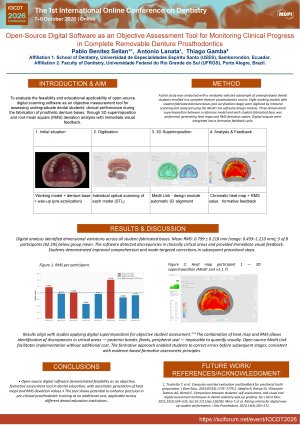
Methods: A pilot study was conducted with a randomly selected subsample of undergraduate dental students enrolled in a complete denture prosthodontics course. Eight working models with student-fabricated denture bases (pre-acrylization stage) were digitized by intraoral scanning and analyzed using the Medit Link software design module. Three-dimensional superimposition between a reference model and each student-fabricated base was performed, generating heat maps and root mean square (RMS) deviation values to quantify dimensional discrepancies. Digital analysis outputs were integrated into a formative feedback cycle, enabling students to identify and correct adaptation errors prior to subsequent procedural stages.
Results: Digital analysis identified dimensional variations across all student-fabricated bases, visualized through heat maps and RMS values. The software detected discrepancies in clinically critical areas of the denture base and provided immediate visual feedback. Students demonstrated improved comprehension of adaptation errors and made targeted corrections in subsequent procedural steps following the feedback intervention.
Conclusions: Open-source digital software demonstrated feasibility as an objective, formative assessment tool in dental education. The combination of quantitative deviation metrics and visual heat-map feedback supported a structured corrective learning process and shows potential to enhance precision in pre-clinical prosthodontic training.
Keywords
dental education
complete denture
open-source software
3D scanning
heat map
RMS deviation
Poster
mdpi pablo benitez.pdf
Contemporary Clinical Approaches for Esthetic Rehabilitation in Cleft Lip and Palate: A Case Series Study
Development and Validation of an Artificial Intelligence Model Using 3D Convolutional Neural Networks for CBCT-Based Diagnosis of Jaw Cysts and Tumors