Event submissions
Published
This submission belongs to the session S1. Preventive Dentistry and Oral Hygiene of the event The 1st International Online Conference on Dentistry
Published date
02 Oct, 2026
Academic Editor
'%3e%3cpath%20d='M12.6657%2010.9104C12.4185%2010.325%2012.0599%209.79327%2011.6097%209.34482C11.1609%208.89508%2010.6293%208.5365%2010.0442%208.28888C10.0389%208.28626%2010.0337%208.28495%2010.0285%208.28233C10.8446%207.69279%2011.3752%206.73249%2011.3752%205.64904C11.3752%203.8542%209.92103%202.39999%208.1262%202.39999C6.33136%202.39999%204.87715%203.8542%204.87715%205.64904C4.87715%206.73249%205.40774%207.69279%206.22393%208.28364C6.21869%208.28626%206.21345%208.28757%206.20821%208.29019C5.62129%208.5378%205.09463%208.89284%204.64265%209.34613C4.1929%209.79493%203.83432%2010.3266%203.58671%2010.9117C3.34345%2011.4845%203.21226%2012.0987%203.20023%2012.7209C3.19988%2012.7349%203.20233%2012.7488%203.20744%2012.7619C3.21255%2012.7749%203.22022%2012.7867%203.22998%2012.7968C3.23975%2012.8068%203.25142%2012.8147%203.26431%2012.8202C3.2772%2012.8256%203.29105%2012.8284%203.30504%2012.8284H4.09109C4.14874%2012.8284%204.19459%2012.7825%204.1959%2012.7262C4.2221%2011.7148%204.62823%2010.7676%205.34617%2010.0497C6.08899%209.30683%207.0755%208.89808%208.1262%208.89808C9.17689%208.89808%2010.1634%209.30683%2010.9062%2010.0497C11.6242%2010.7676%2012.0303%2011.7148%2012.0565%2012.7262C12.0578%2012.7838%2012.1037%2012.8284%2012.1613%2012.8284H12.9474C12.9613%2012.8284%2012.9752%2012.8256%2012.9881%2012.8202C13.001%2012.8147%2013.0126%2012.8068%2013.0224%2012.7968C13.0322%2012.7867%2013.0398%2012.7749%2013.0449%2012.7619C13.0501%2012.7488%2013.0525%2012.7349%2013.0522%2012.7209C13.0391%2012.0947%2012.9094%2011.4855%2012.6657%2010.9104ZM8.1262%207.9024C7.52486%207.9024%206.9589%207.6679%206.53312%207.24211C6.10733%206.81633%205.87283%206.25037%205.87283%205.64904C5.87283%205.0477%206.10733%204.48174%206.53312%204.05596C6.9589%203.63018%207.52486%203.39567%208.1262%203.39567C8.72753%203.39567%209.29349%203.63018%209.71927%204.05596C10.1451%204.48174%2010.3796%205.0477%2010.3796%205.64904C10.3796%206.25037%2010.1451%206.81633%209.71927%207.24211C9.29349%207.6679%208.72753%207.9024%208.1262%207.9024Z'%20fill='%235D1EE1'/%3e%3c/g%3e%3c/svg%3e) Chun Hung Chu
Chun Hung ChuCitation
Saichao Zhou, Marina V. Loktionova, Oleg S. Glazachev, Association Between Mandibular Chewing Patterns and Sleep Bruxism Characteristics: A Clinical Observational Study, in Proceedings of The 1st International Online Conference on Dentistry, 7 October–9 October 2026, MDPI: Basel, Switzerland
Share
Email
Facebook
Twitter
LinkedIn
Association Between Mandibular Chewing Patterns and Sleep Bruxism Characteristics: A Clinical Observational Study
'%3e%3cpath%20d='M12.6647%2010.9104C12.4176%2010.325%2012.0589%209.7933%2011.6088%209.34485C11.16%208.89511%2010.6283%208.53653%2010.0432%208.28891C10.038%208.28629%2010.0327%208.28498%2010.0275%208.28236C10.8437%207.69282%2011.3743%206.73252%2011.3743%205.64907C11.3743%203.85423%209.92005%202.40002%208.12522%202.40002C6.33038%202.40002%204.87618%203.85423%204.87618%205.64907C4.87618%206.73252%205.40677%207.69282%206.22296%208.28367C6.21772%208.28629%206.21248%208.2876%206.20724%208.29022C5.62031%208.53783%205.09365%208.89287%204.64167%209.34616C4.19192%209.79496%203.83334%2010.3266%203.58573%2010.9117C3.34247%2011.4846%203.21128%2012.0987%203.19925%2012.721C3.1989%2012.735%203.20135%2012.7489%203.20646%2012.7619C3.21157%2012.7749%203.21924%2012.7868%203.22901%2012.7968C3.23877%2012.8068%203.25045%2012.8148%203.26334%2012.8202C3.27623%2012.8256%203.29007%2012.8284%203.30406%2012.8284H4.09012C4.14776%2012.8284%204.19362%2012.7825%204.19493%2012.7262C4.22113%2011.7148%204.62726%2010.7676%205.34519%2010.0497C6.08802%209.30686%207.07452%208.89811%208.12522%208.89811C9.17592%208.89811%2010.1624%209.30686%2010.9052%2010.0497C11.6232%2010.7676%2012.0293%2011.7148%2012.0555%2012.7262C12.0568%2012.7839%2012.1027%2012.8284%2012.1603%2012.8284H12.9464C12.9604%2012.8284%2012.9742%2012.8256%2012.9871%2012.8202C13%2012.8148%2013.0117%2012.8068%2013.0214%2012.7968C13.0312%2012.7868%2013.0389%2012.7749%2013.044%2012.7619C13.0491%2012.7489%2013.0515%2012.735%2013.0512%2012.721C13.0381%2012.0947%2012.9084%2011.4856%2012.6647%2010.9104ZM8.12522%207.90243C7.52388%207.90243%206.95792%207.66793%206.53214%207.24215C6.10636%206.81636%205.87185%206.2504%205.87185%205.64907C5.87185%205.04773%206.10636%204.48177%206.53214%204.05599C6.95792%203.63021%207.52388%203.3957%208.12522%203.3957C8.72655%203.3957%209.29252%203.63021%209.7183%204.05599C10.1441%204.48177%2010.3786%205.04773%2010.3786%205.64907C10.3786%206.2504%2010.1441%206.81636%209.7183%207.24215C9.29252%207.66793%208.72655%207.90243%208.12522%207.90243Z'%20fill='%235D1EE1'/%3e%3c/g%3e%3c/svg%3e)
Saichao Zhou 1
Marina V. Loktionova 1
Oleg S. Glazachev 2,3
1. Department of Orthodontics and Preventive Dentistry, Institute of Dentistry, I.M. Sechenov First Moscow State Medical University (Sechenov University), 8/2 Trubetskaya Str., Moscow, 119991, Russia
2. Department of Normal Physiology, Institute of Clinical Medicine, I.M. Sechenov First Moscow State Medical University (Sechenov University), 8/2 Trubetskaya Str., Moscow 119991, Russia
3. Scientific Direction, V.P. Filatov International Foundation for the Development of Biomedical Technologies, 8/2 Trubetskaya Str., Moscow 119991, Russia
Abstract
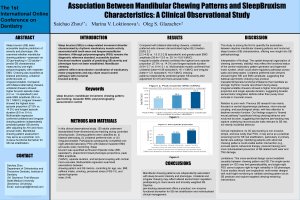
Introduction: Sleep bruxism (SB) is a sleep-related movement disorder characterised by rhythmic masticatory muscle activity associated with tooth wear and temporomandibular disorders. Although polysomnography (PSG) remains the diagnostic reference standard, accessible daytime functional markers capable of predicting SB severity and phenotype have not been established. Mandibular chewing patterns reflect sensorimotor coordination of masticatory motor programmes and may share neural control pathways with nocturnal bruxism activity.
Methods: In this clinical observational study, 120 adults underwent standardised three-dimensional jaw-tracking during controlled chewing tasks. Chewing patterns were classified as: (i) bilateral alternating, (ii) unilateral preferred-side, or (iii) irregular/unstable. Participants subsequently completed one-night attended laboratory PSG with bilateral masseter EMG and audio-video monitoring. Sleep bruxism was quantified as Bruxism Episode Index (BEI, episodes/h), phasic/tonic/mixed phenotype proportions, peak EMG amplitude (%MVC), episode duration, and temporal coupling with cortical micro-arousals. Multivariable regression examined associations between chewing pattern and SB metrics, controlling for age, sex, BMI, caffeine intake, smoking, perceived stress (PSS-10), and apnea-hypopnea index (AHI).
Results: Compared with bilateral alternating chewers, unilateral preferred-side chewers demonstrated higher BEI (median [IQR]: 3.2 [2.2-4.6] vs. 1.9 [1.2-2.8] episodes/h) and greater peak EMG amplitude (38.4+/-12.6 vs. 29.1+/-10.8 %MVC). Irregular/unstable chewers exhibited the highest tonic episode proportion (27.8% vs. 14.3%) and longest episode duration (8.9+/-2.7 vs. 6.4+/-2.1 s). Multivariable models confirmed that unilateral (beta=+0.88 episodes/h; +6.1 %MVC) and irregular (beta=+1.21 episodes/h; +8.4 %MVC) chewing patterns independently predicted greater SB severity after adjustment for AHI and micro-arousal index.
Conclusions: Mandibular chewing patterns are independently associated with sleep bruxism intensity and phenotype. Unilateral and irregular chewing may reflect altered sensorimotor regulation predisposing to more severe and tonically weighted SB. Daytime jaw-tracking assessment offers a practical, non-invasive functional biomarker for SB risk stratification and individualised clinical management.
Keywords
Keywords: sleep bruxism
mandibular movement
chewing pattern
jaw tracking
masseter EMG
polysomnography
sensorimotor control
Poster
PPT-Poster.pdf
Development of a new antibody drug to treat congenital tooth agenesis
Artificial Intelligence in Endodontic Radiology: Current Status of AI Models for CBCT-Based Periapical Pathosis Diagnosis