Event submissions
Published
This submission belongs to the session S2. Dental Materials of the event The 1st International Online Conference on Dentistry
Published date
02 Oct, 2026
Academic Editor
'%3e%3cpath%20d='M12.6657%2010.9104C12.4185%2010.325%2012.0599%209.79327%2011.6097%209.34482C11.1609%208.89508%2010.6293%208.5365%2010.0442%208.28888C10.0389%208.28626%2010.0337%208.28495%2010.0285%208.28233C10.8446%207.69279%2011.3752%206.73249%2011.3752%205.64904C11.3752%203.8542%209.92103%202.39999%208.1262%202.39999C6.33136%202.39999%204.87715%203.8542%204.87715%205.64904C4.87715%206.73249%205.40774%207.69279%206.22393%208.28364C6.21869%208.28626%206.21345%208.28757%206.20821%208.29019C5.62129%208.5378%205.09463%208.89284%204.64265%209.34613C4.1929%209.79493%203.83432%2010.3266%203.58671%2010.9117C3.34345%2011.4845%203.21226%2012.0987%203.20023%2012.7209C3.19988%2012.7349%203.20233%2012.7488%203.20744%2012.7619C3.21255%2012.7749%203.22022%2012.7867%203.22998%2012.7968C3.23975%2012.8068%203.25142%2012.8147%203.26431%2012.8202C3.2772%2012.8256%203.29105%2012.8284%203.30504%2012.8284H4.09109C4.14874%2012.8284%204.19459%2012.7825%204.1959%2012.7262C4.2221%2011.7148%204.62823%2010.7676%205.34617%2010.0497C6.08899%209.30683%207.0755%208.89808%208.1262%208.89808C9.17689%208.89808%2010.1634%209.30683%2010.9062%2010.0497C11.6242%2010.7676%2012.0303%2011.7148%2012.0565%2012.7262C12.0578%2012.7838%2012.1037%2012.8284%2012.1613%2012.8284H12.9474C12.9613%2012.8284%2012.9752%2012.8256%2012.9881%2012.8202C13.001%2012.8147%2013.0126%2012.8068%2013.0224%2012.7968C13.0322%2012.7867%2013.0398%2012.7749%2013.0449%2012.7619C13.0501%2012.7488%2013.0525%2012.7349%2013.0522%2012.7209C13.0391%2012.0947%2012.9094%2011.4855%2012.6657%2010.9104ZM8.1262%207.9024C7.52486%207.9024%206.9589%207.6679%206.53312%207.24211C6.10733%206.81633%205.87283%206.25037%205.87283%205.64904C5.87283%205.0477%206.10733%204.48174%206.53312%204.05596C6.9589%203.63018%207.52486%203.39567%208.1262%203.39567C8.72753%203.39567%209.29349%203.63018%209.71927%204.05596C10.1451%204.48174%2010.3796%205.0477%2010.3796%205.64904C10.3796%206.25037%2010.1451%206.81633%209.71927%207.24211C9.29349%207.6679%208.72753%207.9024%208.1262%207.9024Z'%20fill='%235D1EE1'/%3e%3c/g%3e%3c/svg%3e) Gianrico Spagnuolo
Gianrico SpagnuoloCitation
Yuxuan Bei, Ksenia Babina, Nina Novozhilova, Application and reporting of the CIELAB and CIEDE2000 color-difference formulas in composite resin color-stability research: a systematic review, in Proceedings of The 1st International Online Conference on Dentistry, 7 October–9 October 2026, MDPI: Basel, Switzerland
Share
Email
Facebook
Twitter
LinkedIn
Application and reporting of the CIELAB and CIEDE2000 color-difference formulas in composite resin color-stability research: a systematic review
'%3e%3cpath%20d='M12.6647%2010.9104C12.4176%2010.325%2012.0589%209.7933%2011.6088%209.34485C11.16%208.89511%2010.6283%208.53653%2010.0432%208.28891C10.038%208.28629%2010.0327%208.28498%2010.0275%208.28236C10.8437%207.69282%2011.3743%206.73252%2011.3743%205.64907C11.3743%203.85423%209.92005%202.40002%208.12522%202.40002C6.33038%202.40002%204.87618%203.85423%204.87618%205.64907C4.87618%206.73252%205.40677%207.69282%206.22296%208.28367C6.21772%208.28629%206.21248%208.2876%206.20724%208.29022C5.62031%208.53783%205.09365%208.89287%204.64167%209.34616C4.19192%209.79496%203.83334%2010.3266%203.58573%2010.9117C3.34247%2011.4846%203.21128%2012.0987%203.19925%2012.721C3.1989%2012.735%203.20135%2012.7489%203.20646%2012.7619C3.21157%2012.7749%203.21924%2012.7868%203.22901%2012.7968C3.23877%2012.8068%203.25045%2012.8148%203.26334%2012.8202C3.27623%2012.8256%203.29007%2012.8284%203.30406%2012.8284H4.09012C4.14776%2012.8284%204.19362%2012.7825%204.19493%2012.7262C4.22113%2011.7148%204.62726%2010.7676%205.34519%2010.0497C6.08802%209.30686%207.07452%208.89811%208.12522%208.89811C9.17592%208.89811%2010.1624%209.30686%2010.9052%2010.0497C11.6232%2010.7676%2012.0293%2011.7148%2012.0555%2012.7262C12.0568%2012.7839%2012.1027%2012.8284%2012.1603%2012.8284H12.9464C12.9604%2012.8284%2012.9742%2012.8256%2012.9871%2012.8202C13%2012.8148%2013.0117%2012.8068%2013.0214%2012.7968C13.0312%2012.7868%2013.0389%2012.7749%2013.044%2012.7619C13.0491%2012.7489%2013.0515%2012.735%2013.0512%2012.721C13.0381%2012.0947%2012.9084%2011.4856%2012.6647%2010.9104ZM8.12522%207.90243C7.52388%207.90243%206.95792%207.66793%206.53214%207.24215C6.10636%206.81636%205.87185%206.2504%205.87185%205.64907C5.87185%205.04773%206.10636%204.48177%206.53214%204.05599C6.95792%203.63021%207.52388%203.3957%208.12522%203.3957C8.72655%203.3957%209.29252%203.63021%209.7183%204.05599C10.1441%204.48177%2010.3786%205.04773%2010.3786%205.64907C10.3786%206.2504%2010.1441%206.81636%209.7183%207.24215C9.29252%207.66793%208.72655%207.90243%208.12522%207.90243Z'%20fill='%235D1EE1'/%3e%3c/g%3e%3c/svg%3e)
Yuxuan Bei 1

Ksenia Babina 1
Nina Novozhilova 1
1. E.V. Borovsky Department of Therapeutic Dentistry, I.M. Sechenov First Moscow State Medical University (Sechenov University), Moscow, 119991, Russia
Abstract
Introduction
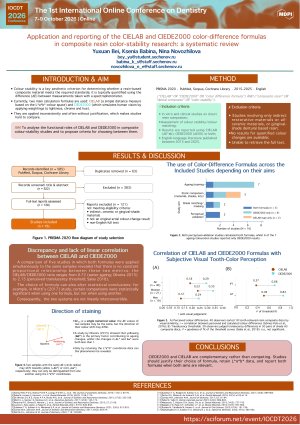
In dental composite colour-stability research, the CIELAB and CIEDE2000 colour-difference formulas are applied inconsistently. This review analyzed the functional roles of CIELAB and CIEDE2000 in studies on the color stability of dental composite materials and proposes criteria for the selection of these color difference formulas.
Methods
Following PRISMA 2020 guidelines, a systematic search of PubMed, Scopus, and the Cochrane Library was performed for studies published between 2015 and 2025, using ("CIELAB" OR "CIEDE2000" OR "color difference formula") AND ("composite resin" OR "dental composite" OR "color stability").
Records were deduplicated and screened by title, abstract, and full text in Rayyan. Studies were excluded if they addressed indirect or ceramic materials or gingival-shade resin bases, reported only summary ΔE without retaining raw L*a*b* coordinates, or applied a formula without justifying its selection.
Results
Of 585 records identified, 522 remained after deduplication and 139 after title and abstract screening; 16 met the final full-text criteria. Others were excluded for not meeting the selection criteria, being unavailable with full texts, or having missing data.
Direct-comparison studies showed that the two formulas are not linearly interconvertible. CIEDE2000 correlated more closely with subjective tooth-colour perception in the low-to-medium-chroma yellow-blue range (r = 0.289) than CIELAB (r = 0.176), supporting its use for acceptability thresholds. Whereas CIELAB with retained L*a*b* coordinates remains necessary for the directional analysis of staining (Δa*, Δb*), which the single ΔE00 scalar cannot describe. Moreover, as the two systems are not linearly related, CIELAB is more suitable for comparability with past studies which mainly used this formula.
Conclusions
CIEDE2000 and CIELAB are complementary rather than competing. Studies should justify their choice of formula, retain L*a*b* data, and report both formulas when both aims are relevant.
Keywords
color difference
CIELAB
CIEDE2000
ΔE
color stability
resin composite
systematic review
Poster
Bei Yuxuan-IOCDT2026-Poster.pdf
Improving documentation of dental radiograph grading through a QR code-linked recording system in a paediatric dental department: A quality improvement project
Development of a new antibody drug to treatcongenital tooth agenesis