Event submissions
Published
This submission belongs to the session S4. Metallic Biomaterials of the event The 3rd International Online Conference on Metals
Published date
08 Oct, 2026
Academic Editor
'%3e%3cpath%20d='M12.6657%2010.9104C12.4185%2010.325%2012.0599%209.79327%2011.6097%209.34482C11.1609%208.89508%2010.6293%208.5365%2010.0442%208.28888C10.0389%208.28626%2010.0337%208.28495%2010.0285%208.28233C10.8446%207.69279%2011.3752%206.73249%2011.3752%205.64904C11.3752%203.8542%209.92103%202.39999%208.1262%202.39999C6.33136%202.39999%204.87715%203.8542%204.87715%205.64904C4.87715%206.73249%205.40774%207.69279%206.22393%208.28364C6.21869%208.28626%206.21345%208.28757%206.20821%208.29019C5.62129%208.5378%205.09463%208.89284%204.64265%209.34613C4.1929%209.79493%203.83432%2010.3266%203.58671%2010.9117C3.34345%2011.4845%203.21226%2012.0987%203.20023%2012.7209C3.19988%2012.7349%203.20233%2012.7488%203.20744%2012.7619C3.21255%2012.7749%203.22022%2012.7867%203.22998%2012.7968C3.23975%2012.8068%203.25142%2012.8147%203.26431%2012.8202C3.2772%2012.8256%203.29105%2012.8284%203.30504%2012.8284H4.09109C4.14874%2012.8284%204.19459%2012.7825%204.1959%2012.7262C4.2221%2011.7148%204.62823%2010.7676%205.34617%2010.0497C6.08899%209.30683%207.0755%208.89808%208.1262%208.89808C9.17689%208.89808%2010.1634%209.30683%2010.9062%2010.0497C11.6242%2010.7676%2012.0303%2011.7148%2012.0565%2012.7262C12.0578%2012.7838%2012.1037%2012.8284%2012.1613%2012.8284H12.9474C12.9613%2012.8284%2012.9752%2012.8256%2012.9881%2012.8202C13.001%2012.8147%2013.0126%2012.8068%2013.0224%2012.7968C13.0322%2012.7867%2013.0398%2012.7749%2013.0449%2012.7619C13.0501%2012.7488%2013.0525%2012.7349%2013.0522%2012.7209C13.0391%2012.0947%2012.9094%2011.4855%2012.6657%2010.9104ZM8.1262%207.9024C7.52486%207.9024%206.9589%207.6679%206.53312%207.24211C6.10733%206.81633%205.87283%206.25037%205.87283%205.64904C5.87283%205.0477%206.10733%204.48174%206.53312%204.05596C6.9589%203.63018%207.52486%203.39567%208.1262%203.39567C8.72753%203.39567%209.29349%203.63018%209.71927%204.05596C10.1451%204.48174%2010.3796%205.0477%2010.3796%205.64904C10.3796%206.25037%2010.1451%206.81633%209.71927%207.24211C9.29349%207.6679%208.72753%207.9024%208.1262%207.9024Z'%20fill='%235D1EE1'/%3e%3c/g%3e%3c/svg%3e) Silvia Spriano
Silvia SprianoCitation
Luccas Nunes Caetano da Silva, Carlos Eduardo Manreza, Lucas Pereira Mendes, Jhuliene Elen Muro Torrento, Carlos Roberto Grandini, Diego Rafael Nespeque Correa, Design, processing, and characterization of novel high-entropy alloys for biomedical applications by using non-toxic and low-cost alloying elements, in Proceedings of The 3rd International Online Conference on Metals, 12 October–14 October 2026, MDPI: Basel, Switzerland
Share
Email
Facebook
Twitter
LinkedIn
Design, processing, and characterization of novel high-entropy alloys for biomedical applications by using non-toxic and low-cost alloying elements
'%3e%3cpath%20d='M12.6647%2010.9104C12.4176%2010.325%2012.0589%209.7933%2011.6088%209.34485C11.16%208.89511%2010.6283%208.53653%2010.0432%208.28891C10.038%208.28629%2010.0327%208.28498%2010.0275%208.28236C10.8437%207.69282%2011.3743%206.73252%2011.3743%205.64907C11.3743%203.85423%209.92005%202.40002%208.12522%202.40002C6.33038%202.40002%204.87618%203.85423%204.87618%205.64907C4.87618%206.73252%205.40677%207.69282%206.22296%208.28367C6.21772%208.28629%206.21248%208.2876%206.20724%208.29022C5.62031%208.53783%205.09365%208.89287%204.64167%209.34616C4.19192%209.79496%203.83334%2010.3266%203.58573%2010.9117C3.34247%2011.4846%203.21128%2012.0987%203.19925%2012.721C3.1989%2012.735%203.20135%2012.7489%203.20646%2012.7619C3.21157%2012.7749%203.21924%2012.7868%203.22901%2012.7968C3.23877%2012.8068%203.25045%2012.8148%203.26334%2012.8202C3.27623%2012.8256%203.29007%2012.8284%203.30406%2012.8284H4.09012C4.14776%2012.8284%204.19362%2012.7825%204.19493%2012.7262C4.22113%2011.7148%204.62726%2010.7676%205.34519%2010.0497C6.08802%209.30686%207.07452%208.89811%208.12522%208.89811C9.17592%208.89811%2010.1624%209.30686%2010.9052%2010.0497C11.6232%2010.7676%2012.0293%2011.7148%2012.0555%2012.7262C12.0568%2012.7839%2012.1027%2012.8284%2012.1603%2012.8284H12.9464C12.9604%2012.8284%2012.9742%2012.8256%2012.9871%2012.8202C13%2012.8148%2013.0117%2012.8068%2013.0214%2012.7968C13.0312%2012.7868%2013.0389%2012.7749%2013.044%2012.7619C13.0491%2012.7489%2013.0515%2012.735%2013.0512%2012.721C13.0381%2012.0947%2012.9084%2011.4856%2012.6647%2010.9104ZM8.12522%207.90243C7.52388%207.90243%206.95792%207.66793%206.53214%207.24215C6.10636%206.81636%205.87185%206.2504%205.87185%205.64907C5.87185%205.04773%206.10636%204.48177%206.53214%204.05599C6.95792%203.63021%207.52388%203.3957%208.12522%203.3957C8.72655%203.3957%209.29252%203.63021%209.7183%204.05599C10.1441%204.48177%2010.3786%205.04773%2010.3786%205.64907C10.3786%206.2504%2010.1441%206.81636%209.7183%207.24215C9.29252%207.66793%208.72655%207.90243%208.12522%207.90243Z'%20fill='%235D1EE1'/%3e%3c/g%3e%3c/svg%3e)
Luccas Nunes Caetano da Silva 1
Carlos Eduardo Manreza 1
Lucas Pereira Mendes 1
Jhuliene Elen Muro Torrento 1

Carlos Roberto Grandini 1

Diego Rafael Nespeque Correa 2
1. São Paulo State University (UNESP), School of Sciences, Campus Bauru, Laboratory of Anelasticity and Biomaterials, 17.033-360 Bauru, SP, Brazil
2. UNESP - Univ Estadual Paulista, School of Sciences, Physics and Meteorology Department
Abstract
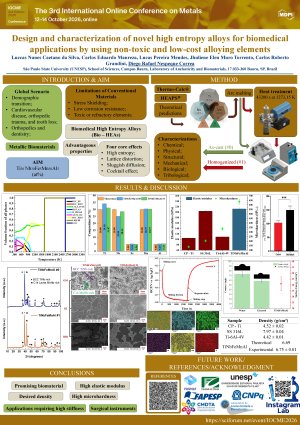
High-entropy alloys (HEAs) have emerged as a hotspot for novel biomedical materials, owing to the unique combination of mechanical, corrosion, tribological, and biological properties enabled by the four core effects. However, the currently developed HEAs for high-performance applications are composed of potentially toxic (Ni, Co, and Cr) or refractory elements (Ta, Mo, and Nb), which limit their use in hard tissue replacements, such as orthopedic and dental implants. In this sense, the goal of this study was to design novel multi-component solid solutions by replacing certain alloying elements with Mn, Al, and Fe to meet certain clinical criteria. The chemical composition was designed by using CALPHAD, resulting in the Ti30Nb30Mn30Fe5Al5 (at%). After that, the samples were produced by argon arc melting of raw metals, characterized by conventional X-ray and electron-based techniques, and tested in preliminary mechanical, tribo-electrochemical, and cytotoxic assays. The results indicated that the presence of distinct amounts of alloying elements can retain secondary phases (e.g., Laves C14 and C15) in a BCC matrix. As a result, positive effects on hardness (~600 HV) and elastic modulus (~200 GPa) were achieved without compromising corrosion resistance in Hank’s solution or cell interaction with the pre-osteoblast lineage, particularly cell adhesion and proliferation. Therefore, the study sheds light on a new route for developing biomedical materials based on the concept of entropy, especially surgical instruments and bone fixation devices. (Financial support: FAPESP #2024/03148-3 and #2024/01132-2, and CNPq #404020/2023–2 and #304400/2025-4)
Keywords
biomaterial
high entropy alloy
microstructure
elastic modulus
corrosion
cytotoxicity.
Poster
Pôster IOCME 2026 Luccas.pdf
Powder Metallurgy-Derived Cr-Reinforced Aluminium Composites with Enhanced Hardness and Alkaline Stability for Solar Thermal Systems
Electrochemical and Corrosion Behavior of a Retrieved Cobalt–Chromium Knee Prosthesis After Two Years of In Vivo Exposure