Event submissions
Published
This submission belongs to the session S1. Design and Characterization of Novel Metallic Materials of the event The 3rd International Online Conference on Metals
Published date
08 Oct, 2026
Academic Editor
'%3e%3cpath%20d='M12.6657%2010.9104C12.4185%2010.325%2012.0599%209.79327%2011.6097%209.34482C11.1609%208.89508%2010.6293%208.5365%2010.0442%208.28888C10.0389%208.28626%2010.0337%208.28495%2010.0285%208.28233C10.8446%207.69279%2011.3752%206.73249%2011.3752%205.64904C11.3752%203.8542%209.92103%202.39999%208.1262%202.39999C6.33136%202.39999%204.87715%203.8542%204.87715%205.64904C4.87715%206.73249%205.40774%207.69279%206.22393%208.28364C6.21869%208.28626%206.21345%208.28757%206.20821%208.29019C5.62129%208.5378%205.09463%208.89284%204.64265%209.34613C4.1929%209.79493%203.83432%2010.3266%203.58671%2010.9117C3.34345%2011.4845%203.21226%2012.0987%203.20023%2012.7209C3.19988%2012.7349%203.20233%2012.7488%203.20744%2012.7619C3.21255%2012.7749%203.22022%2012.7867%203.22998%2012.7968C3.23975%2012.8068%203.25142%2012.8147%203.26431%2012.8202C3.2772%2012.8256%203.29105%2012.8284%203.30504%2012.8284H4.09109C4.14874%2012.8284%204.19459%2012.7825%204.1959%2012.7262C4.2221%2011.7148%204.62823%2010.7676%205.34617%2010.0497C6.08899%209.30683%207.0755%208.89808%208.1262%208.89808C9.17689%208.89808%2010.1634%209.30683%2010.9062%2010.0497C11.6242%2010.7676%2012.0303%2011.7148%2012.0565%2012.7262C12.0578%2012.7838%2012.1037%2012.8284%2012.1613%2012.8284H12.9474C12.9613%2012.8284%2012.9752%2012.8256%2012.9881%2012.8202C13.001%2012.8147%2013.0126%2012.8068%2013.0224%2012.7968C13.0322%2012.7867%2013.0398%2012.7749%2013.0449%2012.7619C13.0501%2012.7488%2013.0525%2012.7349%2013.0522%2012.7209C13.0391%2012.0947%2012.9094%2011.4855%2012.6657%2010.9104ZM8.1262%207.9024C7.52486%207.9024%206.9589%207.6679%206.53312%207.24211C6.10733%206.81633%205.87283%206.25037%205.87283%205.64904C5.87283%205.0477%206.10733%204.48174%206.53312%204.05596C6.9589%203.63018%207.52486%203.39567%208.1262%203.39567C8.72753%203.39567%209.29349%203.63018%209.71927%204.05596C10.1451%204.48174%2010.3796%205.0477%2010.3796%205.64904C10.3796%206.25037%2010.1451%206.81633%209.71927%207.24211C9.29349%207.6679%208.72753%207.9024%208.1262%207.9024Z'%20fill='%235D1EE1'/%3e%3c/g%3e%3c/svg%3e) Eric Hug
Eric HugCitation
Spyridon Chaskis, Marianthi Bouzouni, Evangelos Gavalas, Vasilis Loukadakis, Charoula Vourgidi, Spyros Papaefthymiou, Compositional Design and Casting of Novel Scrap-Tolerant Enhanced Entropy Lead-Free Bronze Alloys, in Proceedings of The 3rd International Online Conference on Metals, 12 October–14 October 2026, MDPI: Basel, Switzerland
Share
Email
Facebook
Twitter
LinkedIn
Compositional Design and Casting of Novel Scrap-Tolerant Enhanced Entropy Lead-Free Bronze Alloys
'%3e%3cpath%20d='M12.6647%2010.9104C12.4176%2010.325%2012.0589%209.7933%2011.6088%209.34485C11.16%208.89511%2010.6283%208.53653%2010.0432%208.28891C10.038%208.28629%2010.0327%208.28498%2010.0275%208.28236C10.8437%207.69282%2011.3743%206.73252%2011.3743%205.64907C11.3743%203.85423%209.92005%202.40002%208.12522%202.40002C6.33038%202.40002%204.87618%203.85423%204.87618%205.64907C4.87618%206.73252%205.40677%207.69282%206.22296%208.28367C6.21772%208.28629%206.21248%208.2876%206.20724%208.29022C5.62031%208.53783%205.09365%208.89287%204.64167%209.34616C4.19192%209.79496%203.83334%2010.3266%203.58573%2010.9117C3.34247%2011.4846%203.21128%2012.0987%203.19925%2012.721C3.1989%2012.735%203.20135%2012.7489%203.20646%2012.7619C3.21157%2012.7749%203.21924%2012.7868%203.22901%2012.7968C3.23877%2012.8068%203.25045%2012.8148%203.26334%2012.8202C3.27623%2012.8256%203.29007%2012.8284%203.30406%2012.8284H4.09012C4.14776%2012.8284%204.19362%2012.7825%204.19493%2012.7262C4.22113%2011.7148%204.62726%2010.7676%205.34519%2010.0497C6.08802%209.30686%207.07452%208.89811%208.12522%208.89811C9.17592%208.89811%2010.1624%209.30686%2010.9052%2010.0497C11.6232%2010.7676%2012.0293%2011.7148%2012.0555%2012.7262C12.0568%2012.7839%2012.1027%2012.8284%2012.1603%2012.8284H12.9464C12.9604%2012.8284%2012.9742%2012.8256%2012.9871%2012.8202C13%2012.8148%2013.0117%2012.8068%2013.0214%2012.7968C13.0312%2012.7868%2013.0389%2012.7749%2013.044%2012.7619C13.0491%2012.7489%2013.0515%2012.735%2013.0512%2012.721C13.0381%2012.0947%2012.9084%2011.4856%2012.6647%2010.9104ZM8.12522%207.90243C7.52388%207.90243%206.95792%207.66793%206.53214%207.24215C6.10636%206.81636%205.87185%206.2504%205.87185%205.64907C5.87185%205.04773%206.10636%204.48177%206.53214%204.05599C6.95792%203.63021%207.52388%203.3957%208.12522%203.3957C8.72655%203.3957%209.29252%203.63021%209.7183%204.05599C10.1441%204.48177%2010.3786%205.04773%2010.3786%205.64907C10.3786%206.2504%2010.1441%206.81636%209.7183%207.24215C9.29252%207.66793%208.72655%207.90243%208.12522%207.90243Z'%20fill='%235D1EE1'/%3e%3c/g%3e%3c/svg%3e)
Spyridon Chaskis 1,2

Marianthi Bouzouni 3
Evangelos Gavalas 3
Vasilis Loukadakis 3
Charoula Vourgidi 4

Spyros Papaefthymiou 1
1. Laboratory of Physical Metallurgy, Division of Metallurgy and Materials, School of Mining and Metallurgical Engineering, National Technical University of Athens, 9, Heroon Polytechniou Street, 15780 Athens, Greece
2. Technology, Marketing and R&D Department of HALCOR, Copper Tubes and Alloys Extrusion Division, ELVALHALCOR S.A., 62nd km Athens-Lamia National Road, 32011 Oinofyta, Greece
3. Department of Physical Metallurgy and Forming, Hellenic Research Centre for Metals (ELKEME S.A.), 61st km Athens-Lamia National Road, 32011 Oinofyta, Greece
4. Department of Process Metallurgy, Hellenic Research Centre for Metals (ELKEME S.A.), 61st km Athens-Lamia National Road, 32011 Oinofyta, Greece
Abstract
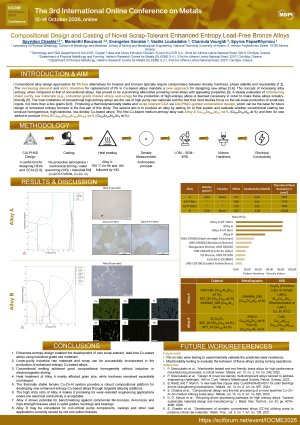
Conventional lead-free brasses and bronzes often require compromises between density, hardness, phase stability and recyclability. In this work, two Cu-based medium-entropy alloys, Cu61.6Zn28.8Al9.5 wt.% (Cu55Zn25Al20 at.%) and Cu45.6Zn29.3Al14.5Sn10.6 wt.% (Cu40Zn25Al30Sn5 at.%), were designed as lead-free alternatives that combine brass/bronze metallurgy with medium-entropy alloy design and scrap-compatible processing. Their novelty lies in using high Al contents to reduce density and promote hard Cu–Al–Zn intermetallic/γ-brass-type phase formation, while Sn was introduced to further decrease density and generate a controlled multiphase structure.
The alloys were designed using CALPHAD-guided thermodynamic calculations and produced by conventional melting and casting using industrially relevant raw materials, including scrap-based feedstocks, without protective atmosphere. The Cu–Zn–Al alloy was heat-treated at 700 °C for 8 and 16 h followed by water quenching. Microstructure and phases were examined by optical microscopy, SEM-EDS, and XRD, while hardness and conductivity were measured to assess engineering relevance.
The Cu–Zn–Al alloy developed a predominantly uniform Cu–Zn–Al matrix reaching 577 HV0.2 at a density of 6.93 g/cm³. Heat treatment caused grain coarsening with the hardness remaining almost unchanged, at 568–579 HV0.2, indicating good microstructural stability. Also, the strengthening is mainly controlled by the retained phase constitution rather than heat-treatment-induced precipitation. The Sn-containing alloy showed a multiphase microstructure reaching 325 HV0.2 hardness and 6.24 g/cm³ density.
These results indicate that Cu–Zn–Al is promising for wear-resistant, lightweight copper-alloy components where high specific hardness is required, while Cu–Zn–Al–Sn offers a lower-density lead-free option for cast components where higher hardness, reduced weight and low production costs are prioritized. These findings support further development of sustainable, recyclable Cu-based medium-entropy alloys for engineering applications.
Keywords
copper-based alloys
medium-entropy alloys
sustainable metallurgy
casting
lightweight alloys
Cu–Zn–Al
Cu–Zn–Al–Sn
CALPHAD
microstructure
mechanical properties
heat treatment
marine applications
bearing
Poster
3rd IOCME 2026 Poster Sciforum 195590 v6.pdf
Electrochemical Evaluation of Octacalcium Phosphate as a Green Corrosion Inhibitor in 1.0 M HCl
THERMAL STABILITY AND MEMORY EFFECT IN Mn(Co,Fe)(Ge,Si) CALORIC ALLOYS