Event submissions
Published
This submission belongs to the session S7. Metals Processing of the event The 3rd International Online Conference on Metals
Published date
08 Oct, 2026
Academic Editor
'%3e%3cpath%20d='M12.6657%2010.9104C12.4185%2010.325%2012.0599%209.79327%2011.6097%209.34482C11.1609%208.89508%2010.6293%208.5365%2010.0442%208.28888C10.0389%208.28626%2010.0337%208.28495%2010.0285%208.28233C10.8446%207.69279%2011.3752%206.73249%2011.3752%205.64904C11.3752%203.8542%209.92103%202.39999%208.1262%202.39999C6.33136%202.39999%204.87715%203.8542%204.87715%205.64904C4.87715%206.73249%205.40774%207.69279%206.22393%208.28364C6.21869%208.28626%206.21345%208.28757%206.20821%208.29019C5.62129%208.5378%205.09463%208.89284%204.64265%209.34613C4.1929%209.79493%203.83432%2010.3266%203.58671%2010.9117C3.34345%2011.4845%203.21226%2012.0987%203.20023%2012.7209C3.19988%2012.7349%203.20233%2012.7488%203.20744%2012.7619C3.21255%2012.7749%203.22022%2012.7867%203.22998%2012.7968C3.23975%2012.8068%203.25142%2012.8147%203.26431%2012.8202C3.2772%2012.8256%203.29105%2012.8284%203.30504%2012.8284H4.09109C4.14874%2012.8284%204.19459%2012.7825%204.1959%2012.7262C4.2221%2011.7148%204.62823%2010.7676%205.34617%2010.0497C6.08899%209.30683%207.0755%208.89808%208.1262%208.89808C9.17689%208.89808%2010.1634%209.30683%2010.9062%2010.0497C11.6242%2010.7676%2012.0303%2011.7148%2012.0565%2012.7262C12.0578%2012.7838%2012.1037%2012.8284%2012.1613%2012.8284H12.9474C12.9613%2012.8284%2012.9752%2012.8256%2012.9881%2012.8202C13.001%2012.8147%2013.0126%2012.8068%2013.0224%2012.7968C13.0322%2012.7867%2013.0398%2012.7749%2013.0449%2012.7619C13.0501%2012.7488%2013.0525%2012.7349%2013.0522%2012.7209C13.0391%2012.0947%2012.9094%2011.4855%2012.6657%2010.9104ZM8.1262%207.9024C7.52486%207.9024%206.9589%207.6679%206.53312%207.24211C6.10733%206.81633%205.87283%206.25037%205.87283%205.64904C5.87283%205.0477%206.10733%204.48174%206.53312%204.05596C6.9589%203.63018%207.52486%203.39567%208.1262%203.39567C8.72753%203.39567%209.29349%203.63018%209.71927%204.05596C10.1451%204.48174%2010.3796%205.0477%2010.3796%205.64904C10.3796%206.25037%2010.1451%206.81633%209.71927%207.24211C9.29349%207.6679%208.72753%207.9024%208.1262%207.9024Z'%20fill='%235D1EE1'/%3e%3c/g%3e%3c/svg%3e) João Pedro Oliveira
João Pedro OliveiraCitation
Yulia Usherenko, Ali Hossein Yazdanicherati, SUPER-DEEP PENETRATION PROCESSING AS A ROUTE FOR VOLUMETRIC ALLOYING AND COMPOSITE STRUCTURE FORMATION IN STEELS, in Proceedings of The 3rd International Online Conference on Metals, 12 October–14 October 2026, MDPI: Basel, Switzerland
Share
Email
Facebook
Twitter
LinkedIn
SUPER-DEEP PENETRATION PROCESSING AS A ROUTE FOR VOLUMETRIC ALLOYING AND COMPOSITE STRUCTURE FORMATION IN STEELS
'%3e%3cpath%20d='M12.6647%2010.9104C12.4176%2010.325%2012.0589%209.7933%2011.6088%209.34485C11.16%208.89511%2010.6283%208.53653%2010.0432%208.28891C10.038%208.28629%2010.0327%208.28498%2010.0275%208.28236C10.8437%207.69282%2011.3743%206.73252%2011.3743%205.64907C11.3743%203.85423%209.92005%202.40002%208.12522%202.40002C6.33038%202.40002%204.87618%203.85423%204.87618%205.64907C4.87618%206.73252%205.40677%207.69282%206.22296%208.28367C6.21772%208.28629%206.21248%208.2876%206.20724%208.29022C5.62031%208.53783%205.09365%208.89287%204.64167%209.34616C4.19192%209.79496%203.83334%2010.3266%203.58573%2010.9117C3.34247%2011.4846%203.21128%2012.0987%203.19925%2012.721C3.1989%2012.735%203.20135%2012.7489%203.20646%2012.7619C3.21157%2012.7749%203.21924%2012.7868%203.22901%2012.7968C3.23877%2012.8068%203.25045%2012.8148%203.26334%2012.8202C3.27623%2012.8256%203.29007%2012.8284%203.30406%2012.8284H4.09012C4.14776%2012.8284%204.19362%2012.7825%204.19493%2012.7262C4.22113%2011.7148%204.62726%2010.7676%205.34519%2010.0497C6.08802%209.30686%207.07452%208.89811%208.12522%208.89811C9.17592%208.89811%2010.1624%209.30686%2010.9052%2010.0497C11.6232%2010.7676%2012.0293%2011.7148%2012.0555%2012.7262C12.0568%2012.7839%2012.1027%2012.8284%2012.1603%2012.8284H12.9464C12.9604%2012.8284%2012.9742%2012.8256%2012.9871%2012.8202C13%2012.8148%2013.0117%2012.8068%2013.0214%2012.7968C13.0312%2012.7868%2013.0389%2012.7749%2013.044%2012.7619C13.0491%2012.7489%2013.0515%2012.735%2013.0512%2012.721C13.0381%2012.0947%2012.9084%2011.4856%2012.6647%2010.9104ZM8.12522%207.90243C7.52388%207.90243%206.95792%207.66793%206.53214%207.24215C6.10636%206.81636%205.87185%206.2504%205.87185%205.64907C5.87185%205.04773%206.10636%204.48177%206.53214%204.05599C6.95792%203.63021%207.52388%203.3957%208.12522%203.3957C8.72655%203.3957%209.29252%203.63021%209.7183%204.05599C10.1441%204.48177%2010.3786%205.04773%2010.3786%205.64907C10.3786%206.2504%2010.1441%206.81636%209.7183%207.24215C9.29252%207.66793%208.72655%207.90243%208.12522%207.90243Z'%20fill='%235D1EE1'/%3e%3c/g%3e%3c/svg%3e)
Yulia Usherenko 1
Ali Hossein Yazdanicherati 1
1. Mechanical Technological Faculty, Belarusian National Technical University, Minsk, 220005, Belarus
Abstract
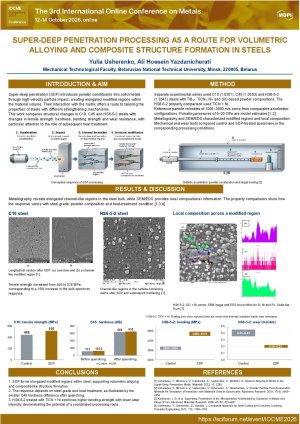
Conventional alloying technologies require significant amounts of alloying elements and energy. Super-deep penetration (SDP) provides an alternative route for introducing alloying elements directly into bulk steels through shock-wave-induced mass transfer and associated structural transformations.
High-velocity powder particle streams were accelerated to velocities of 1000–3000 m/s and introduced into steel targets under SDP conditions. The particle velocity range was based on earlier measurements for comparable SDP accelerator configurations. Pulsating pressure fields of 5–20 GPa were estimated using the established shock-wave model of SDP impact. Low-carbon C10 steel (EN 1.0301), medium-carbon C45 steel (DIN 1.0503), and high-speed steel HS6-5-2 (DIN 1.3343) were processed using TiB₂-, TiCN-, Ni-, and SiC-based powder compositions. Penetration depth was determined from metallographic cross-sections. SEM and EDS were used to characterize the modified regions and identify the distribution of introduced alloying elements. Hardness and wear resistance were evaluated.
Microstructural analysis revealed channel-like elements containing alloying constituents absent from the initial materials, consistent with deep mass transfer and volumetric alloying during SDP processing. The modified regions exhibited characteristics of fibre-reinforced composite structures. In C10 steel, tensile strength increased from 446 MPa to 516 MPa, while local strength values reached 931 MPa. In C45 steel, hardness increased from 113 HB to 125.5 HB and, after quenching at 840 °C, from 640 HB to 653 HB. In HS6-5-2 steel, SDP processing reduced wear intensity by 38–56%, depending on the powder composition. The TiCN+Ni composition produced the highest performance, increasing bending strength from 3820–3950 MPa to 4400–4570 MPa while reducing wear intensity from 0.35–0.45 to 0.18–0.22 mm/km.
The results suggest that SDP can provide volumetric alloying and promote formation of composite-like structures in steels. The observed improvements in strength, hardness, and wear resistance demonstrate the potential applicability of SDP processing to different classes of steels.
Keywords
Super-deep penetration
composite
powders
hardness
heat treatment
Poster
Usherenko IOCME 2026.pdf
Application of shot peening treatments for increasing the durability of hot-forged components
Numerical Simulation of Fluid Flow, Solidification and Casting Defects of a Gas Control Valve Produced by High-Pressure Die Casting