Event submissions
Published
This submission belongs to the session S6. Computational Metallurgy, AI, and Multiscale Modeling of the event The 3rd International Online Conference on Metals
Published date
08 Oct, 2026
Academic Editor
'%3e%3cpath%20d='M12.6657%2010.9104C12.4185%2010.325%2012.0599%209.79327%2011.6097%209.34482C11.1609%208.89508%2010.6293%208.5365%2010.0442%208.28888C10.0389%208.28626%2010.0337%208.28495%2010.0285%208.28233C10.8446%207.69279%2011.3752%206.73249%2011.3752%205.64904C11.3752%203.8542%209.92103%202.39999%208.1262%202.39999C6.33136%202.39999%204.87715%203.8542%204.87715%205.64904C4.87715%206.73249%205.40774%207.69279%206.22393%208.28364C6.21869%208.28626%206.21345%208.28757%206.20821%208.29019C5.62129%208.5378%205.09463%208.89284%204.64265%209.34613C4.1929%209.79493%203.83432%2010.3266%203.58671%2010.9117C3.34345%2011.4845%203.21226%2012.0987%203.20023%2012.7209C3.19988%2012.7349%203.20233%2012.7488%203.20744%2012.7619C3.21255%2012.7749%203.22022%2012.7867%203.22998%2012.7968C3.23975%2012.8068%203.25142%2012.8147%203.26431%2012.8202C3.2772%2012.8256%203.29105%2012.8284%203.30504%2012.8284H4.09109C4.14874%2012.8284%204.19459%2012.7825%204.1959%2012.7262C4.2221%2011.7148%204.62823%2010.7676%205.34617%2010.0497C6.08899%209.30683%207.0755%208.89808%208.1262%208.89808C9.17689%208.89808%2010.1634%209.30683%2010.9062%2010.0497C11.6242%2010.7676%2012.0303%2011.7148%2012.0565%2012.7262C12.0578%2012.7838%2012.1037%2012.8284%2012.1613%2012.8284H12.9474C12.9613%2012.8284%2012.9752%2012.8256%2012.9881%2012.8202C13.001%2012.8147%2013.0126%2012.8068%2013.0224%2012.7968C13.0322%2012.7867%2013.0398%2012.7749%2013.0449%2012.7619C13.0501%2012.7488%2013.0525%2012.7349%2013.0522%2012.7209C13.0391%2012.0947%2012.9094%2011.4855%2012.6657%2010.9104ZM8.1262%207.9024C7.52486%207.9024%206.9589%207.6679%206.53312%207.24211C6.10733%206.81633%205.87283%206.25037%205.87283%205.64904C5.87283%205.0477%206.10733%204.48174%206.53312%204.05596C6.9589%203.63018%207.52486%203.39567%208.1262%203.39567C8.72753%203.39567%209.29349%203.63018%209.71927%204.05596C10.1451%204.48174%2010.3796%205.0477%2010.3796%205.64904C10.3796%206.25037%2010.1451%206.81633%209.71927%207.24211C9.29349%207.6679%208.72753%207.9024%208.1262%207.9024Z'%20fill='%235D1EE1'/%3e%3c/g%3e%3c/svg%3e) Ernst Gamsjäger
Ernst GamsjägerCitation
Charalampos Tsaousis, Vasilis Loukadakis, Spyridon Papaefthymiou, Dislocation Density Prediction in Aluminum–Magnesium Alloys via Molecular Dynamics, in Proceedings of The 3rd International Online Conference on Metals, 12 October–14 October 2026, MDPI: Basel, Switzerland
Share
Email
Facebook
Twitter
LinkedIn
Dislocation Density Prediction in Aluminum–Magnesium Alloys via Molecular Dynamics
'%3e%3cpath%20d='M12.6647%2010.9104C12.4176%2010.325%2012.0589%209.7933%2011.6088%209.34485C11.16%208.89511%2010.6283%208.53653%2010.0432%208.28891C10.038%208.28629%2010.0327%208.28498%2010.0275%208.28236C10.8437%207.69282%2011.3743%206.73252%2011.3743%205.64907C11.3743%203.85423%209.92005%202.40002%208.12522%202.40002C6.33038%202.40002%204.87618%203.85423%204.87618%205.64907C4.87618%206.73252%205.40677%207.69282%206.22296%208.28367C6.21772%208.28629%206.21248%208.2876%206.20724%208.29022C5.62031%208.53783%205.09365%208.89287%204.64167%209.34616C4.19192%209.79496%203.83334%2010.3266%203.58573%2010.9117C3.34247%2011.4846%203.21128%2012.0987%203.19925%2012.721C3.1989%2012.735%203.20135%2012.7489%203.20646%2012.7619C3.21157%2012.7749%203.21924%2012.7868%203.22901%2012.7968C3.23877%2012.8068%203.25045%2012.8148%203.26334%2012.8202C3.27623%2012.8256%203.29007%2012.8284%203.30406%2012.8284H4.09012C4.14776%2012.8284%204.19362%2012.7825%204.19493%2012.7262C4.22113%2011.7148%204.62726%2010.7676%205.34519%2010.0497C6.08802%209.30686%207.07452%208.89811%208.12522%208.89811C9.17592%208.89811%2010.1624%209.30686%2010.9052%2010.0497C11.6232%2010.7676%2012.0293%2011.7148%2012.0555%2012.7262C12.0568%2012.7839%2012.1027%2012.8284%2012.1603%2012.8284H12.9464C12.9604%2012.8284%2012.9742%2012.8256%2012.9871%2012.8202C13%2012.8148%2013.0117%2012.8068%2013.0214%2012.7968C13.0312%2012.7868%2013.0389%2012.7749%2013.044%2012.7619C13.0491%2012.7489%2013.0515%2012.735%2013.0512%2012.721C13.0381%2012.0947%2012.9084%2011.4856%2012.6647%2010.9104ZM8.12522%207.90243C7.52388%207.90243%206.95792%207.66793%206.53214%207.24215C6.10636%206.81636%205.87185%206.2504%205.87185%205.64907C5.87185%205.04773%206.10636%204.48177%206.53214%204.05599C6.95792%203.63021%207.52388%203.3957%208.12522%203.3957C8.72655%203.3957%209.29252%203.63021%209.7183%204.05599C10.1441%204.48177%2010.3786%205.04773%2010.3786%205.64907C10.3786%206.2504%2010.1441%206.81636%209.7183%207.24215C9.29252%207.66793%208.72655%207.90243%208.12522%207.90243Z'%20fill='%235D1EE1'/%3e%3c/g%3e%3c/svg%3e)
Charalampos Tsaousis 1
Vasilis Loukadakis 2

Spyridon Papaefthymiou 2
1. MSc Programme in Computational Mechanics, School of Chemical Engineering, National Technical University of Athens, Athens, Greece
2. School of Mining and Metallurgical Engineering, National Technical University of Athens, Athens, Greece
Abstract
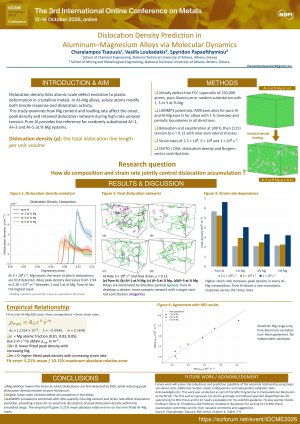
Dislocation density is a key microstructural quantity governing plastic deformation and the mechanical response of crystalline metals. In Al–Mg alloys, Mg addition modifies solute–dislocation interactions and therefore affects strengthening and defect evolution. Molecular dynamics simulations were performed to investigate the tensile response and dislocation-density evolution of pure Al and Al–Mg alloys under high-rate uniaxial loading.
Initially defect-free face-centered-cubic models containing 150,000 atoms were constructed for pure Al and Al–Mg alloys with 1, 3 and 5 at.% Mg, introduced through random substitution. Simulations were conducted in LAMMPS using the EAM/alloy Al99.eam.alloy potential for pure Al and the EAM/FS Al-Mg.eam.fs potential for the alloy systems. Periodic boundary conditions were applied in all directions, with a timestep of 1 fs. Following relaxation and equilibration at 300 K, the systems were subjected to uniaxial tension along [111] up to an engineering strain of 0.12 at strain rates of 2.5×10⁸, 5.0×10⁸ and 1.0×10⁹ s−1. Atomic trajectories were analyzed using the dislocation extraction algorithm in OVITO to quantify dislocation-density evolution and Burgers-vector contributions.
Mg addition significantly altered both mechanical response and defect evolution. Al–Mg alloys exhibited higher stresses than pure Al during the initial and intermediate deformation stages, consistent with solid-solution strengthening; however, maximum stress did not increase monotonically with Mg content, indicating competition among solute strengthening, defect nucleation and stress relaxation. Mg promoted earlier activation of detectable dislocation activity, whereas peak dislocation density remained lower in alloyed systems than in pure Al. Burgers-vector decomposition showed that Al–Mg alloys were dominated by Shockley partial dislocations, while pure Al developed a more complex network with a larger stair-rod contribution. An empirical relationship was finally established to describe the dependence of maximum dislocation density on Mg content and strain rate.
Overall, the combined MD–DXA framework effectively links alloy composition and loading conditions to the evolution of dislocation structures.
Keywords
Molecular dynamics simulations
Al-Mg alloys
Dislocation density evolution
Tensile deformation
Strain rate effects
Atomistic modelling
Computational metallurgy
Poster
IOCME2026_FINAL.pdf
Aluminum recovery from industrial spent catalyst
Laser Powder Bed Fusion of Ti-6Al-4V-TiC Composites: Processability and Microstructure Analysis