Event submissions
Published
This submission belongs to the session S5. Additive Manufacturing of the event The 3rd International Online Conference on Metals
Published date
08 Oct, 2026
Academic Editor
'%3e%3cpath%20d='M12.6657%2010.9104C12.4185%2010.325%2012.0599%209.79327%2011.6097%209.34482C11.1609%208.89508%2010.6293%208.5365%2010.0442%208.28888C10.0389%208.28626%2010.0337%208.28495%2010.0285%208.28233C10.8446%207.69279%2011.3752%206.73249%2011.3752%205.64904C11.3752%203.8542%209.92103%202.39999%208.1262%202.39999C6.33136%202.39999%204.87715%203.8542%204.87715%205.64904C4.87715%206.73249%205.40774%207.69279%206.22393%208.28364C6.21869%208.28626%206.21345%208.28757%206.20821%208.29019C5.62129%208.5378%205.09463%208.89284%204.64265%209.34613C4.1929%209.79493%203.83432%2010.3266%203.58671%2010.9117C3.34345%2011.4845%203.21226%2012.0987%203.20023%2012.7209C3.19988%2012.7349%203.20233%2012.7488%203.20744%2012.7619C3.21255%2012.7749%203.22022%2012.7867%203.22998%2012.7968C3.23975%2012.8068%203.25142%2012.8147%203.26431%2012.8202C3.2772%2012.8256%203.29105%2012.8284%203.30504%2012.8284H4.09109C4.14874%2012.8284%204.19459%2012.7825%204.1959%2012.7262C4.2221%2011.7148%204.62823%2010.7676%205.34617%2010.0497C6.08899%209.30683%207.0755%208.89808%208.1262%208.89808C9.17689%208.89808%2010.1634%209.30683%2010.9062%2010.0497C11.6242%2010.7676%2012.0303%2011.7148%2012.0565%2012.7262C12.0578%2012.7838%2012.1037%2012.8284%2012.1613%2012.8284H12.9474C12.9613%2012.8284%2012.9752%2012.8256%2012.9881%2012.8202C13.001%2012.8147%2013.0126%2012.8068%2013.0224%2012.7968C13.0322%2012.7867%2013.0398%2012.7749%2013.0449%2012.7619C13.0501%2012.7488%2013.0525%2012.7349%2013.0522%2012.7209C13.0391%2012.0947%2012.9094%2011.4855%2012.6657%2010.9104ZM8.1262%207.9024C7.52486%207.9024%206.9589%207.6679%206.53312%207.24211C6.10733%206.81633%205.87283%206.25037%205.87283%205.64904C5.87283%205.0477%206.10733%204.48174%206.53312%204.05596C6.9589%203.63018%207.52486%203.39567%208.1262%203.39567C8.72753%203.39567%209.29349%203.63018%209.71927%204.05596C10.1451%204.48174%2010.3796%205.0477%2010.3796%205.64904C10.3796%206.25037%2010.1451%206.81633%209.71927%207.24211C9.29349%207.6679%208.72753%207.9024%208.1262%207.9024Z'%20fill='%235D1EE1'/%3e%3c/g%3e%3c/svg%3e) Antonio Riveiro Rodriguez
Antonio Riveiro RodriguezCitation
Omid Rezaei, Amir Behjat, Mohammad Taghian Todeshki, Mahta Khorramian, Reza Ghanavati, Luca Iuliano, Abdollah Saboori, Laser Powder Bed Fusion of Ti-6Al-4V-TiC Composites: Processability and Microstructure Analysis, in Proceedings of The 3rd International Online Conference on Metals, 12 October–14 October 2026, MDPI: Basel, Switzerland
Share
Email
Facebook
Twitter
LinkedIn
Laser Powder Bed Fusion of Ti-6Al-4V-TiC Composites: Processability and Microstructure Analysis
'%3e%3cpath%20d='M12.6647%2010.9104C12.4176%2010.325%2012.0589%209.7933%2011.6088%209.34485C11.16%208.89511%2010.6283%208.53653%2010.0432%208.28891C10.038%208.28629%2010.0327%208.28498%2010.0275%208.28236C10.8437%207.69282%2011.3743%206.73252%2011.3743%205.64907C11.3743%203.85423%209.92005%202.40002%208.12522%202.40002C6.33038%202.40002%204.87618%203.85423%204.87618%205.64907C4.87618%206.73252%205.40677%207.69282%206.22296%208.28367C6.21772%208.28629%206.21248%208.2876%206.20724%208.29022C5.62031%208.53783%205.09365%208.89287%204.64167%209.34616C4.19192%209.79496%203.83334%2010.3266%203.58573%2010.9117C3.34247%2011.4846%203.21128%2012.0987%203.19925%2012.721C3.1989%2012.735%203.20135%2012.7489%203.20646%2012.7619C3.21157%2012.7749%203.21924%2012.7868%203.22901%2012.7968C3.23877%2012.8068%203.25045%2012.8148%203.26334%2012.8202C3.27623%2012.8256%203.29007%2012.8284%203.30406%2012.8284H4.09012C4.14776%2012.8284%204.19362%2012.7825%204.19493%2012.7262C4.22113%2011.7148%204.62726%2010.7676%205.34519%2010.0497C6.08802%209.30686%207.07452%208.89811%208.12522%208.89811C9.17592%208.89811%2010.1624%209.30686%2010.9052%2010.0497C11.6232%2010.7676%2012.0293%2011.7148%2012.0555%2012.7262C12.0568%2012.7839%2012.1027%2012.8284%2012.1603%2012.8284H12.9464C12.9604%2012.8284%2012.9742%2012.8256%2012.9871%2012.8202C13%2012.8148%2013.0117%2012.8068%2013.0214%2012.7968C13.0312%2012.7868%2013.0389%2012.7749%2013.044%2012.7619C13.0491%2012.7489%2013.0515%2012.735%2013.0512%2012.721C13.0381%2012.0947%2012.9084%2011.4856%2012.6647%2010.9104ZM8.12522%207.90243C7.52388%207.90243%206.95792%207.66793%206.53214%207.24215C6.10636%206.81636%205.87185%206.2504%205.87185%205.64907C5.87185%205.04773%206.10636%204.48177%206.53214%204.05599C6.95792%203.63021%207.52388%203.3957%208.12522%203.3957C8.72655%203.3957%209.29252%203.63021%209.7183%204.05599C10.1441%204.48177%2010.3786%205.04773%2010.3786%205.64907C10.3786%206.2504%2010.1441%206.81636%209.7183%207.24215C9.29252%207.66793%208.72655%207.90243%208.12522%207.90243Z'%20fill='%235D1EE1'/%3e%3c/g%3e%3c/svg%3e)
Omid Rezaei 1
Amir Behjat 2
Mohammad Taghian Todeshki 2
Mahta Khorramian 2
Reza Ghanavati 2

Luca Iuliano 2

Abdollah Saboori 2
1. Department of Applied Sciecne and Technology, Politecnico di Torino, Corso Duca degli Abruzzi 24, 1029, Torino, Italy
2. Department of Management and Production Engineering, Politecnico di Torino, Corso Duca degli Abruzzi 24, 10129 Torino, Italy
Abstract
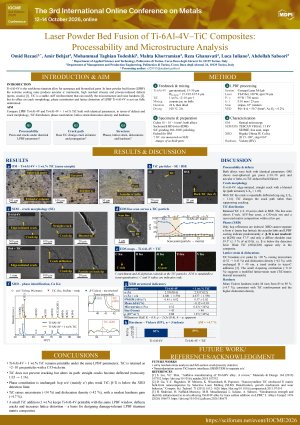
Ti-6Al-4V is a widely used titanium alloy for aerospace and biomedical applications, yet its susceptibility to cracking and defect formation during Laser Powder Bed Fusion (LPBF) remains a critical limitation. Although TiC-reinforced Ti-6Al-4V composites have been reported previously, the effect of TiC addition on printability, crack formation, crack morphology, and residual stress development is still not fully understood.
In this work, Ti-6Al-4V powder was blended with 1 wt.% TiC particles and processed by LPBF under identical conditions to those used for the unreinforced alloy. The printability of the material was evaluated by examining defect formation and cracking behavior, while the microstructure was characterized using optical microscopy and scanning electron microscopy. Crack size, morphology, and distribution were compared between the composite and the reference Ti-6Al-4V samples to clarify the role of TiC in crack initiation and propagation. X-ray diffraction was employed to assess phase evolution and residual stress, and nanoindentation was used to investigate local mechanical response in the matrix and near TiC-containing regions.
The results show that TiC addition modifies the cracking behavior of Ti-6Al-4V during LPBF, influencing both crack morphology and characteristic crack dimensions. The observed cracking is associated with local stress concentration, microstructural heterogeneity, and residual stress accumulation, indicating that the reinforcement changes the damage evolution pathway rather than only increasing hardness. At the same time, the composite remains printable under the selected LPBF conditions, demonstrating that limited TiC addition can be incorporated without compromising buildability.
This study provides a mechanistic understanding of the relationship between TiC reinforcement, residual stress, crack formation, and processability in LPBF-fabricated Ti-6Al-4V composites, offering practical guidance for the development of damage-tolerant titanium matrix materials.
Keywords
additive manufacturing
laser powder bed fusion
Ti-6Al-4V
Tic
process optimization
materials characterization
Poster
IOCME2026_Rezaei_Ti6Al4V-TiC_Poster_edited.pdf
Dislocation Density Prediction in Aluminum–Magnesium Alloys via Molecular Dynamics
Influence of Strain Hardening and Precipitation Sequences on the Mechanical and Electrical Properties of Al-Mg-Si Alloy Wires