Event submissions
Published
This submission belongs to the session S1. Design and Characterization of Novel Metallic Materials of the event The 3rd International Online Conference on Metals
Published date
08 Oct, 2026
Academic Editor
'%3e%3cpath%20d='M12.6657%2010.9104C12.4185%2010.325%2012.0599%209.79327%2011.6097%209.34482C11.1609%208.89508%2010.6293%208.5365%2010.0442%208.28888C10.0389%208.28626%2010.0337%208.28495%2010.0285%208.28233C10.8446%207.69279%2011.3752%206.73249%2011.3752%205.64904C11.3752%203.8542%209.92103%202.39999%208.1262%202.39999C6.33136%202.39999%204.87715%203.8542%204.87715%205.64904C4.87715%206.73249%205.40774%207.69279%206.22393%208.28364C6.21869%208.28626%206.21345%208.28757%206.20821%208.29019C5.62129%208.5378%205.09463%208.89284%204.64265%209.34613C4.1929%209.79493%203.83432%2010.3266%203.58671%2010.9117C3.34345%2011.4845%203.21226%2012.0987%203.20023%2012.7209C3.19988%2012.7349%203.20233%2012.7488%203.20744%2012.7619C3.21255%2012.7749%203.22022%2012.7867%203.22998%2012.7968C3.23975%2012.8068%203.25142%2012.8147%203.26431%2012.8202C3.2772%2012.8256%203.29105%2012.8284%203.30504%2012.8284H4.09109C4.14874%2012.8284%204.19459%2012.7825%204.1959%2012.7262C4.2221%2011.7148%204.62823%2010.7676%205.34617%2010.0497C6.08899%209.30683%207.0755%208.89808%208.1262%208.89808C9.17689%208.89808%2010.1634%209.30683%2010.9062%2010.0497C11.6242%2010.7676%2012.0303%2011.7148%2012.0565%2012.7262C12.0578%2012.7838%2012.1037%2012.8284%2012.1613%2012.8284H12.9474C12.9613%2012.8284%2012.9752%2012.8256%2012.9881%2012.8202C13.001%2012.8147%2013.0126%2012.8068%2013.0224%2012.7968C13.0322%2012.7867%2013.0398%2012.7749%2013.0449%2012.7619C13.0501%2012.7488%2013.0525%2012.7349%2013.0522%2012.7209C13.0391%2012.0947%2012.9094%2011.4855%2012.6657%2010.9104ZM8.1262%207.9024C7.52486%207.9024%206.9589%207.6679%206.53312%207.24211C6.10733%206.81633%205.87283%206.25037%205.87283%205.64904C5.87283%205.0477%206.10733%204.48174%206.53312%204.05596C6.9589%203.63018%207.52486%203.39567%208.1262%203.39567C8.72753%203.39567%209.29349%203.63018%209.71927%204.05596C10.1451%204.48174%2010.3796%205.0477%2010.3796%205.64904C10.3796%206.25037%2010.1451%206.81633%209.71927%207.24211C9.29349%207.6679%208.72753%207.9024%208.1262%207.9024Z'%20fill='%235D1EE1'/%3e%3c/g%3e%3c/svg%3e) Eric Hug
Eric HugCitation
Olta Çakaj, Eleni Zaimi, David Agolli, Toni Shiroka, Eranda Gjeçi, PCA of portable XRF data uncovers compositional trends in Illyrian bronze weaponry from Albania, in Proceedings of The 3rd International Online Conference on Metals, 12 October–14 October 2026, MDPI: Basel, Switzerland
Share
Email
Facebook
Twitter
LinkedIn
PCA of portable XRF data uncovers compositional trends in Illyrian bronze weaponry from Albania
'%3e%3cpath%20d='M12.6647%2010.9104C12.4176%2010.325%2012.0589%209.7933%2011.6088%209.34485C11.16%208.89511%2010.6283%208.53653%2010.0432%208.28891C10.038%208.28629%2010.0327%208.28498%2010.0275%208.28236C10.8437%207.69282%2011.3743%206.73252%2011.3743%205.64907C11.3743%203.85423%209.92005%202.40002%208.12522%202.40002C6.33038%202.40002%204.87618%203.85423%204.87618%205.64907C4.87618%206.73252%205.40677%207.69282%206.22296%208.28367C6.21772%208.28629%206.21248%208.2876%206.20724%208.29022C5.62031%208.53783%205.09365%208.89287%204.64167%209.34616C4.19192%209.79496%203.83334%2010.3266%203.58573%2010.9117C3.34247%2011.4846%203.21128%2012.0987%203.19925%2012.721C3.1989%2012.735%203.20135%2012.7489%203.20646%2012.7619C3.21157%2012.7749%203.21924%2012.7868%203.22901%2012.7968C3.23877%2012.8068%203.25045%2012.8148%203.26334%2012.8202C3.27623%2012.8256%203.29007%2012.8284%203.30406%2012.8284H4.09012C4.14776%2012.8284%204.19362%2012.7825%204.19493%2012.7262C4.22113%2011.7148%204.62726%2010.7676%205.34519%2010.0497C6.08802%209.30686%207.07452%208.89811%208.12522%208.89811C9.17592%208.89811%2010.1624%209.30686%2010.9052%2010.0497C11.6232%2010.7676%2012.0293%2011.7148%2012.0555%2012.7262C12.0568%2012.7839%2012.1027%2012.8284%2012.1603%2012.8284H12.9464C12.9604%2012.8284%2012.9742%2012.8256%2012.9871%2012.8202C13%2012.8148%2013.0117%2012.8068%2013.0214%2012.7968C13.0312%2012.7868%2013.0389%2012.7749%2013.044%2012.7619C13.0491%2012.7489%2013.0515%2012.735%2013.0512%2012.721C13.0381%2012.0947%2012.9084%2011.4856%2012.6647%2010.9104ZM8.12522%207.90243C7.52388%207.90243%206.95792%207.66793%206.53214%207.24215C6.10636%206.81636%205.87185%206.2504%205.87185%205.64907C5.87185%205.04773%206.10636%204.48177%206.53214%204.05599C6.95792%203.63021%207.52388%203.3957%208.12522%203.3957C8.72655%203.3957%209.29252%203.63021%209.7183%204.05599C10.1441%204.48177%2010.3786%205.04773%2010.3786%205.64907C10.3786%206.2504%2010.1441%206.81636%209.7183%207.24215C9.29252%207.66793%208.72655%207.90243%208.12522%207.90243Z'%20fill='%235D1EE1'/%3e%3c/g%3e%3c/svg%3e)
Olta Çakaj 1
Eleni Zaimi 1
David Agolli 1
Toni Shiroka 2
Eranda Gjeçi 1
1. University of Tirana, Tiranë 1010, Albania
2. ETH Zürich, Tiranë 1010, Albania
Abstract
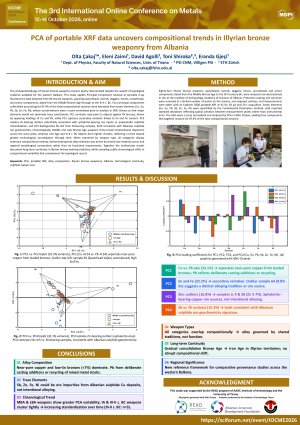
The archaeometallurgy of Illyrian bronze weapons remains poorly documented despite the wealth of typological evidence available for the western Balkans. This study applies Principal Component Analysis to portable X-ray fluorescence data obtained from 84 bronze weapons, spanning spearheads, swords, daggers, knives, arrowheads, and armor components, dated from the Middle Bronze Age through to the 3rd-2nd c. BC. Four principal components collectively accounting for 87.4% of the total compositional variance were extracted from seven elements (Cu, Sn, Pb, Sb, Zn, Fe, Ni), whose concentrations were log-ratio transformed following Aitchison's compositional framework (Cu retained despite closure effects given its interpretive significance across the assemblage), with below-detection-limit values substituted by half the minimum detected value and all variables standardized to unit variance to prevent major elements from dominating trace constituents. PC1 contrasts near-pure Cu objects against Pb bronzes, driven by opposing loadings of Cu and Pb, while PC2 captures secondary variation linked to Sn and Fe content. PC3 isolates Zn-bearing outliers potentially associated with sphalerite-bearing ore inputs or polymetallic sulphide mineralization, and PC4 distinguishes Sb-rich from Ni-bearing samples, both consistent with Albanian sulphide ore geochemistry. Chronologically, Middle and Late Bronze Age weapons show broad compositional dispersion across the score plots, whereas Iron Age and 3rd-2nd c. BC objects form tighter clusters, reflecting a trend toward greater technological consolidation through time. When examined by weapon type, all categories display extensive compositional overlap, demonstrating that alloy selection was driven by shared raw material access and regional metallurgical conventions rather than by functional requirements. Together, the multivariate results document long-term continuity in Illyrian bronze-working traditions while revealing subtle chronological shifts in compositional variability that complement the typological record.
Keywords
Principal Component Analysis
portable XRF
alloy composition
Illyrian bronze weaponry
Albania
technological continuity
sulphide copper ores
Poster
IOCME_Poster_Olta Çakaj et al.pdf
Directionally solidified Al-Si-Mg alloys
Physics-Based Predictive Modeling of Fatigue Crack Propagation Using Strain Field Analytics in Aeronautical Fuselage Aluminum Structures