Event submissions
Published
This submission belongs to the session S6. Computational Metallurgy, AI, and Multiscale Modeling of the event The 3rd International Online Conference on Metals
Published date
08 Oct, 2026
Academic Editor
'%3e%3cpath%20d='M12.6657%2010.9104C12.4185%2010.325%2012.0599%209.79327%2011.6097%209.34482C11.1609%208.89508%2010.6293%208.5365%2010.0442%208.28888C10.0389%208.28626%2010.0337%208.28495%2010.0285%208.28233C10.8446%207.69279%2011.3752%206.73249%2011.3752%205.64904C11.3752%203.8542%209.92103%202.39999%208.1262%202.39999C6.33136%202.39999%204.87715%203.8542%204.87715%205.64904C4.87715%206.73249%205.40774%207.69279%206.22393%208.28364C6.21869%208.28626%206.21345%208.28757%206.20821%208.29019C5.62129%208.5378%205.09463%208.89284%204.64265%209.34613C4.1929%209.79493%203.83432%2010.3266%203.58671%2010.9117C3.34345%2011.4845%203.21226%2012.0987%203.20023%2012.7209C3.19988%2012.7349%203.20233%2012.7488%203.20744%2012.7619C3.21255%2012.7749%203.22022%2012.7867%203.22998%2012.7968C3.23975%2012.8068%203.25142%2012.8147%203.26431%2012.8202C3.2772%2012.8256%203.29105%2012.8284%203.30504%2012.8284H4.09109C4.14874%2012.8284%204.19459%2012.7825%204.1959%2012.7262C4.2221%2011.7148%204.62823%2010.7676%205.34617%2010.0497C6.08899%209.30683%207.0755%208.89808%208.1262%208.89808C9.17689%208.89808%2010.1634%209.30683%2010.9062%2010.0497C11.6242%2010.7676%2012.0303%2011.7148%2012.0565%2012.7262C12.0578%2012.7838%2012.1037%2012.8284%2012.1613%2012.8284H12.9474C12.9613%2012.8284%2012.9752%2012.8256%2012.9881%2012.8202C13.001%2012.8147%2013.0126%2012.8068%2013.0224%2012.7968C13.0322%2012.7867%2013.0398%2012.7749%2013.0449%2012.7619C13.0501%2012.7488%2013.0525%2012.7349%2013.0522%2012.7209C13.0391%2012.0947%2012.9094%2011.4855%2012.6657%2010.9104ZM8.1262%207.9024C7.52486%207.9024%206.9589%207.6679%206.53312%207.24211C6.10733%206.81633%205.87283%206.25037%205.87283%205.64904C5.87283%205.0477%206.10733%204.48174%206.53312%204.05596C6.9589%203.63018%207.52486%203.39567%208.1262%203.39567C8.72753%203.39567%209.29349%203.63018%209.71927%204.05596C10.1451%204.48174%2010.3796%205.0477%2010.3796%205.64904C10.3796%206.25037%2010.1451%206.81633%209.71927%207.24211C9.29349%207.6679%208.72753%207.9024%208.1262%207.9024Z'%20fill='%235D1EE1'/%3e%3c/g%3e%3c/svg%3e) Ernst Gamsjäger
Ernst GamsjägerCitation
Diego Vergara, Antonio del Bosque, Javier Velasco, Jonatan Pradanas, Physics-Based Predictive Modeling of Fatigue Crack Propagation Using Strain Field Analytics in Aeronautical Fuselage Aluminum Structures, in Proceedings of The 3rd International Online Conference on Metals, 12 October–14 October 2026, MDPI: Basel, Switzerland
Share
Email
Facebook
Twitter
LinkedIn
Physics-Based Predictive Modeling of Fatigue Crack Propagation Using Strain Field Analytics in Aeronautical Fuselage Aluminum Structures

Diego Vergara 1

Antonio del Bosque 2
'%3e%3cpath%20d='M12.6647%2010.9104C12.4176%2010.325%2012.0589%209.7933%2011.6088%209.34485C11.16%208.89511%2010.6283%208.53653%2010.0432%208.28891C10.038%208.28629%2010.0327%208.28498%2010.0275%208.28236C10.8437%207.69282%2011.3743%206.73252%2011.3743%205.64907C11.3743%203.85423%209.92005%202.40002%208.12522%202.40002C6.33038%202.40002%204.87618%203.85423%204.87618%205.64907C4.87618%206.73252%205.40677%207.69282%206.22296%208.28367C6.21772%208.28629%206.21248%208.2876%206.20724%208.29022C5.62031%208.53783%205.09365%208.89287%204.64167%209.34616C4.19192%209.79496%203.83334%2010.3266%203.58573%2010.9117C3.34247%2011.4846%203.21128%2012.0987%203.19925%2012.721C3.1989%2012.735%203.20135%2012.7489%203.20646%2012.7619C3.21157%2012.7749%203.21924%2012.7868%203.22901%2012.7968C3.23877%2012.8068%203.25045%2012.8148%203.26334%2012.8202C3.27623%2012.8256%203.29007%2012.8284%203.30406%2012.8284H4.09012C4.14776%2012.8284%204.19362%2012.7825%204.19493%2012.7262C4.22113%2011.7148%204.62726%2010.7676%205.34519%2010.0497C6.08802%209.30686%207.07452%208.89811%208.12522%208.89811C9.17592%208.89811%2010.1624%209.30686%2010.9052%2010.0497C11.6232%2010.7676%2012.0293%2011.7148%2012.0555%2012.7262C12.0568%2012.7839%2012.1027%2012.8284%2012.1603%2012.8284H12.9464C12.9604%2012.8284%2012.9742%2012.8256%2012.9871%2012.8202C13%2012.8148%2013.0117%2012.8068%2013.0214%2012.7968C13.0312%2012.7868%2013.0389%2012.7749%2013.044%2012.7619C13.0491%2012.7489%2013.0515%2012.735%2013.0512%2012.721C13.0381%2012.0947%2012.9084%2011.4856%2012.6647%2010.9104ZM8.12522%207.90243C7.52388%207.90243%206.95792%207.66793%206.53214%207.24215C6.10636%206.81636%205.87185%206.2504%205.87185%205.64907C5.87185%205.04773%206.10636%204.48177%206.53214%204.05599C6.95792%203.63021%207.52388%203.3957%208.12522%203.3957C8.72655%203.3957%209.29252%203.63021%209.7183%204.05599C10.1441%204.48177%2010.3786%205.04773%2010.3786%205.64907C10.3786%206.2504%2010.1441%206.81636%209.7183%207.24215C9.29252%207.66793%208.72655%207.90243%208.12522%207.90243Z'%20fill='%235D1EE1'/%3e%3c/g%3e%3c/svg%3e)
Javier Velasco 3
Jonatan Pradanas 4
1. Technology, Instruction and Design in Engineering and Education Research Group (TiDEE.rg), Catholic University of Ávila, C/Canteros, s/n, 05005 Ávila, Spain
2. Technology, Instruction and Design in Engineering and Education Research Group (TiDEE.rg), Catholic University of Ávila, C/Canteros s/n, 05005 Ávila, Spain
3. Satlantis Microsats SA, Parque Científico, Campus UPV Bizkaia, 48940 Leioa, Spain
4. Aeronautical Technologies Center Foundation (CTA), C/Juan de la Cierva 1, 01510 Miñano Vitoria, Spain
Abstract
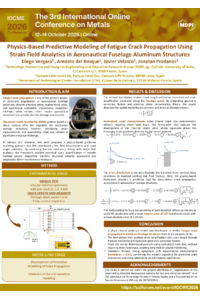
Introduction: Predictive modeling of fatigue crack propagation in metallic structures is essential for structural integrity assessment and prognostics-driven maintenance in aerospace systems. While sensing technologies enable damage detection, the translation of strain measurements into quantitative crack size remains a major analytical challenge. This work presents a physics-based modeling framework aimed at deriving an explicit analytical relationship between distributed strain fields and crack length evolution in aeronautical aluminum components.
Methods: A novel analytical formulation was developed grounded in Linear Fracture Mechanics and stress concentration theory. The model describes crack-tip stress redistribution and its spatial decay along the structure, enabling strain estimation at discrete sensor locations. By incorporating geometric correction factors, gauge positioning, and nominal strain normalization, the formulation allows crack length to be solved as an inverse problem without requiring direct load input. The resulting equation establishes a closed-form relationship linking localized strain amplification to crack size. Experimental fatigue datasets obtained from instrumented aluminum 6082-T6 specimens were used exclusively for calibration and validation purposes, alongside independent non-destructive crack measurements.
Results: The predictive formulation demonstrated strong capability to reconstruct crack growth trajectories under different fatigue loading scenarios. High correlation was achieved between analytically predicted and experimentally measured crack lengths, with coefficients above 0.97. The model captured strain concentration gradients associated with crack propagation and maintained millimetric accuracy across most of the growth regime, with deviations primarily linked to sensor spacing effects.
Conclusions: The proposed model provides a robust analytical tool for strain-based crack quantification in metallic structures. The load-independent formulation, reduced sensing requirements, and compatibility with computational implementation position it as a scalable approach for digital twins, prognostics, and multiscale structural integrity modeling in advanced aerospace applications.
Keywords
Aluminum alloys
Predictive modeling
Fatigue crack propagation
Strain field analytics
Structural health monitoring
Aeronautical fuselage structures
Fracture mechanics
Crack length estimation
Poster
IOCME2026. Physics-Based Predictive Modeling of Fatigue Crack.pdf
PCA of portable XRF data uncovers compositional trends in Illyrian bronze weaponry from Albania
A Study of a Normalized Natural Frequency Strategy for Localization and Quantification of Defects and Material Degradation in Fixed–Fixed Metal Beam Structures