Event submissions
Published
This submission belongs to the session S6. Computational Metallurgy, AI, and Multiscale Modeling of the event The 3rd International Online Conference on Metals
Published date
08 Oct, 2026
Academic Editor
'%3e%3cpath%20d='M12.6657%2010.9104C12.4185%2010.325%2012.0599%209.79327%2011.6097%209.34482C11.1609%208.89508%2010.6293%208.5365%2010.0442%208.28888C10.0389%208.28626%2010.0337%208.28495%2010.0285%208.28233C10.8446%207.69279%2011.3752%206.73249%2011.3752%205.64904C11.3752%203.8542%209.92103%202.39999%208.1262%202.39999C6.33136%202.39999%204.87715%203.8542%204.87715%205.64904C4.87715%206.73249%205.40774%207.69279%206.22393%208.28364C6.21869%208.28626%206.21345%208.28757%206.20821%208.29019C5.62129%208.5378%205.09463%208.89284%204.64265%209.34613C4.1929%209.79493%203.83432%2010.3266%203.58671%2010.9117C3.34345%2011.4845%203.21226%2012.0987%203.20023%2012.7209C3.19988%2012.7349%203.20233%2012.7488%203.20744%2012.7619C3.21255%2012.7749%203.22022%2012.7867%203.22998%2012.7968C3.23975%2012.8068%203.25142%2012.8147%203.26431%2012.8202C3.2772%2012.8256%203.29105%2012.8284%203.30504%2012.8284H4.09109C4.14874%2012.8284%204.19459%2012.7825%204.1959%2012.7262C4.2221%2011.7148%204.62823%2010.7676%205.34617%2010.0497C6.08899%209.30683%207.0755%208.89808%208.1262%208.89808C9.17689%208.89808%2010.1634%209.30683%2010.9062%2010.0497C11.6242%2010.7676%2012.0303%2011.7148%2012.0565%2012.7262C12.0578%2012.7838%2012.1037%2012.8284%2012.1613%2012.8284H12.9474C12.9613%2012.8284%2012.9752%2012.8256%2012.9881%2012.8202C13.001%2012.8147%2013.0126%2012.8068%2013.0224%2012.7968C13.0322%2012.7867%2013.0398%2012.7749%2013.0449%2012.7619C13.0501%2012.7488%2013.0525%2012.7349%2013.0522%2012.7209C13.0391%2012.0947%2012.9094%2011.4855%2012.6657%2010.9104ZM8.1262%207.9024C7.52486%207.9024%206.9589%207.6679%206.53312%207.24211C6.10733%206.81633%205.87283%206.25037%205.87283%205.64904C5.87283%205.0477%206.10733%204.48174%206.53312%204.05596C6.9589%203.63018%207.52486%203.39567%208.1262%203.39567C8.72753%203.39567%209.29349%203.63018%209.71927%204.05596C10.1451%204.48174%2010.3796%205.0477%2010.3796%205.64904C10.3796%206.25037%2010.1451%206.81633%209.71927%207.24211C9.29349%207.6679%208.72753%207.9024%208.1262%207.9024Z'%20fill='%235D1EE1'/%3e%3c/g%3e%3c/svg%3e) Ernst Gamsjäger
Ernst GamsjägerCitation
hozaifah shahadat ali, Costanzo Bellini, Numerical Investigation and Sensitivity Analysis of Koistinen–Marburger Model Parameters for Martensitic Transformation Kinetics in SAE 9254 Spring Steel, in Proceedings of The 3rd International Online Conference on Metals, 12 October–14 October 2026, MDPI: Basel, Switzerland
Share
Email
Facebook
Twitter
LinkedIn
Numerical Investigation and Sensitivity Analysis of Koistinen–Marburger Model Parameters for Martensitic Transformation Kinetics in SAE 9254 Spring Steel
'%3e%3cpath%20d='M12.6647%2010.9104C12.4176%2010.325%2012.0589%209.7933%2011.6088%209.34485C11.16%208.89511%2010.6283%208.53653%2010.0432%208.28891C10.038%208.28629%2010.0327%208.28498%2010.0275%208.28236C10.8437%207.69282%2011.3743%206.73252%2011.3743%205.64907C11.3743%203.85423%209.92005%202.40002%208.12522%202.40002C6.33038%202.40002%204.87618%203.85423%204.87618%205.64907C4.87618%206.73252%205.40677%207.69282%206.22296%208.28367C6.21772%208.28629%206.21248%208.2876%206.20724%208.29022C5.62031%208.53783%205.09365%208.89287%204.64167%209.34616C4.19192%209.79496%203.83334%2010.3266%203.58573%2010.9117C3.34247%2011.4846%203.21128%2012.0987%203.19925%2012.721C3.1989%2012.735%203.20135%2012.7489%203.20646%2012.7619C3.21157%2012.7749%203.21924%2012.7868%203.22901%2012.7968C3.23877%2012.8068%203.25045%2012.8148%203.26334%2012.8202C3.27623%2012.8256%203.29007%2012.8284%203.30406%2012.8284H4.09012C4.14776%2012.8284%204.19362%2012.7825%204.19493%2012.7262C4.22113%2011.7148%204.62726%2010.7676%205.34519%2010.0497C6.08802%209.30686%207.07452%208.89811%208.12522%208.89811C9.17592%208.89811%2010.1624%209.30686%2010.9052%2010.0497C11.6232%2010.7676%2012.0293%2011.7148%2012.0555%2012.7262C12.0568%2012.7839%2012.1027%2012.8284%2012.1603%2012.8284H12.9464C12.9604%2012.8284%2012.9742%2012.8256%2012.9871%2012.8202C13%2012.8148%2013.0117%2012.8068%2013.0214%2012.7968C13.0312%2012.7868%2013.0389%2012.7749%2013.044%2012.7619C13.0491%2012.7489%2013.0515%2012.735%2013.0512%2012.721C13.0381%2012.0947%2012.9084%2011.4856%2012.6647%2010.9104ZM8.12522%207.90243C7.52388%207.90243%206.95792%207.66793%206.53214%207.24215C6.10636%206.81636%205.87185%206.2504%205.87185%205.64907C5.87185%205.04773%206.10636%204.48177%206.53214%204.05599C6.95792%203.63021%207.52388%203.3957%208.12522%203.3957C8.72655%203.3957%209.29252%203.63021%209.7183%204.05599C10.1441%204.48177%2010.3786%205.04773%2010.3786%205.64907C10.3786%206.2504%2010.1441%206.81636%209.7183%207.24215C9.29252%207.66793%208.72655%207.90243%208.12522%207.90243Z'%20fill='%235D1EE1'/%3e%3c/g%3e%3c/svg%3e)
hozaifah shahadat ali 1
Costanzo Bellini 1
1. Department of Civil and Mechanical Engineering, University of Cassino and Southern Lazio, 03043 Cassino, Italy
Abstract
The sensitivity of the Koistinen–Marburger (KM) model parameters governing the martensitic transformation kinetics in SAE 9254 spring steel was systematically investigated using a finite element approach. A transient thermal model was developed in ANSYS Workbench to simulate the quenching of cylindrical specimens under two industrially relevant cooling protocols: single-step cooling at 40 °C/s) and two-step cooling (20 °C/s followed by 1 °C/s). The slower second stage was designed to promote bainite formation prior to the martensitic transformation. The simulated temperature–time profiles were validated against published dilatometric data, with deviations remaining below 10%. A structured parametric sensitivity analysis was carried out by varying the fitted transformation start temperature Tₖₘ by ±10 °C and the rate parameter α by approximately ±10% across austenitising temperatures ranging from 850 to 1050 °C. The results demonstrate that Tₖₘ governs the onset of the martensitic transformation, shifting the martensite fraction curve along the temperature axis without altering its shape. In contrast, α controls the steepness and rate of transformation without affecting the initiation temperature. In all cases examined, the final martensite fraction exceeded 0.99, indicating a low sensitivity of transformation completeness within the parameter ranges investigated. A clear distinction between the two cooling strategies was observed: α values under two-step cooling (0.0499–0.0985 K⁻¹) were considerably higher than those under single-step cooling (0.0283–0.0443 K⁻¹), which can be attributed to the reduced stability of the remaining austenite following bainite formation. These findings confirm the decoupled roles of the KM parameters and their dependence on prior thermal history. The proposed computational framework provides an efficient tool for evaluating the sensitivity of transformation parameters and supporting the optimisation of industrial heat treatment processes.
Keywords
Martensitic transformation
Koistinen–Marburger model
sensitivity analysis
SAE 9254
spring steel
finite element simulation
ANSYS
quenching
bainite
heat treatment optimization
Poster
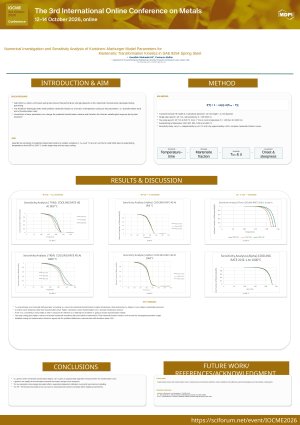
IOCME_Poster_Hozaifah_SAE9254.pdf
Metal-Based Biomimetic Sensors
Dissimilar gas tungsten arc welding of a a nearly eutectic AlCoCrFeNi high-entropy alloy to 316L stainless steel