Event submissions
Published
This submission belongs to the session S5. Additive Manufacturing of the event The 3rd International Online Conference on Metals
Published date
08 Oct, 2026
Academic Editor
'%3e%3cpath%20d='M12.6657%2010.9104C12.4185%2010.325%2012.0599%209.79327%2011.6097%209.34482C11.1609%208.89508%2010.6293%208.5365%2010.0442%208.28888C10.0389%208.28626%2010.0337%208.28495%2010.0285%208.28233C10.8446%207.69279%2011.3752%206.73249%2011.3752%205.64904C11.3752%203.8542%209.92103%202.39999%208.1262%202.39999C6.33136%202.39999%204.87715%203.8542%204.87715%205.64904C4.87715%206.73249%205.40774%207.69279%206.22393%208.28364C6.21869%208.28626%206.21345%208.28757%206.20821%208.29019C5.62129%208.5378%205.09463%208.89284%204.64265%209.34613C4.1929%209.79493%203.83432%2010.3266%203.58671%2010.9117C3.34345%2011.4845%203.21226%2012.0987%203.20023%2012.7209C3.19988%2012.7349%203.20233%2012.7488%203.20744%2012.7619C3.21255%2012.7749%203.22022%2012.7867%203.22998%2012.7968C3.23975%2012.8068%203.25142%2012.8147%203.26431%2012.8202C3.2772%2012.8256%203.29105%2012.8284%203.30504%2012.8284H4.09109C4.14874%2012.8284%204.19459%2012.7825%204.1959%2012.7262C4.2221%2011.7148%204.62823%2010.7676%205.34617%2010.0497C6.08899%209.30683%207.0755%208.89808%208.1262%208.89808C9.17689%208.89808%2010.1634%209.30683%2010.9062%2010.0497C11.6242%2010.7676%2012.0303%2011.7148%2012.0565%2012.7262C12.0578%2012.7838%2012.1037%2012.8284%2012.1613%2012.8284H12.9474C12.9613%2012.8284%2012.9752%2012.8256%2012.9881%2012.8202C13.001%2012.8147%2013.0126%2012.8068%2013.0224%2012.7968C13.0322%2012.7867%2013.0398%2012.7749%2013.0449%2012.7619C13.0501%2012.7488%2013.0525%2012.7349%2013.0522%2012.7209C13.0391%2012.0947%2012.9094%2011.4855%2012.6657%2010.9104ZM8.1262%207.9024C7.52486%207.9024%206.9589%207.6679%206.53312%207.24211C6.10733%206.81633%205.87283%206.25037%205.87283%205.64904C5.87283%205.0477%206.10733%204.48174%206.53312%204.05596C6.9589%203.63018%207.52486%203.39567%208.1262%203.39567C8.72753%203.39567%209.29349%203.63018%209.71927%204.05596C10.1451%204.48174%2010.3796%205.0477%2010.3796%205.64904C10.3796%206.25037%2010.1451%206.81633%209.71927%207.24211C9.29349%207.6679%208.72753%207.9024%208.1262%207.9024Z'%20fill='%235D1EE1'/%3e%3c/g%3e%3c/svg%3e) Antonio Riveiro Rodriguez
Antonio Riveiro RodriguezCitation
Mina Bakhshi, Amir Behjat, Mohammad Taghian Todeshki, Mahta Khorramian, Eleonora Atzeni, Alessandro Salmi, Luca Iuliano, Abdollah Saboori, Process–Structure Relationships in Laser Powder Bed Fusion of Commercially Pure Zr702, in Proceedings of The 3rd International Online Conference on Metals, 12 October–14 October 2026, MDPI: Basel, Switzerland
Share
Email
Facebook
Twitter
LinkedIn
Process–Structure Relationships in Laser Powder Bed Fusion of Commercially Pure Zr702

Mina Bakhshi 1
'%3e%3cpath%20d='M12.6647%2010.9104C12.4176%2010.325%2012.0589%209.7933%2011.6088%209.34485C11.16%208.89511%2010.6283%208.53653%2010.0432%208.28891C10.038%208.28629%2010.0327%208.28498%2010.0275%208.28236C10.8437%207.69282%2011.3743%206.73252%2011.3743%205.64907C11.3743%203.85423%209.92005%202.40002%208.12522%202.40002C6.33038%202.40002%204.87618%203.85423%204.87618%205.64907C4.87618%206.73252%205.40677%207.69282%206.22296%208.28367C6.21772%208.28629%206.21248%208.2876%206.20724%208.29022C5.62031%208.53783%205.09365%208.89287%204.64167%209.34616C4.19192%209.79496%203.83334%2010.3266%203.58573%2010.9117C3.34247%2011.4846%203.21128%2012.0987%203.19925%2012.721C3.1989%2012.735%203.20135%2012.7489%203.20646%2012.7619C3.21157%2012.7749%203.21924%2012.7868%203.22901%2012.7968C3.23877%2012.8068%203.25045%2012.8148%203.26334%2012.8202C3.27623%2012.8256%203.29007%2012.8284%203.30406%2012.8284H4.09012C4.14776%2012.8284%204.19362%2012.7825%204.19493%2012.7262C4.22113%2011.7148%204.62726%2010.7676%205.34519%2010.0497C6.08802%209.30686%207.07452%208.89811%208.12522%208.89811C9.17592%208.89811%2010.1624%209.30686%2010.9052%2010.0497C11.6232%2010.7676%2012.0293%2011.7148%2012.0555%2012.7262C12.0568%2012.7839%2012.1027%2012.8284%2012.1603%2012.8284H12.9464C12.9604%2012.8284%2012.9742%2012.8256%2012.9871%2012.8202C13%2012.8148%2013.0117%2012.8068%2013.0214%2012.7968C13.0312%2012.7868%2013.0389%2012.7749%2013.044%2012.7619C13.0491%2012.7489%2013.0515%2012.735%2013.0512%2012.721C13.0381%2012.0947%2012.9084%2011.4856%2012.6647%2010.9104ZM8.12522%207.90243C7.52388%207.90243%206.95792%207.66793%206.53214%207.24215C6.10636%206.81636%205.87185%206.2504%205.87185%205.64907C5.87185%205.04773%206.10636%204.48177%206.53214%204.05599C6.95792%203.63021%207.52388%203.3957%208.12522%203.3957C8.72655%203.3957%209.29252%203.63021%209.7183%204.05599C10.1441%204.48177%2010.3786%205.04773%2010.3786%205.64907C10.3786%206.2504%2010.1441%206.81636%209.7183%207.24215C9.29252%207.66793%208.72655%207.90243%208.12522%207.90243Z'%20fill='%235D1EE1'/%3e%3c/g%3e%3c/svg%3e)
Amir Behjat 1
Mohammad Taghian Todeshki 1
Mahta Khorramian 1

Eleonora Atzeni 1

Alessandro Salmi 1

Luca Iuliano 1

Abdollah Saboori 1
1. Department of Management and Production Engineering (DIGEP)
Abstract
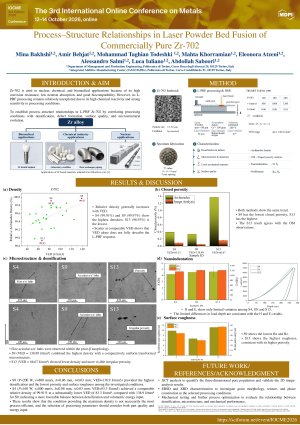
Commercially pure Zr702 is an attractive candidate for Laser Powder Bed Fusion (LPBF) because of its corrosion resistance, biocompatibility, low magnetic susceptibility, and relatively low elastic modulus compared with many conventional metallic implant materials. Previous work on LPBF-fabricated Zr-702 has shown that near-full density, high tensile properties, and good cell viability can be obtained after process optimization. In this work, Zr702 was fabricated using a TRUMPF TruPrint 1000 system. Laser power was varied at 160, 180, and 200 W, scan speed at 800, 1000, and 1200 mm/s, and hatch distance at 0.10, 0.08, and 0.06 mm, while the layer thickness was kept constant at 0.03 mm. These combinations produced a volumetric energy density (VED) range of 44.4–138.9 J/mm³. Relative density was measured for all 27 conditions using the Archimedes method, and selected samples were further characterized by surface roughness analysis, optical microscopy, computed tomography, ImageJ porosity analysis, X-ray diffraction, and nanoindentation. The results show that Zr702 can be processed with high densification over a broad LPBF window, with most samples reaching relative densities above 99.2% and a maximum value of 99.97%. Density does not follow a simple linear dependence on VED, indicating that laser power, scan speed, hatch distance, and their interactions should be considered together. Main effect analysis shows that laser power has the strongest positive influence on densification, while scan speed and hatch distance also affect melt-track stability. Surface roughness varies among the selected samples, with the high-density condition showing lower roughness, Ra = 6.650 µm and Rz = 29.963 µm, compared with the lower-density condition, Ra = 11.144 µm and Rz = 56.843 µm. Microstructural observations reveal a dense α-Zr matrix with fine acicular features, while computed tomography and ImageJ analysis confirm limited residual porosity mainly in the form of isolated pores. X-ray diffraction patterns mainly show α-Zr peaks without clear secondary phase formation. Nanoindentation results indicate a stable local mechanical response in the higher-density samples.
Keywords
additive manufacturing
laser powder bed fusion
Zr702
process optimization
materials characterization
Poster
IOCME-Poster-Mina-Bakhshi.pdf
Laser Powder Bed Fusion of Ti-6Al-4V-XFe: Processability and Microstructure Analysis
Mechanical and Structural Characterization of Functionally Graded Ti-6Al-4V Lattice Structures Fabricated via Laser Powder Bed Fusion for Orthopedic Implants