Event submissions
Published
This submission belongs to the session S5. Additive Manufacturing of the event The 3rd International Online Conference on Metals
Published date
08 Oct, 2026
Academic Editor
'%3e%3cpath%20d='M12.6657%2010.9104C12.4185%2010.325%2012.0599%209.79327%2011.6097%209.34482C11.1609%208.89508%2010.6293%208.5365%2010.0442%208.28888C10.0389%208.28626%2010.0337%208.28495%2010.0285%208.28233C10.8446%207.69279%2011.3752%206.73249%2011.3752%205.64904C11.3752%203.8542%209.92103%202.39999%208.1262%202.39999C6.33136%202.39999%204.87715%203.8542%204.87715%205.64904C4.87715%206.73249%205.40774%207.69279%206.22393%208.28364C6.21869%208.28626%206.21345%208.28757%206.20821%208.29019C5.62129%208.5378%205.09463%208.89284%204.64265%209.34613C4.1929%209.79493%203.83432%2010.3266%203.58671%2010.9117C3.34345%2011.4845%203.21226%2012.0987%203.20023%2012.7209C3.19988%2012.7349%203.20233%2012.7488%203.20744%2012.7619C3.21255%2012.7749%203.22022%2012.7867%203.22998%2012.7968C3.23975%2012.8068%203.25142%2012.8147%203.26431%2012.8202C3.2772%2012.8256%203.29105%2012.8284%203.30504%2012.8284H4.09109C4.14874%2012.8284%204.19459%2012.7825%204.1959%2012.7262C4.2221%2011.7148%204.62823%2010.7676%205.34617%2010.0497C6.08899%209.30683%207.0755%208.89808%208.1262%208.89808C9.17689%208.89808%2010.1634%209.30683%2010.9062%2010.0497C11.6242%2010.7676%2012.0303%2011.7148%2012.0565%2012.7262C12.0578%2012.7838%2012.1037%2012.8284%2012.1613%2012.8284H12.9474C12.9613%2012.8284%2012.9752%2012.8256%2012.9881%2012.8202C13.001%2012.8147%2013.0126%2012.8068%2013.0224%2012.7968C13.0322%2012.7867%2013.0398%2012.7749%2013.0449%2012.7619C13.0501%2012.7488%2013.0525%2012.7349%2013.0522%2012.7209C13.0391%2012.0947%2012.9094%2011.4855%2012.6657%2010.9104ZM8.1262%207.9024C7.52486%207.9024%206.9589%207.6679%206.53312%207.24211C6.10733%206.81633%205.87283%206.25037%205.87283%205.64904C5.87283%205.0477%206.10733%204.48174%206.53312%204.05596C6.9589%203.63018%207.52486%203.39567%208.1262%203.39567C8.72753%203.39567%209.29349%203.63018%209.71927%204.05596C10.1451%204.48174%2010.3796%205.0477%2010.3796%205.64904C10.3796%206.25037%2010.1451%206.81633%209.71927%207.24211C9.29349%207.6679%208.72753%207.9024%208.1262%207.9024Z'%20fill='%235D1EE1'/%3e%3c/g%3e%3c/svg%3e) Antonio Riveiro Rodriguez
Antonio Riveiro RodriguezCitation
Aria Mansouri, Amir Behjat, Mohammad Taghian Todeshki, Mahta Khorramian, Luca Iuliano, Abdollah Saboori, Mechanical and Structural Characterization of Functionally Graded Ti-6Al-4V Lattice Structures Fabricated via Laser Powder Bed Fusion for Orthopedic Implants, in Proceedings of The 3rd International Online Conference on Metals, 12 October–14 October 2026, MDPI: Basel, Switzerland
Share
Email
Facebook
Twitter
LinkedIn
Mechanical and Structural Characterization of Functionally Graded Ti-6Al-4V Lattice Structures Fabricated via Laser Powder Bed Fusion for Orthopedic Implants
'%3e%3cpath%20d='M12.6647%2010.9104C12.4176%2010.325%2012.0589%209.7933%2011.6088%209.34485C11.16%208.89511%2010.6283%208.53653%2010.0432%208.28891C10.038%208.28629%2010.0327%208.28498%2010.0275%208.28236C10.8437%207.69282%2011.3743%206.73252%2011.3743%205.64907C11.3743%203.85423%209.92005%202.40002%208.12522%202.40002C6.33038%202.40002%204.87618%203.85423%204.87618%205.64907C4.87618%206.73252%205.40677%207.69282%206.22296%208.28367C6.21772%208.28629%206.21248%208.2876%206.20724%208.29022C5.62031%208.53783%205.09365%208.89287%204.64167%209.34616C4.19192%209.79496%203.83334%2010.3266%203.58573%2010.9117C3.34247%2011.4846%203.21128%2012.0987%203.19925%2012.721C3.1989%2012.735%203.20135%2012.7489%203.20646%2012.7619C3.21157%2012.7749%203.21924%2012.7868%203.22901%2012.7968C3.23877%2012.8068%203.25045%2012.8148%203.26334%2012.8202C3.27623%2012.8256%203.29007%2012.8284%203.30406%2012.8284H4.09012C4.14776%2012.8284%204.19362%2012.7825%204.19493%2012.7262C4.22113%2011.7148%204.62726%2010.7676%205.34519%2010.0497C6.08802%209.30686%207.07452%208.89811%208.12522%208.89811C9.17592%208.89811%2010.1624%209.30686%2010.9052%2010.0497C11.6232%2010.7676%2012.0293%2011.7148%2012.0555%2012.7262C12.0568%2012.7839%2012.1027%2012.8284%2012.1603%2012.8284H12.9464C12.9604%2012.8284%2012.9742%2012.8256%2012.9871%2012.8202C13%2012.8148%2013.0117%2012.8068%2013.0214%2012.7968C13.0312%2012.7868%2013.0389%2012.7749%2013.044%2012.7619C13.0491%2012.7489%2013.0515%2012.735%2013.0512%2012.721C13.0381%2012.0947%2012.9084%2011.4856%2012.6647%2010.9104ZM8.12522%207.90243C7.52388%207.90243%206.95792%207.66793%206.53214%207.24215C6.10636%206.81636%205.87185%206.2504%205.87185%205.64907C5.87185%205.04773%206.10636%204.48177%206.53214%204.05599C6.95792%203.63021%207.52388%203.3957%208.12522%203.3957C8.72655%203.3957%209.29252%203.63021%209.7183%204.05599C10.1441%204.48177%2010.3786%205.04773%2010.3786%205.64907C10.3786%206.2504%2010.1441%206.81636%209.7183%207.24215C9.29252%207.66793%208.72655%207.90243%208.12522%207.90243Z'%20fill='%235D1EE1'/%3e%3c/g%3e%3c/svg%3e)
Aria Mansouri 1
Amir Behjat 2
Mohammad Taghian Todeshki 2
Mahta Khorramian 2

Luca Iuliano 2

Abdollah Saboori 2
1. Politecnico di Torino
2. Department of Management and Production Engineering (DIGEP) Politecnico di Torino
Abstract
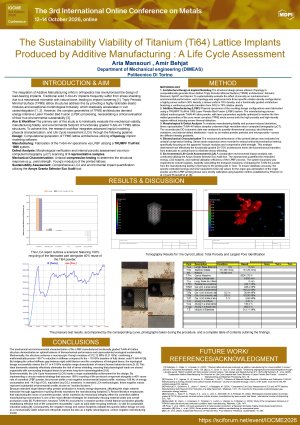
Additive manufacturing, particularly through Laser Powder Bed Fusion (LPBF), has revolutionized the fabrication of intricate, Functionally Graded Lattice Structures (FGLSs) utilizing the biocompatible titanium alloy Ti-6Al-4V. These advanced structural architectures present a highly effective and innovative strategy for mitigating the problematic stress-shielding phenomenon that is frequently observed in traditional orthopedic implants. By meticulously emulating the natural, heterogeneous density gradients found in human bone, these specialized designs promote enhanced osseointegration and significantly prolong the functional lifespan of the implant. This comprehensive systematic study investigates the underlying structural and mechanical characteristics of three distinct Triply Periodic Minimal Surface (TPMS) topologies: Split-P, Gyroid, and Diamond. To rigorously evaluate the influence of these geometric designs on overall mechanical behavior, standardized cylindrical specimens—measuring 0.5 × 0.5 × 1 inch in accordance with ASTM E9 specifications—were fabricated using the LPBF process. For each specific TPMS architecture, three distinct relative density profiles were manufactured: a uniform 30%, a uniform 70%, and a continuous periodic gradient transitioning between 30% and 70%. The as-built printed specimens first underwent high-resolution Computed Tomography (CT) scanning to meticulously assess internal geometric fidelity, overall print quality, and strict dimensional accuracy. Subsequently, the samples were subjected to rigorous quasi-static compression testing to accurately quantify critical mechanical properties, specifically focusing on compressive strength and the elastic modulus (stiffness). By correlating these detailed morphological features with the resulting mechanical responses across the varying density configurations, this research aims to conclusively identify the optimal lattice topology that best mimics the complex biomechanical behavior of natural bone, thereby directly contributing to the advancement and optimization of next-generation biomedical implants.
Keywords
Additive Manufacturing
Laser Powder Bed Fusion (LPBF)
Functionally Graded Lattice Structures (FGLS)
Triply Periodic Minimal Surface (TPMS)
Ti-6Al-4V
Osseointegration
Orthopedic Implants
Poster
Aria M Poster.pdf
Process–Structure Relationships in Laser Powder Bed Fusion of Commercially Pure Zr702
Influence of oxidation temperature on surface morphology and corrosion resistance of a biocompatible cast TiNi-based alloy