Event submissions
Published
This submission belongs to the session S5. Additive Manufacturing of the event The 3rd International Online Conference on Metals
Published date
08 Oct, 2026
Academic Editor
'%3e%3cpath%20d='M12.6657%2010.9104C12.4185%2010.325%2012.0599%209.79327%2011.6097%209.34482C11.1609%208.89508%2010.6293%208.5365%2010.0442%208.28888C10.0389%208.28626%2010.0337%208.28495%2010.0285%208.28233C10.8446%207.69279%2011.3752%206.73249%2011.3752%205.64904C11.3752%203.8542%209.92103%202.39999%208.1262%202.39999C6.33136%202.39999%204.87715%203.8542%204.87715%205.64904C4.87715%206.73249%205.40774%207.69279%206.22393%208.28364C6.21869%208.28626%206.21345%208.28757%206.20821%208.29019C5.62129%208.5378%205.09463%208.89284%204.64265%209.34613C4.1929%209.79493%203.83432%2010.3266%203.58671%2010.9117C3.34345%2011.4845%203.21226%2012.0987%203.20023%2012.7209C3.19988%2012.7349%203.20233%2012.7488%203.20744%2012.7619C3.21255%2012.7749%203.22022%2012.7867%203.22998%2012.7968C3.23975%2012.8068%203.25142%2012.8147%203.26431%2012.8202C3.2772%2012.8256%203.29105%2012.8284%203.30504%2012.8284H4.09109C4.14874%2012.8284%204.19459%2012.7825%204.1959%2012.7262C4.2221%2011.7148%204.62823%2010.7676%205.34617%2010.0497C6.08899%209.30683%207.0755%208.89808%208.1262%208.89808C9.17689%208.89808%2010.1634%209.30683%2010.9062%2010.0497C11.6242%2010.7676%2012.0303%2011.7148%2012.0565%2012.7262C12.0578%2012.7838%2012.1037%2012.8284%2012.1613%2012.8284H12.9474C12.9613%2012.8284%2012.9752%2012.8256%2012.9881%2012.8202C13.001%2012.8147%2013.0126%2012.8068%2013.0224%2012.7968C13.0322%2012.7867%2013.0398%2012.7749%2013.0449%2012.7619C13.0501%2012.7488%2013.0525%2012.7349%2013.0522%2012.7209C13.0391%2012.0947%2012.9094%2011.4855%2012.6657%2010.9104ZM8.1262%207.9024C7.52486%207.9024%206.9589%207.6679%206.53312%207.24211C6.10733%206.81633%205.87283%206.25037%205.87283%205.64904C5.87283%205.0477%206.10733%204.48174%206.53312%204.05596C6.9589%203.63018%207.52486%203.39567%208.1262%203.39567C8.72753%203.39567%209.29349%203.63018%209.71927%204.05596C10.1451%204.48174%2010.3796%205.0477%2010.3796%205.64904C10.3796%206.25037%2010.1451%206.81633%209.71927%207.24211C9.29349%207.6679%208.72753%207.9024%208.1262%207.9024Z'%20fill='%235D1EE1'/%3e%3c/g%3e%3c/svg%3e) Antonio Riveiro Rodriguez
Antonio Riveiro RodriguezCitation
Mohammad Akbari, Amir Behjat, Mahta Khorramian, Mario Boccalini Junior, Fernando Jose Gomes Landgraf, Abdollah Saboori, Optimization of Laser Powder Bed Fusion Parameters for Ti-13Nb-13Zr: The Interplay Between Energy Density, Surface Integrity, and Nanomechanical Performance, in Proceedings of The 3rd International Online Conference on Metals, 12 October–14 October 2026, MDPI: Basel, Switzerland
Share
Email
Facebook
Twitter
LinkedIn
Optimization of Laser Powder Bed Fusion Parameters for Ti-13Nb-13Zr: The Interplay Between Energy Density, Surface Integrity, and Nanomechanical Performance
'%3e%3cpath%20d='M12.6647%2010.9104C12.4176%2010.325%2012.0589%209.7933%2011.6088%209.34485C11.16%208.89511%2010.6283%208.53653%2010.0432%208.28891C10.038%208.28629%2010.0327%208.28498%2010.0275%208.28236C10.8437%207.69282%2011.3743%206.73252%2011.3743%205.64907C11.3743%203.85423%209.92005%202.40002%208.12522%202.40002C6.33038%202.40002%204.87618%203.85423%204.87618%205.64907C4.87618%206.73252%205.40677%207.69282%206.22296%208.28367C6.21772%208.28629%206.21248%208.2876%206.20724%208.29022C5.62031%208.53783%205.09365%208.89287%204.64167%209.34616C4.19192%209.79496%203.83334%2010.3266%203.58573%2010.9117C3.34247%2011.4846%203.21128%2012.0987%203.19925%2012.721C3.1989%2012.735%203.20135%2012.7489%203.20646%2012.7619C3.21157%2012.7749%203.21924%2012.7868%203.22901%2012.7968C3.23877%2012.8068%203.25045%2012.8148%203.26334%2012.8202C3.27623%2012.8256%203.29007%2012.8284%203.30406%2012.8284H4.09012C4.14776%2012.8284%204.19362%2012.7825%204.19493%2012.7262C4.22113%2011.7148%204.62726%2010.7676%205.34519%2010.0497C6.08802%209.30686%207.07452%208.89811%208.12522%208.89811C9.17592%208.89811%2010.1624%209.30686%2010.9052%2010.0497C11.6232%2010.7676%2012.0293%2011.7148%2012.0555%2012.7262C12.0568%2012.7839%2012.1027%2012.8284%2012.1603%2012.8284H12.9464C12.9604%2012.8284%2012.9742%2012.8256%2012.9871%2012.8202C13%2012.8148%2013.0117%2012.8068%2013.0214%2012.7968C13.0312%2012.7868%2013.0389%2012.7749%2013.044%2012.7619C13.0491%2012.7489%2013.0515%2012.735%2013.0512%2012.721C13.0381%2012.0947%2012.9084%2011.4856%2012.6647%2010.9104ZM8.12522%207.90243C7.52388%207.90243%206.95792%207.66793%206.53214%207.24215C6.10636%206.81636%205.87185%206.2504%205.87185%205.64907C5.87185%205.04773%206.10636%204.48177%206.53214%204.05599C6.95792%203.63021%207.52388%203.3957%208.12522%203.3957C8.72655%203.3957%209.29252%203.63021%209.7183%204.05599C10.1441%204.48177%2010.3786%205.04773%2010.3786%205.64907C10.3786%206.2504%2010.1441%206.81636%209.7183%207.24215C9.29252%207.66793%208.72655%207.90243%208.12522%207.90243Z'%20fill='%235D1EE1'/%3e%3c/g%3e%3c/svg%3e)
Mohammad Akbari 1
Amir Behjat 2,3
Mahta Khorramian 2,3
Mario Boccalini Junior 4
Fernando Jose Gomes Landgraf 5

Abdollah Saboori 2,3
1. Department of Applied Science and Technology, Politecncio di Torino, Corso Duca degli Abruzzi 24, 10129 Torino Italy
2. Department of Management and Production Engineering, Politecnico di Torino, Corso Duca degli Abruzzi 24, 10129 Torino, Italy
3. Integrated Additive Manufacturing Center (IAM@PoliTo), Politecnico di Torino, Corso Castelfidardo 51, 10129 Torino, Italy
4. Advanced Materials Unit, Institute for Technological Research, São Paulo, SP, 05508-901, Brazil
5. Department of Metallurgical and Materials Engineering, University of São Paulo, Av. Professor Mello Moraes 2463, 05508-030 São Paulo, SP, Brazil
Abstract
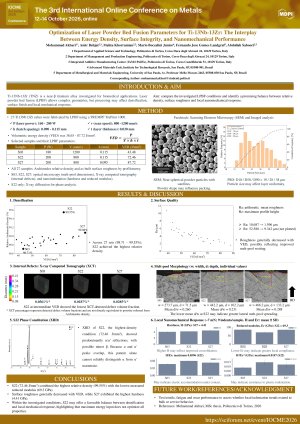
Laser Powder Bed Fusion (LPBF) offers a transformative route for manufacturing patient-specific biomedical components from low-modulus β-type titanium alloys. In this work, the processability of Ti-13Nb-13Zr was assessed through a VED-based approach, focusing on how energy input influences densification, surface topography, and local nanomechanical response across a processing window of 38.65-87.72 J/mm³. Relative density measurements, surface profilometry, and nanoindentation were used to identify the processing conditions that provide the most favorable balance between build quality and mechanical performance. The results show that near-full densification, ranging from 98.71% to 99.55%, can be achieved within the investigated LPBF window. The highest relative density was obtained at an intermediate VED of 72.46 J/mm³, indicating that increasing energy input alone does not necessarily lead to optimal densification. Surface quality improved markedly at higher VED, with Ra decreasing from 10.687 μm to 1.596 μm and Rz from 52.588 μm to 9.342 μm, suggesting enhanced melt pool wetting and surface consolidation. Nanoindentation revealed an increase in hardness from 3.97 GPa to 4.41 GPa with increasing VED. However, the intermediate-VED condition exhibited the lowest reduced modulus and the highest H/Er and H³/Er² ratios, indicating a favorable combination of mechanical compliance and resistance to local deformation. Overall, these findings show that the most promising LPBF condition for Ti-13Nb-13Zr is not governed solely by maximum energy input. Instead, an intermediate VED provides the best density nanomechanical balance, while higher VED mainly benefits surface finish.
Keywords
Ti-13Nb-13Zr
Laser Powder Bed Fusion
β-titanium alloy
Volumetric Energy Density
Nanoindentation
Surface Roughness
Biomedical Applications
Poster
Mohammad_Akbari_IOCME2026.pdf
Application of chromium additives to Ti2Ni-based hydrogen carrier material
Comparison of the wear and corrosion resistance of 17-4PH manufactured by SLM and micro-SLM