Event submissions
Published
This submission belongs to the session S1. Design and Characterization of Novel Metallic Materials of the event The 3rd International Online Conference on Metals
Published date
08 Oct, 2026
Academic Editor
'%3e%3cpath%20d='M12.6657%2010.9104C12.4185%2010.325%2012.0599%209.79327%2011.6097%209.34482C11.1609%208.89508%2010.6293%208.5365%2010.0442%208.28888C10.0389%208.28626%2010.0337%208.28495%2010.0285%208.28233C10.8446%207.69279%2011.3752%206.73249%2011.3752%205.64904C11.3752%203.8542%209.92103%202.39999%208.1262%202.39999C6.33136%202.39999%204.87715%203.8542%204.87715%205.64904C4.87715%206.73249%205.40774%207.69279%206.22393%208.28364C6.21869%208.28626%206.21345%208.28757%206.20821%208.29019C5.62129%208.5378%205.09463%208.89284%204.64265%209.34613C4.1929%209.79493%203.83432%2010.3266%203.58671%2010.9117C3.34345%2011.4845%203.21226%2012.0987%203.20023%2012.7209C3.19988%2012.7349%203.20233%2012.7488%203.20744%2012.7619C3.21255%2012.7749%203.22022%2012.7867%203.22998%2012.7968C3.23975%2012.8068%203.25142%2012.8147%203.26431%2012.8202C3.2772%2012.8256%203.29105%2012.8284%203.30504%2012.8284H4.09109C4.14874%2012.8284%204.19459%2012.7825%204.1959%2012.7262C4.2221%2011.7148%204.62823%2010.7676%205.34617%2010.0497C6.08899%209.30683%207.0755%208.89808%208.1262%208.89808C9.17689%208.89808%2010.1634%209.30683%2010.9062%2010.0497C11.6242%2010.7676%2012.0303%2011.7148%2012.0565%2012.7262C12.0578%2012.7838%2012.1037%2012.8284%2012.1613%2012.8284H12.9474C12.9613%2012.8284%2012.9752%2012.8256%2012.9881%2012.8202C13.001%2012.8147%2013.0126%2012.8068%2013.0224%2012.7968C13.0322%2012.7867%2013.0398%2012.7749%2013.0449%2012.7619C13.0501%2012.7488%2013.0525%2012.7349%2013.0522%2012.7209C13.0391%2012.0947%2012.9094%2011.4855%2012.6657%2010.9104ZM8.1262%207.9024C7.52486%207.9024%206.9589%207.6679%206.53312%207.24211C6.10733%206.81633%205.87283%206.25037%205.87283%205.64904C5.87283%205.0477%206.10733%204.48174%206.53312%204.05596C6.9589%203.63018%207.52486%203.39567%208.1262%203.39567C8.72753%203.39567%209.29349%203.63018%209.71927%204.05596C10.1451%204.48174%2010.3796%205.0477%2010.3796%205.64904C10.3796%206.25037%2010.1451%206.81633%209.71927%207.24211C9.29349%207.6679%208.72753%207.9024%208.1262%207.9024Z'%20fill='%235D1EE1'/%3e%3c/g%3e%3c/svg%3e) Eric Hug
Eric HugCitation
Elżbieta Cygan-Bączek, Karol Krukowski, Anna Czech, Krzysztof Pęcak, Dariusz Kołacz, Andrzej Romański, Application of high-entropy matrix materials in diamond impregnated grinding tools, in Proceedings of The 3rd International Online Conference on Metals, 12 October–14 October 2026, MDPI: Basel, Switzerland
Share
Email
Facebook
Twitter
LinkedIn
Application of high-entropy matrix materials in diamond impregnated grinding tools
'%3e%3cpath%20d='M12.6647%2010.9104C12.4176%2010.325%2012.0589%209.7933%2011.6088%209.34485C11.16%208.89511%2010.6283%208.53653%2010.0432%208.28891C10.038%208.28629%2010.0327%208.28498%2010.0275%208.28236C10.8437%207.69282%2011.3743%206.73252%2011.3743%205.64907C11.3743%203.85423%209.92005%202.40002%208.12522%202.40002C6.33038%202.40002%204.87618%203.85423%204.87618%205.64907C4.87618%206.73252%205.40677%207.69282%206.22296%208.28367C6.21772%208.28629%206.21248%208.2876%206.20724%208.29022C5.62031%208.53783%205.09365%208.89287%204.64167%209.34616C4.19192%209.79496%203.83334%2010.3266%203.58573%2010.9117C3.34247%2011.4846%203.21128%2012.0987%203.19925%2012.721C3.1989%2012.735%203.20135%2012.7489%203.20646%2012.7619C3.21157%2012.7749%203.21924%2012.7868%203.22901%2012.7968C3.23877%2012.8068%203.25045%2012.8148%203.26334%2012.8202C3.27623%2012.8256%203.29007%2012.8284%203.30406%2012.8284H4.09012C4.14776%2012.8284%204.19362%2012.7825%204.19493%2012.7262C4.22113%2011.7148%204.62726%2010.7676%205.34519%2010.0497C6.08802%209.30686%207.07452%208.89811%208.12522%208.89811C9.17592%208.89811%2010.1624%209.30686%2010.9052%2010.0497C11.6232%2010.7676%2012.0293%2011.7148%2012.0555%2012.7262C12.0568%2012.7839%2012.1027%2012.8284%2012.1603%2012.8284H12.9464C12.9604%2012.8284%2012.9742%2012.8256%2012.9871%2012.8202C13%2012.8148%2013.0117%2012.8068%2013.0214%2012.7968C13.0312%2012.7868%2013.0389%2012.7749%2013.044%2012.7619C13.0491%2012.7489%2013.0515%2012.735%2013.0512%2012.721C13.0381%2012.0947%2012.9084%2011.4856%2012.6647%2010.9104ZM8.12522%207.90243C7.52388%207.90243%206.95792%207.66793%206.53214%207.24215C6.10636%206.81636%205.87185%206.2504%205.87185%205.64907C5.87185%205.04773%206.10636%204.48177%206.53214%204.05599C6.95792%203.63021%207.52388%203.3957%208.12522%203.3957C8.72655%203.3957%209.29252%203.63021%209.7183%204.05599C10.1441%204.48177%2010.3786%205.04773%2010.3786%205.64907C10.3786%206.2504%2010.1441%206.81636%209.7183%207.24215C9.29252%207.66793%208.72655%207.90243%208.12522%207.90243Z'%20fill='%235D1EE1'/%3e%3c/g%3e%3c/svg%3e)
Elżbieta Cygan-Bączek 1
Karol Krukowski 2
Anna Czech 2
Krzysztof Pęcak 2
Dariusz Kołacz 2

Andrzej Romański 3
1. Łukasiewicz Research Network - Institute of Non-Ferrous Metals
2. Łukasiewicz Research Network - Institute of Non-Ferrous Metals, Józefa Sowińskiego 5 Str., 44-100 Gliwice, Poland
3. AGH University of Science and Technology, 30 Mickiewicz Avenue, 30-059 Krakow, Poland
Abstract
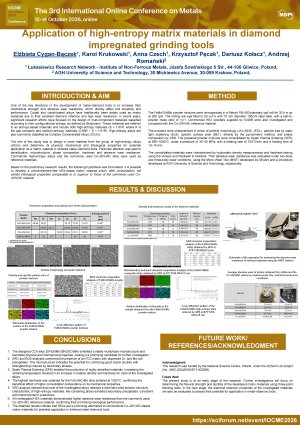
In the present study, the main objective was to investigate the physical, mechanical, and tribological properties of high-entropy alloys (HEAs) and complex concentrated alloys (CCAs) used as the matrix in sintered metallic-diamond tools. Commercial materials FeCoCrNiMn, FeCoCrNiMo, FeCoCrNiAl and ground powders based on the Fe–Mn system were consolidated using the SPS (Spark Plasma Sintering) method, achieving a relative density of 95–98% at temperatures ranging from 850 to 1050°C, under a pressure of 35–50 MPa and a sintering time of 10 min. Apparent density, microstructural features, phase composition, hardness, and abrasion wear resistance were determined. An increase in the hardness and wear resistance of the new matrix materials as compared to the base material (Fe–Mn–Cu–Sn–C) provides metallic-diamond tools with high-performance properties. In order to evaluate the performance of the investigated materials, metallic-diamond segments were fabricated. The segments were tested for resistance to abrasive wear during the grinding of concrete surfaces. The obtained materials exhibited high densification, enhanced hardness, and improved resistance to abrasive wear compared to conventional matrix materials. Microstructural observations confirmed the formation of a uniform multiphase structure, contributing to improved diamond retention during grinding tests. The results indicate that high-entropy matrix materials are promising candidates for advanced metallic-diamond tools intended for concrete and natural stone machining.
The research was funded by the National Science Centre, Poland, under the SONATA 20 project no. UMO-2024/55/D/ST11/02858.
Keywords
diamond tools
wear resistance
powder metallurgy
retention
high entropy alloys
matrix materials
Poster
IOCME-Poster-Elzbieta_Cygan-Baczek.pdf
Interlayer enabled crack-free joining of NiTi shape memory alloy to AlCoCrFeNi2.1 eutectic high entropy alloy by arc-offset GTAW
Cost-Effective Zinc–Manganese Coatings for Hydrazine Oxidation Applications