Event submissions
Published
This submission belongs to the session S3. Metals for Energy, Mobility, and Emerging Technologies of the event The 3rd International Online Conference on Metals
Published date
08 Oct, 2026
Academic Editor
'%3e%3cpath%20d='M12.6657%2010.9104C12.4185%2010.325%2012.0599%209.79327%2011.6097%209.34482C11.1609%208.89508%2010.6293%208.5365%2010.0442%208.28888C10.0389%208.28626%2010.0337%208.28495%2010.0285%208.28233C10.8446%207.69279%2011.3752%206.73249%2011.3752%205.64904C11.3752%203.8542%209.92103%202.39999%208.1262%202.39999C6.33136%202.39999%204.87715%203.8542%204.87715%205.64904C4.87715%206.73249%205.40774%207.69279%206.22393%208.28364C6.21869%208.28626%206.21345%208.28757%206.20821%208.29019C5.62129%208.5378%205.09463%208.89284%204.64265%209.34613C4.1929%209.79493%203.83432%2010.3266%203.58671%2010.9117C3.34345%2011.4845%203.21226%2012.0987%203.20023%2012.7209C3.19988%2012.7349%203.20233%2012.7488%203.20744%2012.7619C3.21255%2012.7749%203.22022%2012.7867%203.22998%2012.7968C3.23975%2012.8068%203.25142%2012.8147%203.26431%2012.8202C3.2772%2012.8256%203.29105%2012.8284%203.30504%2012.8284H4.09109C4.14874%2012.8284%204.19459%2012.7825%204.1959%2012.7262C4.2221%2011.7148%204.62823%2010.7676%205.34617%2010.0497C6.08899%209.30683%207.0755%208.89808%208.1262%208.89808C9.17689%208.89808%2010.1634%209.30683%2010.9062%2010.0497C11.6242%2010.7676%2012.0303%2011.7148%2012.0565%2012.7262C12.0578%2012.7838%2012.1037%2012.8284%2012.1613%2012.8284H12.9474C12.9613%2012.8284%2012.9752%2012.8256%2012.9881%2012.8202C13.001%2012.8147%2013.0126%2012.8068%2013.0224%2012.7968C13.0322%2012.7867%2013.0398%2012.7749%2013.0449%2012.7619C13.0501%2012.7488%2013.0525%2012.7349%2013.0522%2012.7209C13.0391%2012.0947%2012.9094%2011.4855%2012.6657%2010.9104ZM8.1262%207.9024C7.52486%207.9024%206.9589%207.6679%206.53312%207.24211C6.10733%206.81633%205.87283%206.25037%205.87283%205.64904C5.87283%205.0477%206.10733%204.48174%206.53312%204.05596C6.9589%203.63018%207.52486%203.39567%208.1262%203.39567C8.72753%203.39567%209.29349%203.63018%209.71927%204.05596C10.1451%204.48174%2010.3796%205.0477%2010.3796%205.64904C10.3796%206.25037%2010.1451%206.81633%209.71927%207.24211C9.29349%207.6679%208.72753%207.9024%208.1262%207.9024Z'%20fill='%235D1EE1'/%3e%3c/g%3e%3c/svg%3e) Paulo J. Tavares
Paulo J. TavaresCitation
Karina Vjūnova, Zenius Mockus, Loreta Tamašauskaitė-Tamašiūnaitė, Eugenijus Norkus, Cost-Effective Zinc–Manganese Coatings for Hydrazine Oxidation Applications, in Proceedings of The 3rd International Online Conference on Metals, 12 October–14 October 2026, MDPI: Basel, Switzerland
Share
Email
Facebook
Twitter
LinkedIn
Cost-Effective Zinc–Manganese Coatings for Hydrazine Oxidation Applications
'%3e%3cpath%20d='M12.6647%2010.9104C12.4176%2010.325%2012.0589%209.7933%2011.6088%209.34485C11.16%208.89511%2010.6283%208.53653%2010.0432%208.28891C10.038%208.28629%2010.0327%208.28498%2010.0275%208.28236C10.8437%207.69282%2011.3743%206.73252%2011.3743%205.64907C11.3743%203.85423%209.92005%202.40002%208.12522%202.40002C6.33038%202.40002%204.87618%203.85423%204.87618%205.64907C4.87618%206.73252%205.40677%207.69282%206.22296%208.28367C6.21772%208.28629%206.21248%208.2876%206.20724%208.29022C5.62031%208.53783%205.09365%208.89287%204.64167%209.34616C4.19192%209.79496%203.83334%2010.3266%203.58573%2010.9117C3.34247%2011.4846%203.21128%2012.0987%203.19925%2012.721C3.1989%2012.735%203.20135%2012.7489%203.20646%2012.7619C3.21157%2012.7749%203.21924%2012.7868%203.22901%2012.7968C3.23877%2012.8068%203.25045%2012.8148%203.26334%2012.8202C3.27623%2012.8256%203.29007%2012.8284%203.30406%2012.8284H4.09012C4.14776%2012.8284%204.19362%2012.7825%204.19493%2012.7262C4.22113%2011.7148%204.62726%2010.7676%205.34519%2010.0497C6.08802%209.30686%207.07452%208.89811%208.12522%208.89811C9.17592%208.89811%2010.1624%209.30686%2010.9052%2010.0497C11.6232%2010.7676%2012.0293%2011.7148%2012.0555%2012.7262C12.0568%2012.7839%2012.1027%2012.8284%2012.1603%2012.8284H12.9464C12.9604%2012.8284%2012.9742%2012.8256%2012.9871%2012.8202C13%2012.8148%2013.0117%2012.8068%2013.0214%2012.7968C13.0312%2012.7868%2013.0389%2012.7749%2013.044%2012.7619C13.0491%2012.7489%2013.0515%2012.735%2013.0512%2012.721C13.0381%2012.0947%2012.9084%2011.4856%2012.6647%2010.9104ZM8.12522%207.90243C7.52388%207.90243%206.95792%207.66793%206.53214%207.24215C6.10636%206.81636%205.87185%206.2504%205.87185%205.64907C5.87185%205.04773%206.10636%204.48177%206.53214%204.05599C6.95792%203.63021%207.52388%203.3957%208.12522%203.3957C8.72655%203.3957%209.29252%203.63021%209.7183%204.05599C10.1441%204.48177%2010.3786%205.04773%2010.3786%205.64907C10.3786%206.2504%2010.1441%206.81636%209.7183%207.24215C9.29252%207.66793%208.72655%207.90243%208.12522%207.90243Z'%20fill='%235D1EE1'/%3e%3c/g%3e%3c/svg%3e)
Karina Vjūnova 1
Zenius Mockus 1

Loreta Tamašauskaitė-Tamašiūnaitė 1
Eugenijus Norkus 1
1. Center for Physical Sciences and Technology
Abstract
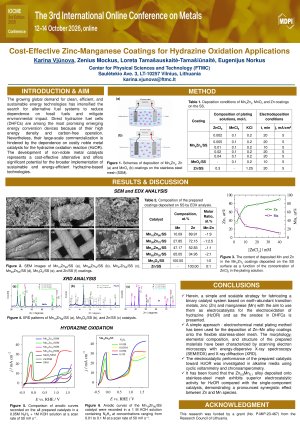
The growing global demand for clean, efficient, and sustainable energy technologies has intensified the search for alternative fuel systems to reduce dependence on fossil fuels and mitigate environmental impact. Direct hydrazine fuel cells (DHFCs) are among the most promising emerging energy conversion devices because of their high energy density and carbon-free operation. Nevertheless, their large-scale commercialization is hindered by the dependence on costly noble metal catalysts for the hydrazine oxidation reaction (HzOR). The development of non-noble metal catalysts represents a cost-effective alternative and offers significant potential for the broader implementation of sustainable and energy-efficient hydrazine-based technologies. Herein, a simple and scalable strategy for fabricating a binary catalyst system based on earth-abundant transition metals, zinc (Zn) and manganese (Mn) with the aim to use them as electrocatalysts for the electrooxidation of hydrazine (HzOR) and as the anodes in DHFCs is presented. A simple approach - electrochemical metal plating method has been used for the deposition of Zn–Mn alloy coatings onto the flexible stainless-steel mesh. The morphology, elemental composition, and structure of the prepared materials have been characterized by scanning electron microscopy with energy-dispersive X-ray spectroscopy (SEM/EDX) and X-ray diffraction (XRD). The electrocatalytic performance of the prepared catalysts toward HzOR was investigated in alkaline media using cyclic voltammetry and chronoamperometry. It has been found that the Zn1.95Mn0.05 alloy deposited onto stainless-steel mesh exhibits superior electrocatalytic activity for HzOR compared with the single-component catalysts, demonstrating a pronounced synergistic effect between Zn and Mn species.
Acknowledgments: This research was funded by a grant (No. P-MIP-23-467) from the Research Council of Lithuania.
Keywords
Zinc
Manganese
Electrochemical deposition
Alloys
Hydrazine oxidation.
Poster
Karina Vj. The 3rd International Online Conference on Metals.pdf
Application of high-entropy matrix materials in diamond impregnated grinding tools
Numerical Simulation of Aluminum Pitting Corrosion: Influence of Electrolyte Conductivity and Nitrate/Sulfate Ions