Event submissions
Published
This submission belongs to the session S3. Aerosols of the event The 8th International Electronic Conference on Atmospheric Sciences
Published date
09 Oct, 2026
Academic Editor
'%3e%3cpath%20d='M12.6657%2010.9104C12.4185%2010.325%2012.0599%209.79327%2011.6097%209.34482C11.1609%208.89508%2010.6293%208.5365%2010.0442%208.28888C10.0389%208.28626%2010.0337%208.28495%2010.0285%208.28233C10.8446%207.69279%2011.3752%206.73249%2011.3752%205.64904C11.3752%203.8542%209.92103%202.39999%208.1262%202.39999C6.33136%202.39999%204.87715%203.8542%204.87715%205.64904C4.87715%206.73249%205.40774%207.69279%206.22393%208.28364C6.21869%208.28626%206.21345%208.28757%206.20821%208.29019C5.62129%208.5378%205.09463%208.89284%204.64265%209.34613C4.1929%209.79493%203.83432%2010.3266%203.58671%2010.9117C3.34345%2011.4845%203.21226%2012.0987%203.20023%2012.7209C3.19988%2012.7349%203.20233%2012.7488%203.20744%2012.7619C3.21255%2012.7749%203.22022%2012.7867%203.22998%2012.7968C3.23975%2012.8068%203.25142%2012.8147%203.26431%2012.8202C3.2772%2012.8256%203.29105%2012.8284%203.30504%2012.8284H4.09109C4.14874%2012.8284%204.19459%2012.7825%204.1959%2012.7262C4.2221%2011.7148%204.62823%2010.7676%205.34617%2010.0497C6.08899%209.30683%207.0755%208.89808%208.1262%208.89808C9.17689%208.89808%2010.1634%209.30683%2010.9062%2010.0497C11.6242%2010.7676%2012.0303%2011.7148%2012.0565%2012.7262C12.0578%2012.7838%2012.1037%2012.8284%2012.1613%2012.8284H12.9474C12.9613%2012.8284%2012.9752%2012.8256%2012.9881%2012.8202C13.001%2012.8147%2013.0126%2012.8068%2013.0224%2012.7968C13.0322%2012.7867%2013.0398%2012.7749%2013.0449%2012.7619C13.0501%2012.7488%2013.0525%2012.7349%2013.0522%2012.7209C13.0391%2012.0947%2012.9094%2011.4855%2012.6657%2010.9104ZM8.1262%207.9024C7.52486%207.9024%206.9589%207.6679%206.53312%207.24211C6.10733%206.81633%205.87283%206.25037%205.87283%205.64904C5.87283%205.0477%206.10733%204.48174%206.53312%204.05596C6.9589%203.63018%207.52486%203.39567%208.1262%203.39567C8.72753%203.39567%209.29349%203.63018%209.71927%204.05596C10.1451%204.48174%2010.3796%205.0477%2010.3796%205.64904C10.3796%206.25037%2010.1451%206.81633%209.71927%207.24211C9.29349%207.6679%208.72753%207.9024%208.1262%207.9024Z'%20fill='%235D1EE1'/%3e%3c/g%3e%3c/svg%3e) Dimitris Kaskaoutis
Dimitris KaskaoutisCitation
Artyom Denisovich Golikov, Natalia Yevgenievna Chubarova, Alexander Andreevich Kirsanov, The radiative and temperature effect of urban aerosol and its dependence on surface albedo according to experiments with the ICON-ART model and measurements at the MSU Meteorological Observatory in Moscow, in Proceedings of The 8th International Electronic Conference on Atmospheric Sciences, 14 October–16 October 2026, MDPI: Basel, Switzerland
Share
Email
Facebook
Twitter
LinkedIn
The radiative and temperature effect of urban aerosol and its dependence on surface albedo according to experiments with the ICON-ART model and measurements at the MSU Meteorological Observatory in Moscow
'%3e%3cpath%20d='M12.6647%2010.9104C12.4176%2010.325%2012.0589%209.7933%2011.6088%209.34485C11.16%208.89511%2010.6283%208.53653%2010.0432%208.28891C10.038%208.28629%2010.0327%208.28498%2010.0275%208.28236C10.8437%207.69282%2011.3743%206.73252%2011.3743%205.64907C11.3743%203.85423%209.92005%202.40002%208.12522%202.40002C6.33038%202.40002%204.87618%203.85423%204.87618%205.64907C4.87618%206.73252%205.40677%207.69282%206.22296%208.28367C6.21772%208.28629%206.21248%208.2876%206.20724%208.29022C5.62031%208.53783%205.09365%208.89287%204.64167%209.34616C4.19192%209.79496%203.83334%2010.3266%203.58573%2010.9117C3.34247%2011.4846%203.21128%2012.0987%203.19925%2012.721C3.1989%2012.735%203.20135%2012.7489%203.20646%2012.7619C3.21157%2012.7749%203.21924%2012.7868%203.22901%2012.7968C3.23877%2012.8068%203.25045%2012.8148%203.26334%2012.8202C3.27623%2012.8256%203.29007%2012.8284%203.30406%2012.8284H4.09012C4.14776%2012.8284%204.19362%2012.7825%204.19493%2012.7262C4.22113%2011.7148%204.62726%2010.7676%205.34519%2010.0497C6.08802%209.30686%207.07452%208.89811%208.12522%208.89811C9.17592%208.89811%2010.1624%209.30686%2010.9052%2010.0497C11.6232%2010.7676%2012.0293%2011.7148%2012.0555%2012.7262C12.0568%2012.7839%2012.1027%2012.8284%2012.1603%2012.8284H12.9464C12.9604%2012.8284%2012.9742%2012.8256%2012.9871%2012.8202C13%2012.8148%2013.0117%2012.8068%2013.0214%2012.7968C13.0312%2012.7868%2013.0389%2012.7749%2013.044%2012.7619C13.0491%2012.7489%2013.0515%2012.735%2013.0512%2012.721C13.0381%2012.0947%2012.9084%2011.4856%2012.6647%2010.9104ZM8.12522%207.90243C7.52388%207.90243%206.95792%207.66793%206.53214%207.24215C6.10636%206.81636%205.87185%206.2504%205.87185%205.64907C5.87185%205.04773%206.10636%204.48177%206.53214%204.05599C6.95792%203.63021%207.52388%203.3957%208.12522%203.3957C8.72655%203.3957%209.29252%203.63021%209.7183%204.05599C10.1441%204.48177%2010.3786%205.04773%2010.3786%205.64907C10.3786%206.2504%2010.1441%206.81636%209.7183%207.24215C9.29252%207.66793%208.72655%207.90243%208.12522%207.90243Z'%20fill='%235D1EE1'/%3e%3c/g%3e%3c/svg%3e)
Artyom Denisovich Golikov 1,2
Natalia Yevgenievna Chubarova 1,2
Alexander Andreevich Kirsanov 2
1. Faculty of Geography, Lomonosov Moscow State University, Leninskie Gory, 1, Moscow, 119991, Russia
2. Hydrometeorological Research Center of Russian Federation, Bolshoy Predtechensky Lane, 13, building 1, Moscow, 123376, Russia
Abstract
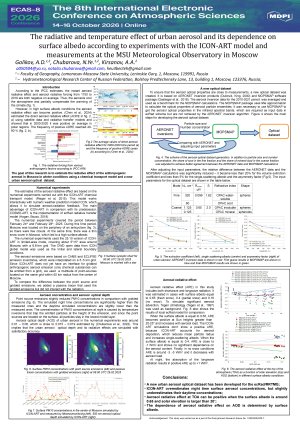
Atmospheric aerosols partially absorb and scatter radiation in the atmosphere. Radiative effects of aerosols are negative on average, so aerosols slightly cool the atmosphere. However, recent studies indicate that in conditions with high surface albedo, the aerosol direct radiative effect (ADRE) can become positive, which leads to warming of the atmosphere (Chen et al., 2024).
To analyze the ADRE in Moscow and its dependence on surface albedo, a set of numerical experiments was carried out using the ICON-ART (Rieger et al., 2015) chemical transport model. ICON-ART currently does not include anthropogenic aerosols, so a dataset of aerosol optical properties was created with the MOPSMAP software package (Gasteiger, Wiegner, 2018). This dataset is based on AERONET Aerosol Inversion products (Dubovik, King, 2000) retrieved from measurements which were carried out at the MSU Meteorological Observatory in 2010 – 2021.
The numerical experiments cover the period between February 24th and February 28th, 2025. They were carried out with three different surface albedo values, 0.18, 0.4 and 0.65, which correspond to no snow, partial snow and snow conditions in Moscow. The results show that in high-surface-albedo conditions (A = 0.65), the ADRE becomes positive when solar height exceeds 18° and increases with aerosol load. When the surface albedo is equal to 0.4, the ADRE is about -1 W/m2 and it does not depend on aerosol content. In conditions with no snow, the ADRE is negative and decreases with aerosol load. Thus, the ADRE strongly depends on surface albedo and during sunny weather, a strong positive ADRE occurs in polluted areas covered by snow.
The aerosol temperature effect was also studied. It is positive at the top of the boundary layer and negative at the surface level, which is in accordance with (Yang et al., 2021), although the values do not exceed ±0.1 °C.
Keywords
aerosol
surface albedo
radiative effect
Poster
ECAS_poster_Golikov.pdf
Transport-Derived PM2.5 and Black Carbon Aerosol Burden in West African Megacities: A Source-Attribution and Biofuel-Mitigation Case Study from Lagos, Port Harcourt, and Kano, Nigeria
Zernike polynomials distribution measurement in atmospheric turbulence conditions for adaptive optics efficiency performance: lab and field condition comparison