Event submissions
Published
This submission belongs to the session S7. Atmospheric Techniques, Instruments and Modeling of the event The 8th International Electronic Conference on Atmospheric Sciences
Published date
09 Oct, 2026
Academic Editor
'%3e%3cpath%20d='M12.6657%2010.9104C12.4185%2010.325%2012.0599%209.79327%2011.6097%209.34482C11.1609%208.89508%2010.6293%208.5365%2010.0442%208.28888C10.0389%208.28626%2010.0337%208.28495%2010.0285%208.28233C10.8446%207.69279%2011.3752%206.73249%2011.3752%205.64904C11.3752%203.8542%209.92103%202.39999%208.1262%202.39999C6.33136%202.39999%204.87715%203.8542%204.87715%205.64904C4.87715%206.73249%205.40774%207.69279%206.22393%208.28364C6.21869%208.28626%206.21345%208.28757%206.20821%208.29019C5.62129%208.5378%205.09463%208.89284%204.64265%209.34613C4.1929%209.79493%203.83432%2010.3266%203.58671%2010.9117C3.34345%2011.4845%203.21226%2012.0987%203.20023%2012.7209C3.19988%2012.7349%203.20233%2012.7488%203.20744%2012.7619C3.21255%2012.7749%203.22022%2012.7867%203.22998%2012.7968C3.23975%2012.8068%203.25142%2012.8147%203.26431%2012.8202C3.2772%2012.8256%203.29105%2012.8284%203.30504%2012.8284H4.09109C4.14874%2012.8284%204.19459%2012.7825%204.1959%2012.7262C4.2221%2011.7148%204.62823%2010.7676%205.34617%2010.0497C6.08899%209.30683%207.0755%208.89808%208.1262%208.89808C9.17689%208.89808%2010.1634%209.30683%2010.9062%2010.0497C11.6242%2010.7676%2012.0303%2011.7148%2012.0565%2012.7262C12.0578%2012.7838%2012.1037%2012.8284%2012.1613%2012.8284H12.9474C12.9613%2012.8284%2012.9752%2012.8256%2012.9881%2012.8202C13.001%2012.8147%2013.0126%2012.8068%2013.0224%2012.7968C13.0322%2012.7867%2013.0398%2012.7749%2013.0449%2012.7619C13.0501%2012.7488%2013.0525%2012.7349%2013.0522%2012.7209C13.0391%2012.0947%2012.9094%2011.4855%2012.6657%2010.9104ZM8.1262%207.9024C7.52486%207.9024%206.9589%207.6679%206.53312%207.24211C6.10733%206.81633%205.87283%206.25037%205.87283%205.64904C5.87283%205.0477%206.10733%204.48174%206.53312%204.05596C6.9589%203.63018%207.52486%203.39567%208.1262%203.39567C8.72753%203.39567%209.29349%203.63018%209.71927%204.05596C10.1451%204.48174%2010.3796%205.0477%2010.3796%205.64904C10.3796%206.25037%2010.1451%206.81633%209.71927%207.24211C9.29349%207.6679%208.72753%207.9024%208.1262%207.9024Z'%20fill='%235D1EE1'/%3e%3c/g%3e%3c/svg%3e) Chun Ho Liu
Chun Ho LiuCitation
Vladimir Toporovsky, Ilya Galaktionov, Oleg Kolesnikov, Zernike polynomials distribution measurement in atmospheric turbulence conditions for adaptive optics efficiency performance: lab and field condition comparison, in Proceedings of The 8th International Electronic Conference on Atmospheric Sciences, 14 October–16 October 2026, MDPI: Basel, Switzerland
Share
Email
Facebook
Twitter
LinkedIn
Zernike polynomials distribution measurement in atmospheric turbulence conditions for adaptive optics efficiency performance: lab and field condition comparison

Vladimir Toporovsky 1
'%3e%3cpath%20d='M12.6647%2010.9104C12.4176%2010.325%2012.0589%209.7933%2011.6088%209.34485C11.16%208.89511%2010.6283%208.53653%2010.0432%208.28891C10.038%208.28629%2010.0327%208.28498%2010.0275%208.28236C10.8437%207.69282%2011.3743%206.73252%2011.3743%205.64907C11.3743%203.85423%209.92005%202.40002%208.12522%202.40002C6.33038%202.40002%204.87618%203.85423%204.87618%205.64907C4.87618%206.73252%205.40677%207.69282%206.22296%208.28367C6.21772%208.28629%206.21248%208.2876%206.20724%208.29022C5.62031%208.53783%205.09365%208.89287%204.64167%209.34616C4.19192%209.79496%203.83334%2010.3266%203.58573%2010.9117C3.34247%2011.4846%203.21128%2012.0987%203.19925%2012.721C3.1989%2012.735%203.20135%2012.7489%203.20646%2012.7619C3.21157%2012.7749%203.21924%2012.7868%203.22901%2012.7968C3.23877%2012.8068%203.25045%2012.8148%203.26334%2012.8202C3.27623%2012.8256%203.29007%2012.8284%203.30406%2012.8284H4.09012C4.14776%2012.8284%204.19362%2012.7825%204.19493%2012.7262C4.22113%2011.7148%204.62726%2010.7676%205.34519%2010.0497C6.08802%209.30686%207.07452%208.89811%208.12522%208.89811C9.17592%208.89811%2010.1624%209.30686%2010.9052%2010.0497C11.6232%2010.7676%2012.0293%2011.7148%2012.0555%2012.7262C12.0568%2012.7839%2012.1027%2012.8284%2012.1603%2012.8284H12.9464C12.9604%2012.8284%2012.9742%2012.8256%2012.9871%2012.8202C13%2012.8148%2013.0117%2012.8068%2013.0214%2012.7968C13.0312%2012.7868%2013.0389%2012.7749%2013.044%2012.7619C13.0491%2012.7489%2013.0515%2012.735%2013.0512%2012.721C13.0381%2012.0947%2012.9084%2011.4856%2012.6647%2010.9104ZM8.12522%207.90243C7.52388%207.90243%206.95792%207.66793%206.53214%207.24215C6.10636%206.81636%205.87185%206.2504%205.87185%205.64907C5.87185%205.04773%206.10636%204.48177%206.53214%204.05599C6.95792%203.63021%207.52388%203.3957%208.12522%203.3957C8.72655%203.3957%209.29252%203.63021%209.7183%204.05599C10.1441%204.48177%2010.3786%205.04773%2010.3786%205.64907C10.3786%206.2504%2010.1441%206.81636%209.7183%207.24215C9.29252%207.66793%208.72655%207.90243%208.12522%207.90243Z'%20fill='%235D1EE1'/%3e%3c/g%3e%3c/svg%3e)
Ilya Galaktionov 1,2
Oleg Kolesnikov 1
1. Quantum Center, Moscow Technical University of Communications and Informatics, Moscow, 111024, Russia
2. Physics Department, Moscow Polytechnic University, Moscow, 107023, Russia
Abstract
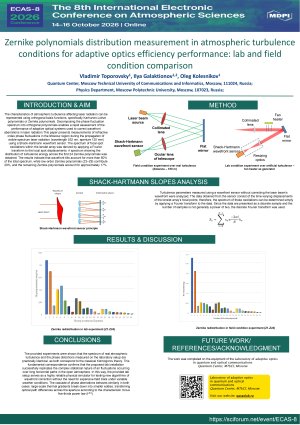
Measuring the distribution of Zernike polynomials across the atmospheric turbulence spectrum is fundamental to understanding and compensating for optical aberrations introduced by Earth's atmosphere. While raw wavefront slope data from sensors like Shack-Hartmann provides a snapshot of distortion, decomposing this phase map into an orthogonal set of Zernike modes offers deep physical insight into the nature of the turbulence itself. The primary importance lies in modal filtering and system optimization. Atmospheric turbulence follows specific statistical laws, most notably Kolmogorov theory, which dictates how variance distributes among different spatial frequencies. In terms of Zernike modes, this energy is not uniform; low-order terms such as tilt (Z1, Z2), defocus (Z3), and astigmatism (Z4, Z5) typically contain the vast majority of the total wavefront error power. IIn lab experiment a laser diode coupled to an optical fiber was used as a radiation source. A collimating lens diverged the diverging laser beam into a parallel beam with a diameter of 50 mm. The laser beam then struck a flat mirror and was directed to the WFS. A telescope with a magnification of 12x was used to match the laser beam diameter (50 mm) to the WFS entrance pupil (4.8 mm). This reduced the beam size to 4.2 mm and completely fit within the receiving matrix of the wavefront sensor (WFS). Artificial turbulence on the optical stand was created using a fan heater, the flow generated by which corresponded to the atmospheric turbulence of the Kolmogorov spectrum. For field condition experiment the optical trace of 250 m over horizontal path was investigated. . The paper presents the Zernike polynomials spectrum estimation in real optical traces close to urban conditions (refractive index structure constant Cn2 - 10-14 m-2/3). The comparison was performed with lab experiment where fan heater was used as atmospheric turbulence simulator
Keywords
adaptive optics
Zernike polynomials
atmospheric turbulence
wavefront corrector
refractive index structure constant
Poster
Lab and field experiment.pdf
The radiative and temperature effect of urban aerosol and its dependence on surface albedo according to experiments with the ICON-ART model and measurements at the MSU Meteorological Observatory in Moscow
Atmospheric turbulence parameter analysis based on the slope dynamic and spatial behavior of the Shack–Hartmann wavefront sensor