Event submissions
Published
This submission belongs to the session S7. Atmospheric Techniques, Instruments and Modeling of the event The 8th International Electronic Conference on Atmospheric Sciences
Published date
09 Oct, 2026
Academic Editor
'%3e%3cpath%20d='M12.6657%2010.9104C12.4185%2010.325%2012.0599%209.79327%2011.6097%209.34482C11.1609%208.89508%2010.6293%208.5365%2010.0442%208.28888C10.0389%208.28626%2010.0337%208.28495%2010.0285%208.28233C10.8446%207.69279%2011.3752%206.73249%2011.3752%205.64904C11.3752%203.8542%209.92103%202.39999%208.1262%202.39999C6.33136%202.39999%204.87715%203.8542%204.87715%205.64904C4.87715%206.73249%205.40774%207.69279%206.22393%208.28364C6.21869%208.28626%206.21345%208.28757%206.20821%208.29019C5.62129%208.5378%205.09463%208.89284%204.64265%209.34613C4.1929%209.79493%203.83432%2010.3266%203.58671%2010.9117C3.34345%2011.4845%203.21226%2012.0987%203.20023%2012.7209C3.19988%2012.7349%203.20233%2012.7488%203.20744%2012.7619C3.21255%2012.7749%203.22022%2012.7867%203.22998%2012.7968C3.23975%2012.8068%203.25142%2012.8147%203.26431%2012.8202C3.2772%2012.8256%203.29105%2012.8284%203.30504%2012.8284H4.09109C4.14874%2012.8284%204.19459%2012.7825%204.1959%2012.7262C4.2221%2011.7148%204.62823%2010.7676%205.34617%2010.0497C6.08899%209.30683%207.0755%208.89808%208.1262%208.89808C9.17689%208.89808%2010.1634%209.30683%2010.9062%2010.0497C11.6242%2010.7676%2012.0303%2011.7148%2012.0565%2012.7262C12.0578%2012.7838%2012.1037%2012.8284%2012.1613%2012.8284H12.9474C12.9613%2012.8284%2012.9752%2012.8256%2012.9881%2012.8202C13.001%2012.8147%2013.0126%2012.8068%2013.0224%2012.7968C13.0322%2012.7867%2013.0398%2012.7749%2013.0449%2012.7619C13.0501%2012.7488%2013.0525%2012.7349%2013.0522%2012.7209C13.0391%2012.0947%2012.9094%2011.4855%2012.6657%2010.9104ZM8.1262%207.9024C7.52486%207.9024%206.9589%207.6679%206.53312%207.24211C6.10733%206.81633%205.87283%206.25037%205.87283%205.64904C5.87283%205.0477%206.10733%204.48174%206.53312%204.05596C6.9589%203.63018%207.52486%203.39567%208.1262%203.39567C8.72753%203.39567%209.29349%203.63018%209.71927%204.05596C10.1451%204.48174%2010.3796%205.0477%2010.3796%205.64904C10.3796%206.25037%2010.1451%206.81633%209.71927%207.24211C9.29349%207.6679%208.72753%207.9024%208.1262%207.9024Z'%20fill='%235D1EE1'/%3e%3c/g%3e%3c/svg%3e) Chun Ho Liu
Chun Ho LiuCitation
Vladimir Toporovsky, Ilya Galaktionov, Oleg Kolesnikov, Atmospheric turbulence parameter analysis based on the slope dynamic and spatial behavior of the Shack–Hartmann wavefront sensor, in Proceedings of The 8th International Electronic Conference on Atmospheric Sciences, 14 October–16 October 2026, MDPI: Basel, Switzerland
Share
Email
Facebook
Twitter
LinkedIn
Atmospheric turbulence parameter analysis based on the slope dynamic and spatial behavior of the Shack–Hartmann wavefront sensor

Vladimir Toporovsky 1
'%3e%3cpath%20d='M12.6647%2010.9104C12.4176%2010.325%2012.0589%209.7933%2011.6088%209.34485C11.16%208.89511%2010.6283%208.53653%2010.0432%208.28891C10.038%208.28629%2010.0327%208.28498%2010.0275%208.28236C10.8437%207.69282%2011.3743%206.73252%2011.3743%205.64907C11.3743%203.85423%209.92005%202.40002%208.12522%202.40002C6.33038%202.40002%204.87618%203.85423%204.87618%205.64907C4.87618%206.73252%205.40677%207.69282%206.22296%208.28367C6.21772%208.28629%206.21248%208.2876%206.20724%208.29022C5.62031%208.53783%205.09365%208.89287%204.64167%209.34616C4.19192%209.79496%203.83334%2010.3266%203.58573%2010.9117C3.34247%2011.4846%203.21128%2012.0987%203.19925%2012.721C3.1989%2012.735%203.20135%2012.7489%203.20646%2012.7619C3.21157%2012.7749%203.21924%2012.7868%203.22901%2012.7968C3.23877%2012.8068%203.25045%2012.8148%203.26334%2012.8202C3.27623%2012.8256%203.29007%2012.8284%203.30406%2012.8284H4.09012C4.14776%2012.8284%204.19362%2012.7825%204.19493%2012.7262C4.22113%2011.7148%204.62726%2010.7676%205.34519%2010.0497C6.08802%209.30686%207.07452%208.89811%208.12522%208.89811C9.17592%208.89811%2010.1624%209.30686%2010.9052%2010.0497C11.6232%2010.7676%2012.0293%2011.7148%2012.0555%2012.7262C12.0568%2012.7839%2012.1027%2012.8284%2012.1603%2012.8284H12.9464C12.9604%2012.8284%2012.9742%2012.8256%2012.9871%2012.8202C13%2012.8148%2013.0117%2012.8068%2013.0214%2012.7968C13.0312%2012.7868%2013.0389%2012.7749%2013.044%2012.7619C13.0491%2012.7489%2013.0515%2012.735%2013.0512%2012.721C13.0381%2012.0947%2012.9084%2011.4856%2012.6647%2010.9104ZM8.12522%207.90243C7.52388%207.90243%206.95792%207.66793%206.53214%207.24215C6.10636%206.81636%205.87185%206.2504%205.87185%205.64907C5.87185%205.04773%206.10636%204.48177%206.53214%204.05599C6.95792%203.63021%207.52388%203.3957%208.12522%203.3957C8.72655%203.3957%209.29252%203.63021%209.7183%204.05599C10.1441%204.48177%2010.3786%205.04773%2010.3786%205.64907C10.3786%206.2504%2010.1441%206.81636%209.7183%207.24215C9.29252%207.66793%208.72655%207.90243%208.12522%207.90243Z'%20fill='%235D1EE1'/%3e%3c/g%3e%3c/svg%3e)
Ilya Galaktionov 1,2
Oleg Kolesnikov 1
1. Quantum Center, Moscow Technical University of Communications and Informatics, Moscow, 111024, Russia
2. Physics Department, Moscow Polytechnic University, Moscow, 107023, Russia
Abstract
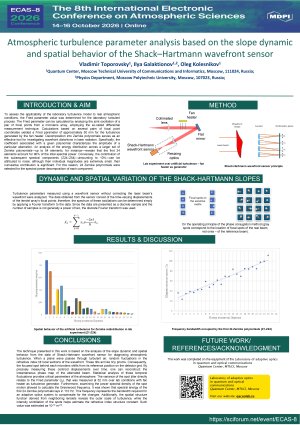
The Shack–Hartmann Wavefront Sensor (SHWFS) remains the most prevalent and robust instrument for characterizing atmospheric turbulence in adaptive optics. Its capability to quantify key parameters—such as the Fried parameter, Greenwood frequency, and the refractive index structure constant—stems from its direct, geometric measurement of local wavefront slopes. To measure Fried coherent length, which defines the coherence diameter of the atmosphere, one analyzes the spatial statistics of these slope measurements over time. The variance in the reconstructed wavefront phase is directly proportional to the ratio between the aperture diameter and Fried parameter. This allows one to assess whether a specific correction system will be effective under current seeing conditions. Simultaneously, by observing the temporal evolution of these shifts at high frame rates (often exceeding 1 kHz), the Greenwood frequency can be derived. In this work, we present the results of the estimation of the Fried coherence length as spatial characteristics and Greenwood frequence analysis as a dynamic parameter of atmospheric turbulence, based on the data from the Shack–Hartmann wavefront sensor obtained in moderate turbulence medium at a distance of 250 m with a 130 mm radius transmitting/receiving telescope. Turbulence parameters measured using a WFS without correcting the laser radiation wave function were examined. The data obtained from the SHWFS are the temporal displacements of the lens raster's focal points, so to find the spectrum of these oscillations, it is sufficient to take the Fourier transform of the obtained data. Since the data are presented as a discrete sample, and the number of samples is generally not a multiple of 2 to the power m, a discrete Fourier transform was used. It was shown that the spectrum of turbulence does not exceed 100 Hz and the Fried parameter is not less than 50 mm.
Keywords
atmospheric turbulence
adaptive optics
Shack-Hartmann wavefront sensor
Fried coherence length
Greenwood frequency
Poster
Slope measurement-1.pdf
Zernike polynomials distribution measurement in atmospheric turbulence conditions for adaptive optics efficiency performance: lab and field condition comparison
Robustness analysis of the phase-conjugation algorithm in weak and medium atmospheric turbulence for free-space optical laser communications