Event submissions
Published
This submission belongs to the session S7. Atmospheric Techniques, Instruments and Modeling of the event The 8th International Electronic Conference on Atmospheric Sciences
Published date
09 Oct, 2026
Academic Editor
'%3e%3cpath%20d='M12.6657%2010.9104C12.4185%2010.325%2012.0599%209.79327%2011.6097%209.34482C11.1609%208.89508%2010.6293%208.5365%2010.0442%208.28888C10.0389%208.28626%2010.0337%208.28495%2010.0285%208.28233C10.8446%207.69279%2011.3752%206.73249%2011.3752%205.64904C11.3752%203.8542%209.92103%202.39999%208.1262%202.39999C6.33136%202.39999%204.87715%203.8542%204.87715%205.64904C4.87715%206.73249%205.40774%207.69279%206.22393%208.28364C6.21869%208.28626%206.21345%208.28757%206.20821%208.29019C5.62129%208.5378%205.09463%208.89284%204.64265%209.34613C4.1929%209.79493%203.83432%2010.3266%203.58671%2010.9117C3.34345%2011.4845%203.21226%2012.0987%203.20023%2012.7209C3.19988%2012.7349%203.20233%2012.7488%203.20744%2012.7619C3.21255%2012.7749%203.22022%2012.7867%203.22998%2012.7968C3.23975%2012.8068%203.25142%2012.8147%203.26431%2012.8202C3.2772%2012.8256%203.29105%2012.8284%203.30504%2012.8284H4.09109C4.14874%2012.8284%204.19459%2012.7825%204.1959%2012.7262C4.2221%2011.7148%204.62823%2010.7676%205.34617%2010.0497C6.08899%209.30683%207.0755%208.89808%208.1262%208.89808C9.17689%208.89808%2010.1634%209.30683%2010.9062%2010.0497C11.6242%2010.7676%2012.0303%2011.7148%2012.0565%2012.7262C12.0578%2012.7838%2012.1037%2012.8284%2012.1613%2012.8284H12.9474C12.9613%2012.8284%2012.9752%2012.8256%2012.9881%2012.8202C13.001%2012.8147%2013.0126%2012.8068%2013.0224%2012.7968C13.0322%2012.7867%2013.0398%2012.7749%2013.0449%2012.7619C13.0501%2012.7488%2013.0525%2012.7349%2013.0522%2012.7209C13.0391%2012.0947%2012.9094%2011.4855%2012.6657%2010.9104ZM8.1262%207.9024C7.52486%207.9024%206.9589%207.6679%206.53312%207.24211C6.10733%206.81633%205.87283%206.25037%205.87283%205.64904C5.87283%205.0477%206.10733%204.48174%206.53312%204.05596C6.9589%203.63018%207.52486%203.39567%208.1262%203.39567C8.72753%203.39567%209.29349%203.63018%209.71927%204.05596C10.1451%204.48174%2010.3796%205.0477%2010.3796%205.64904C10.3796%206.25037%2010.1451%206.81633%209.71927%207.24211C9.29349%207.6679%208.72753%207.9024%208.1262%207.9024Z'%20fill='%235D1EE1'/%3e%3c/g%3e%3c/svg%3e) Chun Ho Liu
Chun Ho LiuCitation
Vladimir Toporovsky, Ilya Galaktionov, Oleg Kolesnikov, Robustness analysis of the phase-conjugation algorithm in weak and medium atmospheric turbulence for free-space optical laser communications, in Proceedings of The 8th International Electronic Conference on Atmospheric Sciences, 14 October–16 October 2026, MDPI: Basel, Switzerland
Share
Email
Facebook
Twitter
LinkedIn
Robustness analysis of the phase-conjugation algorithm in weak and medium atmospheric turbulence for free-space optical laser communications

Vladimir Toporovsky 1
'%3e%3cpath%20d='M12.6647%2010.9104C12.4176%2010.325%2012.0589%209.7933%2011.6088%209.34485C11.16%208.89511%2010.6283%208.53653%2010.0432%208.28891C10.038%208.28629%2010.0327%208.28498%2010.0275%208.28236C10.8437%207.69282%2011.3743%206.73252%2011.3743%205.64907C11.3743%203.85423%209.92005%202.40002%208.12522%202.40002C6.33038%202.40002%204.87618%203.85423%204.87618%205.64907C4.87618%206.73252%205.40677%207.69282%206.22296%208.28367C6.21772%208.28629%206.21248%208.2876%206.20724%208.29022C5.62031%208.53783%205.09365%208.89287%204.64167%209.34616C4.19192%209.79496%203.83334%2010.3266%203.58573%2010.9117C3.34247%2011.4846%203.21128%2012.0987%203.19925%2012.721C3.1989%2012.735%203.20135%2012.7489%203.20646%2012.7619C3.21157%2012.7749%203.21924%2012.7868%203.22901%2012.7968C3.23877%2012.8068%203.25045%2012.8148%203.26334%2012.8202C3.27623%2012.8256%203.29007%2012.8284%203.30406%2012.8284H4.09012C4.14776%2012.8284%204.19362%2012.7825%204.19493%2012.7262C4.22113%2011.7148%204.62726%2010.7676%205.34519%2010.0497C6.08802%209.30686%207.07452%208.89811%208.12522%208.89811C9.17592%208.89811%2010.1624%209.30686%2010.9052%2010.0497C11.6232%2010.7676%2012.0293%2011.7148%2012.0555%2012.7262C12.0568%2012.7839%2012.1027%2012.8284%2012.1603%2012.8284H12.9464C12.9604%2012.8284%2012.9742%2012.8256%2012.9871%2012.8202C13%2012.8148%2013.0117%2012.8068%2013.0214%2012.7968C13.0312%2012.7868%2013.0389%2012.7749%2013.044%2012.7619C13.0491%2012.7489%2013.0515%2012.735%2013.0512%2012.721C13.0381%2012.0947%2012.9084%2011.4856%2012.6647%2010.9104ZM8.12522%207.90243C7.52388%207.90243%206.95792%207.66793%206.53214%207.24215C6.10636%206.81636%205.87185%206.2504%205.87185%205.64907C5.87185%205.04773%206.10636%204.48177%206.53214%204.05599C6.95792%203.63021%207.52388%203.3957%208.12522%203.3957C8.72655%203.3957%209.29252%203.63021%209.7183%204.05599C10.1441%204.48177%2010.3786%205.04773%2010.3786%205.64907C10.3786%206.2504%2010.1441%206.81636%209.7183%207.24215C9.29252%207.66793%208.72655%207.90243%208.12522%207.90243Z'%20fill='%235D1EE1'/%3e%3c/g%3e%3c/svg%3e)
Ilya Galaktionov 1,2
Oleg Kolesnikov 1
1. Quantum Center, Moscow Technical University of Communications and Informatics, Moscow, 111024, Russia
2. Physics Department, Moscow Polytechnic University, Moscow, 107023, Russia
Abstract
Modeling the phase conjugation algorithm in atmospheric turbulence is a cornerstone for advancing free-space optical communication systems. The primary challenge lies in mitigating the severe wavefront distortions that degrade signal quality as a laser beam propagates through an inhomogeneous medium. This process, often referred to as generating a "time-reversed" or "phase-conjugate" wave, aims to precisely undo these aberrations. The simulation of this algorithm typically involves several key stages. First, a realistic model of atmospheric turbulence must be generated. Next, a sensor, such as a Shack-Hartmann wavefront sensor, measures the distorted wavefront, capturing its local slopes across a grid of sub-apertures. The core of the phase conjugation algorithm then takes this measured phase profile and mathematically inverts it by multiplying the complex field by its complex conjugate (E*). The entire system was modeled in MathWorks Simulink R2024b utilizing the Phased Array System Toolbox for field propagation and custom MATLAB Function blocks for low-level matrix operations. This signal contains pronounced high-frequency components associated with rapid changes in atmospheric inhomogeneities. The oscillation amplitude in the provided example reaches 0.6–0.8 radians, which corresponds to a moderate level of phase distortions. The assessment of the algorithm's stability was performed by varying two key parameters: the intensity of atmospheric disturbances (the Gain coefficient in the Atmosphere subsystem) and the negative feedback coefficient from the deformable mirror controller. The numerical experiment revealed the following patterns: At low Gain values (0.2–0.3), the algorithm is fully stable, and the system response smoothly converges to the compensating signal At Gain values of 0.5–0.6, an increase in disturbance amplitude is observed; however, the controller maintains stability provided that the feedback coefficient remains within the range of –0.8 to –1.1 At Gain values above 0.7, oscillations of the compensation signal may occur in the system, indicating a transition into a high-frequency saturation mode.
Keywords
adaptive optics
phase-conjugation algortihm
Simulink environment
atmopheric turbulence
Poster
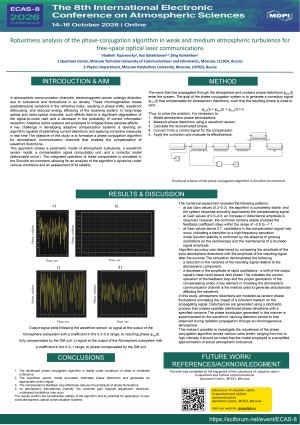
Phase-conjugation robustness.pdf
Atmospheric turbulence parameter analysis based on the slope dynamic and spatial behavior of the Shack–Hartmann wavefront sensor
Sequential Compound Extremes in an Inverse-Seasonal City: A Multi-Reanalysis Framework for Heat–Air Quality Risk Assessment in Ahmedabad, India