Event submissions
Published
This submission belongs to the session S1. Air Quality and Human Health of the event The 8th International Electronic Conference on Atmospheric Sciences
Published date
09 Oct, 2026
Academic Editor
'%3e%3cpath%20d='M12.6657%2010.9104C12.4185%2010.325%2012.0599%209.79327%2011.6097%209.34482C11.1609%208.89508%2010.6293%208.5365%2010.0442%208.28888C10.0389%208.28626%2010.0337%208.28495%2010.0285%208.28233C10.8446%207.69279%2011.3752%206.73249%2011.3752%205.64904C11.3752%203.8542%209.92103%202.39999%208.1262%202.39999C6.33136%202.39999%204.87715%203.8542%204.87715%205.64904C4.87715%206.73249%205.40774%207.69279%206.22393%208.28364C6.21869%208.28626%206.21345%208.28757%206.20821%208.29019C5.62129%208.5378%205.09463%208.89284%204.64265%209.34613C4.1929%209.79493%203.83432%2010.3266%203.58671%2010.9117C3.34345%2011.4845%203.21226%2012.0987%203.20023%2012.7209C3.19988%2012.7349%203.20233%2012.7488%203.20744%2012.7619C3.21255%2012.7749%203.22022%2012.7867%203.22998%2012.7968C3.23975%2012.8068%203.25142%2012.8147%203.26431%2012.8202C3.2772%2012.8256%203.29105%2012.8284%203.30504%2012.8284H4.09109C4.14874%2012.8284%204.19459%2012.7825%204.1959%2012.7262C4.2221%2011.7148%204.62823%2010.7676%205.34617%2010.0497C6.08899%209.30683%207.0755%208.89808%208.1262%208.89808C9.17689%208.89808%2010.1634%209.30683%2010.9062%2010.0497C11.6242%2010.7676%2012.0303%2011.7148%2012.0565%2012.7262C12.0578%2012.7838%2012.1037%2012.8284%2012.1613%2012.8284H12.9474C12.9613%2012.8284%2012.9752%2012.8256%2012.9881%2012.8202C13.001%2012.8147%2013.0126%2012.8068%2013.0224%2012.7968C13.0322%2012.7867%2013.0398%2012.7749%2013.0449%2012.7619C13.0501%2012.7488%2013.0525%2012.7349%2013.0522%2012.7209C13.0391%2012.0947%2012.9094%2011.4855%2012.6657%2010.9104ZM8.1262%207.9024C7.52486%207.9024%206.9589%207.6679%206.53312%207.24211C6.10733%206.81633%205.87283%206.25037%205.87283%205.64904C5.87283%205.0477%206.10733%204.48174%206.53312%204.05596C6.9589%203.63018%207.52486%203.39567%208.1262%203.39567C8.72753%203.39567%209.29349%203.63018%209.71927%204.05596C10.1451%204.48174%2010.3796%205.0477%2010.3796%205.64904C10.3796%206.25037%2010.1451%206.81633%209.71927%207.24211C9.29349%207.6679%208.72753%207.9024%208.1262%207.9024Z'%20fill='%235D1EE1'/%3e%3c/g%3e%3c/svg%3e) Daniele Contini
Daniele ContiniCitation
Poornima Suthar, Sequential Compound Extremes in an Inverse-Seasonal City: A Multi-Reanalysis Framework for Heat–Air Quality Risk Assessment in Ahmedabad, India, in Proceedings of The 8th International Electronic Conference on Atmospheric Sciences, 14 October–16 October 2026, MDPI: Basel, Switzerland
Share
Email
Facebook
Twitter
LinkedIn
Sequential Compound Extremes in an Inverse-Seasonal City: A Multi-Reanalysis Framework for Heat–Air Quality Risk Assessment in Ahmedabad, India
'%3e%3cpath%20d='M12.6647%2010.9104C12.4176%2010.325%2012.0589%209.7933%2011.6088%209.34485C11.16%208.89511%2010.6283%208.53653%2010.0432%208.28891C10.038%208.28629%2010.0327%208.28498%2010.0275%208.28236C10.8437%207.69282%2011.3743%206.73252%2011.3743%205.64907C11.3743%203.85423%209.92005%202.40002%208.12522%202.40002C6.33038%202.40002%204.87618%203.85423%204.87618%205.64907C4.87618%206.73252%205.40677%207.69282%206.22296%208.28367C6.21772%208.28629%206.21248%208.2876%206.20724%208.29022C5.62031%208.53783%205.09365%208.89287%204.64167%209.34616C4.19192%209.79496%203.83334%2010.3266%203.58573%2010.9117C3.34247%2011.4846%203.21128%2012.0987%203.19925%2012.721C3.1989%2012.735%203.20135%2012.7489%203.20646%2012.7619C3.21157%2012.7749%203.21924%2012.7868%203.22901%2012.7968C3.23877%2012.8068%203.25045%2012.8148%203.26334%2012.8202C3.27623%2012.8256%203.29007%2012.8284%203.30406%2012.8284H4.09012C4.14776%2012.8284%204.19362%2012.7825%204.19493%2012.7262C4.22113%2011.7148%204.62726%2010.7676%205.34519%2010.0497C6.08802%209.30686%207.07452%208.89811%208.12522%208.89811C9.17592%208.89811%2010.1624%209.30686%2010.9052%2010.0497C11.6232%2010.7676%2012.0293%2011.7148%2012.0555%2012.7262C12.0568%2012.7839%2012.1027%2012.8284%2012.1603%2012.8284H12.9464C12.9604%2012.8284%2012.9742%2012.8256%2012.9871%2012.8202C13%2012.8148%2013.0117%2012.8068%2013.0214%2012.7968C13.0312%2012.7868%2013.0389%2012.7749%2013.044%2012.7619C13.0491%2012.7489%2013.0515%2012.735%2013.0512%2012.721C13.0381%2012.0947%2012.9084%2011.4856%2012.6647%2010.9104ZM8.12522%207.90243C7.52388%207.90243%206.95792%207.66793%206.53214%207.24215C6.10636%206.81636%205.87185%206.2504%205.87185%205.64907C5.87185%205.04773%206.10636%204.48177%206.53214%204.05599C6.95792%203.63021%207.52388%203.3957%208.12522%203.3957C8.72655%203.3957%209.29252%203.63021%209.7183%204.05599C10.1441%204.48177%2010.3786%205.04773%2010.3786%205.64907C10.3786%206.2504%2010.1441%206.81636%209.7183%207.24215C9.29252%207.66793%208.72655%207.90243%208.12522%207.90243Z'%20fill='%235D1EE1'/%3e%3c/g%3e%3c/svg%3e)
Poornima Suthar 1
1. L.D. College of Engineering, Gujarat Technological University, Ahmedabad, 382424, India
Abstract
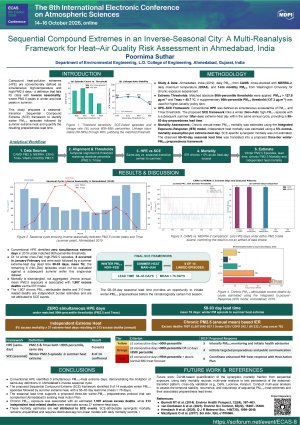
Compound heat–pollution extremes (HPE) are conventionally defined as simultaneous high-temperature and high-PM₂.₅ days, a definition that fails for cities with inverse seasonality, where PM₂.₅ peaks in winter and heat peaks in summer. We propose a Sequential Compound Extreme (SCE) framework and apply it to Ahmedabad, India (2019), using daily PM₂.₅ (CAMS, MERRA-2), daily maximum temperature (ERA5), and 1-km monthly PM₂.₅ (Washington University) for chronic exposure assessment. Using matched absolute 90th-percentile thresholds (PM₂.₅ >127.8 µg m⁻³; Tmax >40.7 °C), conventional HPE identified zero simultaneous extreme days. Of 14 winter (Nov–Feb) high-PM₂.₅ episodes, 8 occurred in January–February and were each followed by a summer extreme-heat day (lead time 58–93 days, mean 76); the remaining 6 November–December episodes could not be evaluated against a subsequent summer within the single-year window. Annual chronic PM₂.₅-attributable mortality, estimated via the Integrated Exposure–Response model, was 1,907 excess deaths (IHD 827, stroke 529, COPD 242, lung cancer 78, LRI 232); this reflects annual mean exposure and is not attributed to SCE events. Independent extreme-heat mortality was 313 deaths (37 extreme-heat days), consistent with observed heat-mortality risk escalation in Indian populations (Mazdiyasni et al., 2017). The synergistic mortality fraction from sequential exposure requires distributed lag non-linear models and daily mortality records, identified as essential future work. Spatial analysis revealed stronger PM₂.₅–mortality associations in western industrial corridors, with confounding caveats acknowledged. We propose a three-tier winter-PM preparedness protocol integrated with Ahmedabad's existing Heat Action Plan, providing 58–93 days of preparedness lead time ahead of the climatologically certain hot season. Findings are presented as a case study and transferable analytical approach; cross-city validation in other inverse-seasonal South Asian cities is required.
Reference [1] Mazdiyasni, O.; AghaKouchak, A.; Davis, S.J.; Madadgar, S.; Mehran, A.; Ragno, E.; et al. Increasing probability of mortality during Indian heat waves. Sci. Adv. 2017, 3, e1700066. https://doi.org/10.1126/sciadv.1700066
Keywords
air quality
urban health
heat
Poster
PS Final Draft 2.pdf
Robustness analysis of the phase-conjugation algorithm in weak and medium atmospheric turbulence for free-space optical laser communications
Development of a Geospatial Air-Quality Intervention Priority Index Based on Satellite Atmospheric, Urban Exposure, Environmental, and Vulnerability Indicators: Application to Kinshasa, 2023–2025