Event submissions
Published
This submission belongs to the session S1. Air Quality and Human Health of the event The 8th International Electronic Conference on Atmospheric Sciences
Published date
09 Oct, 2026
Academic Editor
'%3e%3cpath%20d='M12.6657%2010.9104C12.4185%2010.325%2012.0599%209.79327%2011.6097%209.34482C11.1609%208.89508%2010.6293%208.5365%2010.0442%208.28888C10.0389%208.28626%2010.0337%208.28495%2010.0285%208.28233C10.8446%207.69279%2011.3752%206.73249%2011.3752%205.64904C11.3752%203.8542%209.92103%202.39999%208.1262%202.39999C6.33136%202.39999%204.87715%203.8542%204.87715%205.64904C4.87715%206.73249%205.40774%207.69279%206.22393%208.28364C6.21869%208.28626%206.21345%208.28757%206.20821%208.29019C5.62129%208.5378%205.09463%208.89284%204.64265%209.34613C4.1929%209.79493%203.83432%2010.3266%203.58671%2010.9117C3.34345%2011.4845%203.21226%2012.0987%203.20023%2012.7209C3.19988%2012.7349%203.20233%2012.7488%203.20744%2012.7619C3.21255%2012.7749%203.22022%2012.7867%203.22998%2012.7968C3.23975%2012.8068%203.25142%2012.8147%203.26431%2012.8202C3.2772%2012.8256%203.29105%2012.8284%203.30504%2012.8284H4.09109C4.14874%2012.8284%204.19459%2012.7825%204.1959%2012.7262C4.2221%2011.7148%204.62823%2010.7676%205.34617%2010.0497C6.08899%209.30683%207.0755%208.89808%208.1262%208.89808C9.17689%208.89808%2010.1634%209.30683%2010.9062%2010.0497C11.6242%2010.7676%2012.0303%2011.7148%2012.0565%2012.7262C12.0578%2012.7838%2012.1037%2012.8284%2012.1613%2012.8284H12.9474C12.9613%2012.8284%2012.9752%2012.8256%2012.9881%2012.8202C13.001%2012.8147%2013.0126%2012.8068%2013.0224%2012.7968C13.0322%2012.7867%2013.0398%2012.7749%2013.0449%2012.7619C13.0501%2012.7488%2013.0525%2012.7349%2013.0522%2012.7209C13.0391%2012.0947%2012.9094%2011.4855%2012.6657%2010.9104ZM8.1262%207.9024C7.52486%207.9024%206.9589%207.6679%206.53312%207.24211C6.10733%206.81633%205.87283%206.25037%205.87283%205.64904C5.87283%205.0477%206.10733%204.48174%206.53312%204.05596C6.9589%203.63018%207.52486%203.39567%208.1262%203.39567C8.72753%203.39567%209.29349%203.63018%209.71927%204.05596C10.1451%204.48174%2010.3796%205.0477%2010.3796%205.64904C10.3796%206.25037%2010.1451%206.81633%209.71927%207.24211C9.29349%207.6679%208.72753%207.9024%208.1262%207.9024Z'%20fill='%235D1EE1'/%3e%3c/g%3e%3c/svg%3e) Qingqing He
Qingqing HeCitation
Nour El Imene Brahmi, Kaouther Kerboua, Life Cycle Assessment of Climate and Human Health Impacts of Solar-Powered Green Hydrogen for Ammonia Production, in Proceedings of The 8th International Electronic Conference on Atmospheric Sciences, 14 October–16 October 2026, MDPI: Basel, Switzerland
Share
Email
Facebook
Twitter
LinkedIn
Life Cycle Assessment of Climate and Human Health Impacts of Solar-Powered Green Hydrogen for Ammonia Production
'%3e%3cpath%20d='M12.6647%2010.9104C12.4176%2010.325%2012.0589%209.7933%2011.6088%209.34485C11.16%208.89511%2010.6283%208.53653%2010.0432%208.28891C10.038%208.28629%2010.0327%208.28498%2010.0275%208.28236C10.8437%207.69282%2011.3743%206.73252%2011.3743%205.64907C11.3743%203.85423%209.92005%202.40002%208.12522%202.40002C6.33038%202.40002%204.87618%203.85423%204.87618%205.64907C4.87618%206.73252%205.40677%207.69282%206.22296%208.28367C6.21772%208.28629%206.21248%208.2876%206.20724%208.29022C5.62031%208.53783%205.09365%208.89287%204.64167%209.34616C4.19192%209.79496%203.83334%2010.3266%203.58573%2010.9117C3.34247%2011.4846%203.21128%2012.0987%203.19925%2012.721C3.1989%2012.735%203.20135%2012.7489%203.20646%2012.7619C3.21157%2012.7749%203.21924%2012.7868%203.22901%2012.7968C3.23877%2012.8068%203.25045%2012.8148%203.26334%2012.8202C3.27623%2012.8256%203.29007%2012.8284%203.30406%2012.8284H4.09012C4.14776%2012.8284%204.19362%2012.7825%204.19493%2012.7262C4.22113%2011.7148%204.62726%2010.7676%205.34519%2010.0497C6.08802%209.30686%207.07452%208.89811%208.12522%208.89811C9.17592%208.89811%2010.1624%209.30686%2010.9052%2010.0497C11.6232%2010.7676%2012.0293%2011.7148%2012.0555%2012.7262C12.0568%2012.7839%2012.1027%2012.8284%2012.1603%2012.8284H12.9464C12.9604%2012.8284%2012.9742%2012.8256%2012.9871%2012.8202C13%2012.8148%2013.0117%2012.8068%2013.0214%2012.7968C13.0312%2012.7868%2013.0389%2012.7749%2013.044%2012.7619C13.0491%2012.7489%2013.0515%2012.735%2013.0512%2012.721C13.0381%2012.0947%2012.9084%2011.4856%2012.6647%2010.9104ZM8.12522%207.90243C7.52388%207.90243%206.95792%207.66793%206.53214%207.24215C6.10636%206.81636%205.87185%206.2504%205.87185%205.64907C5.87185%205.04773%206.10636%204.48177%206.53214%204.05599C6.95792%203.63021%207.52388%203.3957%208.12522%203.3957C8.72655%203.3957%209.29252%203.63021%209.7183%204.05599C10.1441%204.48177%2010.3786%205.04773%2010.3786%205.64907C10.3786%206.2504%2010.1441%206.81636%209.7183%207.24215C9.29252%207.66793%208.72655%207.90243%208.12522%207.90243Z'%20fill='%235D1EE1'/%3e%3c/g%3e%3c/svg%3e)
Nour El Imene Brahmi 1,2
Kaouther Kerboua 1,2
1. Department of Process and Energy Engineering, National Higher School of Technology and Engineering, 23005 Annaba, Algeria.
2. Laboratory of Mining, Metallurgy and Materials L3M, National Higher School of Technology and Engineering, Annaba, Algeria.
Abstract
Introduction
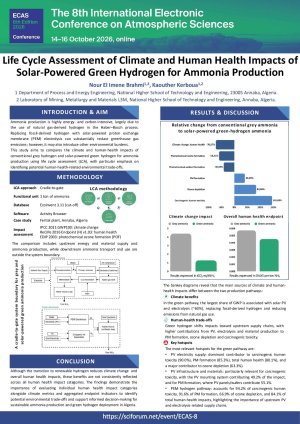
Green hydrogen produced via solar-powered proton exchange membrane (PEM) electrolysis is increasingly recognized as a promising pathway for decarbonizing ammonia production. Although its potential to reduce greenhouse gas emissions is well established, its implications for human health remain less understood, as improvements in climate-related indicators may not be reflected across all health-related environmental impacts.
Methods
A cradle-to-gate life cycle assessment (LCA) was conducted to compare conventional grey ammonia and green hydrogen-based ammonia production. The functional unit was 1 tonne of anhydrous liquid ammonia (99.9% purity). Foreground inventories combined industrial operational data from the Fertial plant in Annaba, Algeria (April 2025–March 2026) for the conventional process with literature-based modelling of the PEM electrolysis system for the green process. Background processes were modelled using ecoinvent v3.11. Environmental and human health impacts were assessed using IPCC 2021 GWP100, ReCiPe 2016 Endpoint (H) v1.03, and EDIP 2003 for photochemical ozone formation (POF) impacts on human health.
Results
Green hydrogen reduces the GWP by 63% (from 4.6 to 1.7 tCO2-eq/tNH3). The corresponding climate change impact on human health decreases by 64%, while POF impacts on human health decline by 44.67%. The overall human health endpoint decreases from 5.89 × 10⁻³ to 5.64 × 10⁻³ DALY/tNH3 (4%). However, particulate matter (PM) formation increases by 108%, ozone depletion by 141%, and carcinogenic human toxicity by 181%. These increases are associated with elevated risks of respiratory and cardiovascular diseases arising from PM formation, increased exposure to ultraviolet radiation resulting from ozone depletion, and a higher risk of cancer linked to carcinogenic human toxicity.
Conclusions
Although green hydrogen reduces climate change impacts, these benefits are not consistently reflected across all human health impact categories. The findings demonstrate the importance of evaluating individual human health impact categories alongside climate metrics and aggregated endpoint indicators to identify potential environmental trade-offs and support informed decision-making for sustainable ammonia production and green hydrogen deployment in Algeria.
Keywords
green hydrogen
ammonia
life cycle assessment
human health
air quality
PEM electrolysis
Poster
Poster IECAS-8.pdf
Weather sets airborne pollen dynamics in motion: a five-year case study from northeastern Croatia
The role of natural and anthropogenic sources on toxicological properties of PM2.5