Event submissions
Published
This submission belongs to the session S1. Air Quality and Human Health of the event The 8th International Electronic Conference on Atmospheric Sciences
Published date
09 Oct, 2026
Academic Editor
'%3e%3cpath%20d='M12.6657%2010.9104C12.4185%2010.325%2012.0599%209.79327%2011.6097%209.34482C11.1609%208.89508%2010.6293%208.5365%2010.0442%208.28888C10.0389%208.28626%2010.0337%208.28495%2010.0285%208.28233C10.8446%207.69279%2011.3752%206.73249%2011.3752%205.64904C11.3752%203.8542%209.92103%202.39999%208.1262%202.39999C6.33136%202.39999%204.87715%203.8542%204.87715%205.64904C4.87715%206.73249%205.40774%207.69279%206.22393%208.28364C6.21869%208.28626%206.21345%208.28757%206.20821%208.29019C5.62129%208.5378%205.09463%208.89284%204.64265%209.34613C4.1929%209.79493%203.83432%2010.3266%203.58671%2010.9117C3.34345%2011.4845%203.21226%2012.0987%203.20023%2012.7209C3.19988%2012.7349%203.20233%2012.7488%203.20744%2012.7619C3.21255%2012.7749%203.22022%2012.7867%203.22998%2012.7968C3.23975%2012.8068%203.25142%2012.8147%203.26431%2012.8202C3.2772%2012.8256%203.29105%2012.8284%203.30504%2012.8284H4.09109C4.14874%2012.8284%204.19459%2012.7825%204.1959%2012.7262C4.2221%2011.7148%204.62823%2010.7676%205.34617%2010.0497C6.08899%209.30683%207.0755%208.89808%208.1262%208.89808C9.17689%208.89808%2010.1634%209.30683%2010.9062%2010.0497C11.6242%2010.7676%2012.0303%2011.7148%2012.0565%2012.7262C12.0578%2012.7838%2012.1037%2012.8284%2012.1613%2012.8284H12.9474C12.9613%2012.8284%2012.9752%2012.8256%2012.9881%2012.8202C13.001%2012.8147%2013.0126%2012.8068%2013.0224%2012.7968C13.0322%2012.7867%2013.0398%2012.7749%2013.0449%2012.7619C13.0501%2012.7488%2013.0525%2012.7349%2013.0522%2012.7209C13.0391%2012.0947%2012.9094%2011.4855%2012.6657%2010.9104ZM8.1262%207.9024C7.52486%207.9024%206.9589%207.6679%206.53312%207.24211C6.10733%206.81633%205.87283%206.25037%205.87283%205.64904C5.87283%205.0477%206.10733%204.48174%206.53312%204.05596C6.9589%203.63018%207.52486%203.39567%208.1262%203.39567C8.72753%203.39567%209.29349%203.63018%209.71927%204.05596C10.1451%204.48174%2010.3796%205.0477%2010.3796%205.64904C10.3796%206.25037%2010.1451%206.81633%209.71927%207.24211C9.29349%207.6679%208.72753%207.9024%208.1262%207.9024Z'%20fill='%235D1EE1'/%3e%3c/g%3e%3c/svg%3e) Daniele Contini
Daniele ContiniCitation
Chisom Ugonna Obi, Chidiezie Chineke, Air quality and human health: A case study of Particulate matter analysis across Four Microenvironments in Egbu, Imo State, Nigeria., in Proceedings of The 8th International Electronic Conference on Atmospheric Sciences, 14 October–16 October 2026, MDPI: Basel, Switzerland
Share
Email
Facebook
Twitter
LinkedIn
Air quality and human health: A case study of Particulate matter analysis across Four Microenvironments in Egbu, Imo State, Nigeria.
'%3e%3cpath%20d='M12.6647%2010.9104C12.4176%2010.325%2012.0589%209.7933%2011.6088%209.34485C11.16%208.89511%2010.6283%208.53653%2010.0432%208.28891C10.038%208.28629%2010.0327%208.28498%2010.0275%208.28236C10.8437%207.69282%2011.3743%206.73252%2011.3743%205.64907C11.3743%203.85423%209.92005%202.40002%208.12522%202.40002C6.33038%202.40002%204.87618%203.85423%204.87618%205.64907C4.87618%206.73252%205.40677%207.69282%206.22296%208.28367C6.21772%208.28629%206.21248%208.2876%206.20724%208.29022C5.62031%208.53783%205.09365%208.89287%204.64167%209.34616C4.19192%209.79496%203.83334%2010.3266%203.58573%2010.9117C3.34247%2011.4846%203.21128%2012.0987%203.19925%2012.721C3.1989%2012.735%203.20135%2012.7489%203.20646%2012.7619C3.21157%2012.7749%203.21924%2012.7868%203.22901%2012.7968C3.23877%2012.8068%203.25045%2012.8148%203.26334%2012.8202C3.27623%2012.8256%203.29007%2012.8284%203.30406%2012.8284H4.09012C4.14776%2012.8284%204.19362%2012.7825%204.19493%2012.7262C4.22113%2011.7148%204.62726%2010.7676%205.34519%2010.0497C6.08802%209.30686%207.07452%208.89811%208.12522%208.89811C9.17592%208.89811%2010.1624%209.30686%2010.9052%2010.0497C11.6232%2010.7676%2012.0293%2011.7148%2012.0555%2012.7262C12.0568%2012.7839%2012.1027%2012.8284%2012.1603%2012.8284H12.9464C12.9604%2012.8284%2012.9742%2012.8256%2012.9871%2012.8202C13%2012.8148%2013.0117%2012.8068%2013.0214%2012.7968C13.0312%2012.7868%2013.0389%2012.7749%2013.044%2012.7619C13.0491%2012.7489%2013.0515%2012.735%2013.0512%2012.721C13.0381%2012.0947%2012.9084%2011.4856%2012.6647%2010.9104ZM8.12522%207.90243C7.52388%207.90243%206.95792%207.66793%206.53214%207.24215C6.10636%206.81636%205.87185%206.2504%205.87185%205.64907C5.87185%205.04773%206.10636%204.48177%206.53214%204.05599C6.95792%203.63021%207.52388%203.3957%208.12522%203.3957C8.72655%203.3957%209.29252%203.63021%209.7183%204.05599C10.1441%204.48177%2010.3786%205.04773%2010.3786%205.64907C10.3786%206.2504%2010.1441%206.81636%209.7183%207.24215C9.29252%207.66793%208.72655%207.90243%208.12522%207.90243Z'%20fill='%235D1EE1'/%3e%3c/g%3e%3c/svg%3e)
Chisom Ugonna Obi 1
Chidiezie Chineke 1
1. Department of Physics, Imo State University, Owerri, Nigeria
Abstract
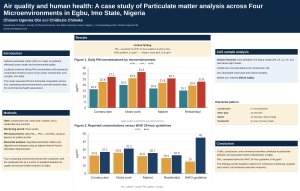
Ambient particulate matter (PM) remains one of the most significant air pollutants affecting human health and environmental quality worldwide. In Nigeria, rapid urbanization and increasing vehicular and commercial activities have intensified PM pollution, yet localized data linking PM concentrations with elemental composition remain scarce, particularly in peri-urban communities such as Egbu, Imo State. This study assessed particulate matter concentrations and elemental composition across four contrasting microenvironments to provide baseline data for environmental health assessment. Four sampling sites—a construction site, a motor park, a market, and a residential area (control)—were monitored over a three-week period. Daily PM₁.₀, PM₂.₅, and PM₁₀ concentrations were measured using an Igeress air quality monitor, while deposited particulate samples were analysed for elemental composition using an Agilent Network Atomic Absorption Spectrometer following acid digestion. The construction site recorded PM₁.₀, PM₂.₅, and PM₁₀ concentrations of 16.2, 22.6, and 27.1 µg/m³, respectively; the motor park recorded the highest concentrations (20.0, 25.9, and 31.3 µg/m³); the market recorded 16.9, 21.8, and 25.7 µg/m³; while the residential site recorded the lowest concentrations (15.1, 19.4, and 22.9 µg/m³). PM₂.₅ concentrations at all monitored sites exceeded the WHO 24-hour guideline value of 15 µg/m³, indicating elevated fine-particle exposure, whereas PM₁₀ concentrations remained below the corresponding WHO 24-hour guideline value (45 µg/m³). Elemental analysis identified sixteen elements, comprising five heavy metals (Pb, Zn, Cu, Fe, and Co) and eleven light metals. Cobalt was most abundant at the construction site, while zinc dominated samples from the motor park and market, reaching 269.22 mg/kg at the latter. These findings indicate that traffic, construction, and commercial activities are important contributors to particulate pollution and associated metal contamination in Egbu. The results provide baseline evidence to support continuous air-quality monitoring, targeted dust-control strategies, and emission-reduction measures to minimize long-term human exposure in rapidly urbanizing communities.
Keywords
Particulate matter
elemental composition
heavy metals
air quality
human health
Nigeria
Poster
Obi &Chineke_Air_quality_Human_health_poster-1_260922_204212.pdf
Resuspended Dust as an Indicator of Urban Air Quality in Kuwait
Urban Green and Blue Spaces as Atmospheric Environment Modifiers: Tract-Level Satellite Exposure and Multiscale Mental Health Associations