Event submissions
Published
This submission belongs to the session S1. Air Quality and Human Health of the event The 8th International Electronic Conference on Atmospheric Sciences
Published date
09 Oct, 2026
Academic Editor
'%3e%3cpath%20d='M12.6657%2010.9104C12.4185%2010.325%2012.0599%209.79327%2011.6097%209.34482C11.1609%208.89508%2010.6293%208.5365%2010.0442%208.28888C10.0389%208.28626%2010.0337%208.28495%2010.0285%208.28233C10.8446%207.69279%2011.3752%206.73249%2011.3752%205.64904C11.3752%203.8542%209.92103%202.39999%208.1262%202.39999C6.33136%202.39999%204.87715%203.8542%204.87715%205.64904C4.87715%206.73249%205.40774%207.69279%206.22393%208.28364C6.21869%208.28626%206.21345%208.28757%206.20821%208.29019C5.62129%208.5378%205.09463%208.89284%204.64265%209.34613C4.1929%209.79493%203.83432%2010.3266%203.58671%2010.9117C3.34345%2011.4845%203.21226%2012.0987%203.20023%2012.7209C3.19988%2012.7349%203.20233%2012.7488%203.20744%2012.7619C3.21255%2012.7749%203.22022%2012.7867%203.22998%2012.7968C3.23975%2012.8068%203.25142%2012.8147%203.26431%2012.8202C3.2772%2012.8256%203.29105%2012.8284%203.30504%2012.8284H4.09109C4.14874%2012.8284%204.19459%2012.7825%204.1959%2012.7262C4.2221%2011.7148%204.62823%2010.7676%205.34617%2010.0497C6.08899%209.30683%207.0755%208.89808%208.1262%208.89808C9.17689%208.89808%2010.1634%209.30683%2010.9062%2010.0497C11.6242%2010.7676%2012.0303%2011.7148%2012.0565%2012.7262C12.0578%2012.7838%2012.1037%2012.8284%2012.1613%2012.8284H12.9474C12.9613%2012.8284%2012.9752%2012.8256%2012.9881%2012.8202C13.001%2012.8147%2013.0126%2012.8068%2013.0224%2012.7968C13.0322%2012.7867%2013.0398%2012.7749%2013.0449%2012.7619C13.0501%2012.7488%2013.0525%2012.7349%2013.0522%2012.7209C13.0391%2012.0947%2012.9094%2011.4855%2012.6657%2010.9104ZM8.1262%207.9024C7.52486%207.9024%206.9589%207.6679%206.53312%207.24211C6.10733%206.81633%205.87283%206.25037%205.87283%205.64904C5.87283%205.0477%206.10733%204.48174%206.53312%204.05596C6.9589%203.63018%207.52486%203.39567%208.1262%203.39567C8.72753%203.39567%209.29349%203.63018%209.71927%204.05596C10.1451%204.48174%2010.3796%205.0477%2010.3796%205.64904C10.3796%206.25037%2010.1451%206.81633%209.71927%207.24211C9.29349%207.6679%208.72753%207.9024%208.1262%207.9024Z'%20fill='%235D1EE1'/%3e%3c/g%3e%3c/svg%3e) Qingqing He
Qingqing HeCitation
Jude Maduabuchi Anyanwu, María Ángeles García, Isidro A Pérez, Influence of Synoptic Weather Patterns and Thermal Conditions on Urban Air Pollution Dynamics in North-Central Spain, in Proceedings of The 8th International Electronic Conference on Atmospheric Sciences, 14 October–16 October 2026, MDPI: Basel, Switzerland
Share
Email
Facebook
Twitter
LinkedIn
Influence of Synoptic Weather Patterns and Thermal Conditions on Urban Air Pollution Dynamics in North-Central Spain

Jude Maduabuchi Anyanwu 1,2

María Ángeles García 1

Isidro A Pérez 1
1. Department of Applied Physics, Faculty of Sciences, University of Valladolid, Paseo de Belén 7, 47011 Valladolid, Spain
2. Department of Physics and Astronomy, University of Nigeria, Nsukka 410001, Enugu State, Nigeria
Abstract
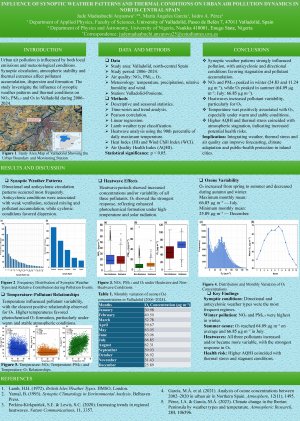
Urban air pollution is strongly influenced by both local emission sources and large-scale atmospheric circulation patterns. This study examined the influence of synoptic weather patterns and thermal conditions on urban air pollution dynamics in Valladolid, North-Central Spain, using long-term observations of nitrogen dioxide (NO2), fine particulate matter (PM2.5), and ozone (O3) collected between 2006 and 2024. Meteorological variables, synoptic circulation types, thermal stress indices, and air-quality indicators were analysed using descriptive statistics, seasonal analysis, Pearson correlation, regression models, and graphical techniques. The results showed that anticyclonic weather patterns were the dominant synoptic regimes over Valladolid and were frequently associated with pollution accumulation events. Heatwave conditions drove the formation of higher concentrations of NO2, PM2.5, and especially O3, indicating the strong role of atmospheric stability and enhanced photochemical activity during extreme heat events. Seasonal analysis revealed that NO₂ and PM2.5 concentrations were highest during winter, whereas O3 reached maximum values during summer, with a peak monthly concentration of 66.85 µg m⁻3 recorded in July. Long-term variability further indicated that meteorological conditions and thermal extremes significantly influenced pollutant behaviour over time. Temperature–pollutant relationships demonstrated that warmer conditions favored ozone formation, while stagnant atmospheric conditions enhanced pollutant accumulation near the surface. The air quality health index (AQHI) also showed higher health risks during warm and stable atmospheric periods. Hence, the study demonstrates the important role of synoptic weather patterns and thermal variability in shaping urban air pollution dynamics in Valladolid. The findings provide useful information for air-quality forecasting, environmental management, and public health planning in medium-sized inland cities under increasing climate variability.
Keywords
Synoptic weather patterns
Urban air pollution
Ozone
Particulate Matter
Nitrogen dioxide
Heatwaves
Air Quality Health Index
Urban climate
Poster
ECAS-8 POSTER Final.pdf
Joint Effects of Heatwaves and Elevated Ground-Level Ozone on Mortality Risk and Population Vulnerability
Integrated Assessment of Cement Plant Pollutant Emissions in the Balkans Region, Southeastern Europe: A Multi-Approach Analysis Using Machine Learning Models, Spatio-temporal Trends, and Statistical Calculations