Event submissions
Published
This submission belongs to the session S1. Air Quality and Human Health of the event The 8th International Electronic Conference on Atmospheric Sciences
Published date
09 Oct, 2026
Academic Editor
'%3e%3cpath%20d='M12.6657%2010.9104C12.4185%2010.325%2012.0599%209.79327%2011.6097%209.34482C11.1609%208.89508%2010.6293%208.5365%2010.0442%208.28888C10.0389%208.28626%2010.0337%208.28495%2010.0285%208.28233C10.8446%207.69279%2011.3752%206.73249%2011.3752%205.64904C11.3752%203.8542%209.92103%202.39999%208.1262%202.39999C6.33136%202.39999%204.87715%203.8542%204.87715%205.64904C4.87715%206.73249%205.40774%207.69279%206.22393%208.28364C6.21869%208.28626%206.21345%208.28757%206.20821%208.29019C5.62129%208.5378%205.09463%208.89284%204.64265%209.34613C4.1929%209.79493%203.83432%2010.3266%203.58671%2010.9117C3.34345%2011.4845%203.21226%2012.0987%203.20023%2012.7209C3.19988%2012.7349%203.20233%2012.7488%203.20744%2012.7619C3.21255%2012.7749%203.22022%2012.7867%203.22998%2012.7968C3.23975%2012.8068%203.25142%2012.8147%203.26431%2012.8202C3.2772%2012.8256%203.29105%2012.8284%203.30504%2012.8284H4.09109C4.14874%2012.8284%204.19459%2012.7825%204.1959%2012.7262C4.2221%2011.7148%204.62823%2010.7676%205.34617%2010.0497C6.08899%209.30683%207.0755%208.89808%208.1262%208.89808C9.17689%208.89808%2010.1634%209.30683%2010.9062%2010.0497C11.6242%2010.7676%2012.0303%2011.7148%2012.0565%2012.7262C12.0578%2012.7838%2012.1037%2012.8284%2012.1613%2012.8284H12.9474C12.9613%2012.8284%2012.9752%2012.8256%2012.9881%2012.8202C13.001%2012.8147%2013.0126%2012.8068%2013.0224%2012.7968C13.0322%2012.7867%2013.0398%2012.7749%2013.0449%2012.7619C13.0501%2012.7488%2013.0525%2012.7349%2013.0522%2012.7209C13.0391%2012.0947%2012.9094%2011.4855%2012.6657%2010.9104ZM8.1262%207.9024C7.52486%207.9024%206.9589%207.6679%206.53312%207.24211C6.10733%206.81633%205.87283%206.25037%205.87283%205.64904C5.87283%205.0477%206.10733%204.48174%206.53312%204.05596C6.9589%203.63018%207.52486%203.39567%208.1262%203.39567C8.72753%203.39567%209.29349%203.63018%209.71927%204.05596C10.1451%204.48174%2010.3796%205.0477%2010.3796%205.64904C10.3796%206.25037%2010.1451%206.81633%209.71927%207.24211C9.29349%207.6679%208.72753%207.9024%208.1262%207.9024Z'%20fill='%235D1EE1'/%3e%3c/g%3e%3c/svg%3e) Daniele Contini
Daniele ContiniCitation
Asma Shehzadi, Iqra Hassan, Talal Ahmed, Integrated Assessment of Cement Plant Pollutant Emissions in the Balkans Region, Southeastern Europe: A Multi-Approach Analysis Using Machine Learning Models, Spatio-temporal Trends, and Statistical Calculations, in Proceedings of The 8th International Electronic Conference on Atmospheric Sciences, 14 October–16 October 2026, MDPI: Basel, Switzerland
Share
Email
Facebook
Twitter
LinkedIn
Integrated Assessment of Cement Plant Pollutant Emissions in the Balkans Region, Southeastern Europe: A Multi-Approach Analysis Using Machine Learning Models, Spatio-temporal Trends, and Statistical Calculations
'%3e%3cpath%20d='M12.6647%2010.9104C12.4176%2010.325%2012.0589%209.7933%2011.6088%209.34485C11.16%208.89511%2010.6283%208.53653%2010.0432%208.28891C10.038%208.28629%2010.0327%208.28498%2010.0275%208.28236C10.8437%207.69282%2011.3743%206.73252%2011.3743%205.64907C11.3743%203.85423%209.92005%202.40002%208.12522%202.40002C6.33038%202.40002%204.87618%203.85423%204.87618%205.64907C4.87618%206.73252%205.40677%207.69282%206.22296%208.28367C6.21772%208.28629%206.21248%208.2876%206.20724%208.29022C5.62031%208.53783%205.09365%208.89287%204.64167%209.34616C4.19192%209.79496%203.83334%2010.3266%203.58573%2010.9117C3.34247%2011.4846%203.21128%2012.0987%203.19925%2012.721C3.1989%2012.735%203.20135%2012.7489%203.20646%2012.7619C3.21157%2012.7749%203.21924%2012.7868%203.22901%2012.7968C3.23877%2012.8068%203.25045%2012.8148%203.26334%2012.8202C3.27623%2012.8256%203.29007%2012.8284%203.30406%2012.8284H4.09012C4.14776%2012.8284%204.19362%2012.7825%204.19493%2012.7262C4.22113%2011.7148%204.62726%2010.7676%205.34519%2010.0497C6.08802%209.30686%207.07452%208.89811%208.12522%208.89811C9.17592%208.89811%2010.1624%209.30686%2010.9052%2010.0497C11.6232%2010.7676%2012.0293%2011.7148%2012.0555%2012.7262C12.0568%2012.7839%2012.1027%2012.8284%2012.1603%2012.8284H12.9464C12.9604%2012.8284%2012.9742%2012.8256%2012.9871%2012.8202C13%2012.8148%2013.0117%2012.8068%2013.0214%2012.7968C13.0312%2012.7868%2013.0389%2012.7749%2013.044%2012.7619C13.0491%2012.7489%2013.0515%2012.735%2013.0512%2012.721C13.0381%2012.0947%2012.9084%2011.4856%2012.6647%2010.9104ZM8.12522%207.90243C7.52388%207.90243%206.95792%207.66793%206.53214%207.24215C6.10636%206.81636%205.87185%206.2504%205.87185%205.64907C5.87185%205.04773%206.10636%204.48177%206.53214%204.05599C6.95792%203.63021%207.52388%203.3957%208.12522%203.3957C8.72655%203.3957%209.29252%203.63021%209.7183%204.05599C10.1441%204.48177%2010.3786%205.04773%2010.3786%205.64907C10.3786%206.2504%2010.1441%206.81636%209.7183%207.24215C9.29252%207.66793%208.72655%207.90243%208.12522%207.90243Z'%20fill='%235D1EE1'/%3e%3c/g%3e%3c/svg%3e)
Asma Shehzadi 1

Iqra Hassan 2

Talal Ahmed 3
1. Department of Remote Sensing and GIS, COMSATS University Islamabad, Islamabad Campus, Islamabad, Federal Capital, 45550, Pakistan
2. Department of Geological Engineering, University of Engineering and Technology, Lahore, Punjab, 54890, Pakistan
3. Department of Earth and Environmental Sciences, BSEAS, H-11 Campus, Bahria University, Islamabad, Federal Capital, 44000, Pakistan
Abstract
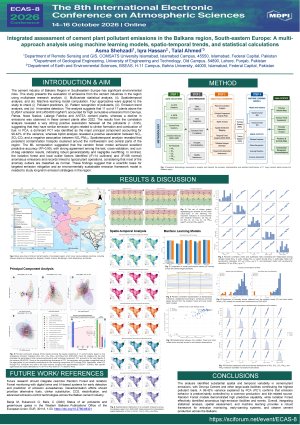
The cement industry of Balkans Region in Southeastern Europe has significant environmental risks. This study presents the evaluation of emissions from the cement industries in the region using multiphase research analysis. (i). Multivariate statistical analysis, (ii). Spatiotemporal analysis, and (iii). Machine learning model computation. Four approaches were applied to the study to check (i). Pollutant predictors, (ii). Pattern recognition of pollutants, (iii). Emission trend analysis, and (iv). Anomalies detection. The analysis suggests that 11 out of 17 plants above the EU/BAT emission limit (450-600 mg/Nm3) accounted for high cumulative emissions from Devnya, Patras, Nexe Nasice, Lafarge Fabrika and ANTEA cement plants, whereas a decline in emissions was observed in these cement plants after 2022. The results from the correlation analysis revealed a very strong positive association between all the pollutants (r ~0.95), suggesting that they have similar emission origins related to clinker formation and combustion of fuel. In PCA, a dominant PC1 was identified as the major principal component accounting for 99.42% of the variance, whereas biplot analysis revealed a positive association between NOx-SOx-CO2 and a negative association between NOx-PM2.5. Spatiotemporal analysis revealed that persistent contamination hotspots clustered around the northwestern and central parts of the region. The ML computation suggested that the random forest model achieved excellent predictive accuracy (R2>0.99), with strong agreement among the test, cross-validation, and out-of-bag validation results, indicating robust generalizability and negligible overfitting. In contrast, the isolation forest and local outlier factors identified (IF=14 outliners) and (IF=88 normal) anomalous emissions and records linked to typical plant operations, considering that most of the anomaly outliers are classified as normal. These findings suggest that a scientific basis for targeted emission mitigation and an environmentally sustainable emission framework model is needed to study long-term emission strategies in the region.
Keywords
Emission trading system
European pollutant release and transfer register
Spatial mapping
Random forest model
Isolation forest model
Poster
Sciforum-202679-Poster Final.pdf
Influence of Synoptic Weather Patterns and Thermal Conditions on Urban Air Pollution Dynamics in North-Central Spain
Time Series Forecasting of PM 2.5 Concentration and Associated Health Risks Using a Supervised Hybrid Machine Learning (SHML) Model