Event submissions
Published
This submission belongs to the session S1. Air Quality and Human Health of the event The 8th International Electronic Conference on Atmospheric Sciences
Published date
09 Oct, 2026
Academic Editor
'%3e%3cpath%20d='M12.6657%2010.9104C12.4185%2010.325%2012.0599%209.79327%2011.6097%209.34482C11.1609%208.89508%2010.6293%208.5365%2010.0442%208.28888C10.0389%208.28626%2010.0337%208.28495%2010.0285%208.28233C10.8446%207.69279%2011.3752%206.73249%2011.3752%205.64904C11.3752%203.8542%209.92103%202.39999%208.1262%202.39999C6.33136%202.39999%204.87715%203.8542%204.87715%205.64904C4.87715%206.73249%205.40774%207.69279%206.22393%208.28364C6.21869%208.28626%206.21345%208.28757%206.20821%208.29019C5.62129%208.5378%205.09463%208.89284%204.64265%209.34613C4.1929%209.79493%203.83432%2010.3266%203.58671%2010.9117C3.34345%2011.4845%203.21226%2012.0987%203.20023%2012.7209C3.19988%2012.7349%203.20233%2012.7488%203.20744%2012.7619C3.21255%2012.7749%203.22022%2012.7867%203.22998%2012.7968C3.23975%2012.8068%203.25142%2012.8147%203.26431%2012.8202C3.2772%2012.8256%203.29105%2012.8284%203.30504%2012.8284H4.09109C4.14874%2012.8284%204.19459%2012.7825%204.1959%2012.7262C4.2221%2011.7148%204.62823%2010.7676%205.34617%2010.0497C6.08899%209.30683%207.0755%208.89808%208.1262%208.89808C9.17689%208.89808%2010.1634%209.30683%2010.9062%2010.0497C11.6242%2010.7676%2012.0303%2011.7148%2012.0565%2012.7262C12.0578%2012.7838%2012.1037%2012.8284%2012.1613%2012.8284H12.9474C12.9613%2012.8284%2012.9752%2012.8256%2012.9881%2012.8202C13.001%2012.8147%2013.0126%2012.8068%2013.0224%2012.7968C13.0322%2012.7867%2013.0398%2012.7749%2013.0449%2012.7619C13.0501%2012.7488%2013.0525%2012.7349%2013.0522%2012.7209C13.0391%2012.0947%2012.9094%2011.4855%2012.6657%2010.9104ZM8.1262%207.9024C7.52486%207.9024%206.9589%207.6679%206.53312%207.24211C6.10733%206.81633%205.87283%206.25037%205.87283%205.64904C5.87283%205.0477%206.10733%204.48174%206.53312%204.05596C6.9589%203.63018%207.52486%203.39567%208.1262%203.39567C8.72753%203.39567%209.29349%203.63018%209.71927%204.05596C10.1451%204.48174%2010.3796%205.0477%2010.3796%205.64904C10.3796%206.25037%2010.1451%206.81633%209.71927%207.24211C9.29349%207.6679%208.72753%207.9024%208.1262%207.9024Z'%20fill='%235D1EE1'/%3e%3c/g%3e%3c/svg%3e) Daniele Contini
Daniele ContiniCitation
Fernanda De Luca, Poliana Dutra Maia, Artur Amorim, Fernando Sodré, Spatiotemporal Assessment of Ions and Total Carbon in Atmospheric Particulate Matter in the Distrito Federal, Central Brazil, in Proceedings of The 8th International Electronic Conference on Atmospheric Sciences, 14 October–16 October 2026, MDPI: Basel, Switzerland
Share
Email
Facebook
Twitter
LinkedIn
Spatiotemporal Assessment of Ions and Total Carbon in Atmospheric Particulate Matter in the Distrito Federal, Central Brazil
'%3e%3cpath%20d='M12.6647%2010.9104C12.4176%2010.325%2012.0589%209.7933%2011.6088%209.34485C11.16%208.89511%2010.6283%208.53653%2010.0432%208.28891C10.038%208.28629%2010.0327%208.28498%2010.0275%208.28236C10.8437%207.69282%2011.3743%206.73252%2011.3743%205.64907C11.3743%203.85423%209.92005%202.40002%208.12522%202.40002C6.33038%202.40002%204.87618%203.85423%204.87618%205.64907C4.87618%206.73252%205.40677%207.69282%206.22296%208.28367C6.21772%208.28629%206.21248%208.2876%206.20724%208.29022C5.62031%208.53783%205.09365%208.89287%204.64167%209.34616C4.19192%209.79496%203.83334%2010.3266%203.58573%2010.9117C3.34247%2011.4846%203.21128%2012.0987%203.19925%2012.721C3.1989%2012.735%203.20135%2012.7489%203.20646%2012.7619C3.21157%2012.7749%203.21924%2012.7868%203.22901%2012.7968C3.23877%2012.8068%203.25045%2012.8148%203.26334%2012.8202C3.27623%2012.8256%203.29007%2012.8284%203.30406%2012.8284H4.09012C4.14776%2012.8284%204.19362%2012.7825%204.19493%2012.7262C4.22113%2011.7148%204.62726%2010.7676%205.34519%2010.0497C6.08802%209.30686%207.07452%208.89811%208.12522%208.89811C9.17592%208.89811%2010.1624%209.30686%2010.9052%2010.0497C11.6232%2010.7676%2012.0293%2011.7148%2012.0555%2012.7262C12.0568%2012.7839%2012.1027%2012.8284%2012.1603%2012.8284H12.9464C12.9604%2012.8284%2012.9742%2012.8256%2012.9871%2012.8202C13%2012.8148%2013.0117%2012.8068%2013.0214%2012.7968C13.0312%2012.7868%2013.0389%2012.7749%2013.044%2012.7619C13.0491%2012.7489%2013.0515%2012.735%2013.0512%2012.721C13.0381%2012.0947%2012.9084%2011.4856%2012.6647%2010.9104ZM8.12522%207.90243C7.52388%207.90243%206.95792%207.66793%206.53214%207.24215C6.10636%206.81636%205.87185%206.2504%205.87185%205.64907C5.87185%205.04773%206.10636%204.48177%206.53214%204.05599C6.95792%203.63021%207.52388%203.3957%208.12522%203.3957C8.72655%203.3957%209.29252%203.63021%209.7183%204.05599C10.1441%204.48177%2010.3786%205.04773%2010.3786%205.64907C10.3786%206.2504%2010.1441%206.81636%209.7183%207.24215C9.29252%207.66793%208.72655%207.90243%208.12522%207.90243Z'%20fill='%235D1EE1'/%3e%3c/g%3e%3c/svg%3e)
Fernanda De Luca 1
Poliana Dutra Maia 2
Artur Amorim 3
Fernando Sodré 4
1. Institute of Chemistry, University of Brasília, 70910-000, Brasília, Brazil
2. Faculty of Planaltina, University of Brasília, Área Universitária N.1, Vila Nossa Senhora de Fátima 73300-000, Planaltina, Brazil
3. Laboratory of Geochronology, Institute of Geosciences, University of Brasilia 70910-000, Brasília, Brazil
4. Laboratory of Chemometrics and Environmental Chemistry, Institute of Chemistry, University of Brasilia 70910-000, Brasília, Brazil
Abstract
Introduction
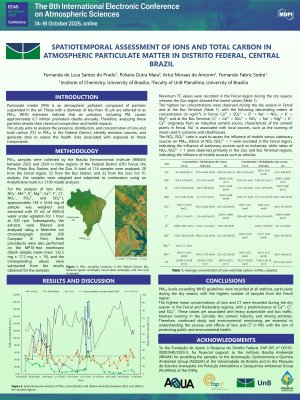
We characterized PM10 in the Distrito Federal, Central Brazil—a region with agricultural areas, neighboring the Cerrado and biomass burning zones—to identify potential emission sources. We quantified the ions (Li⁺, Na⁺, NH₄⁺, K⁺, Mg²⁺, Ca²⁺, F⁻, Cl⁻, NO₃⁻, PO₄³⁻, and SO₄²⁻) and total carbon (TC) in PM10 during the dry and rainy seasons, between March 2022 and July 2024, across three distinct areas: Fercal (cement industry), Rodoviária (urban bus station), and Zoo (background area).
Methodology
A total of 114 samples were collected using High-Vol samplers (1 m3/min/24h of flow) with a sampling frequency of one 24 h sample per day. TC was determined via an Analytik Jena Multi N/C 3100 analyzer, and ions were quantified using ion chromatography.
Results
The highest average PM10 concentrations occurred during the dry season in Fercal (86.29 ± 56.18 μg/m³) and Rodoviária (48.14 ± 17.97 μg /m³), frequently exceeding WHO guidelines of 50 μg/m³ in 69% and 40% of the samples, respectively. Fercal also exhibited the highest TC and ionic concentrations. During the dry season, the decreasing orders of ions (in ng/m3) were as follows: Ca2+ > SO42- > Cl- > Na+ > NO3- > K+ > Mg2+ for Fercal and Cl- > Ca2+ > SO42- > NO3- > Na+ > Mg2+ > K+ for Rodoviária. The NO₃⁻/SO₄²⁻ ratio < 1 indicated a prevalence of stationary sources in Fercal, whereas NO₃⁻/SO₄²⁻ ratio > 1 indicated a prevalence of mobile sources in Rodoviária and Zoo.
Conclusion
Air pollution in these regions is highly driven by vehicular traffic, wildfires, the cement industry, and agriculture. These findings underscore the critical need for stricter anthropogenic emission controls, wildfire management, and continuous monitoring to mitigate health and environmental impacts.
Acknowledgments
The authors acknowledge FAP-DF No. 00193-00002040/2023-3 for financial support, IBRAM for providing the samples, and the Research Group ProPAGA of CNPq.
Keywords
Atmospheric particulate matter
ions
total carbon
air quality.
Poster
Poster.pdf
Rainwater Reuse Project (RRP): Rainwater Treatment to removeAtmospheric Pollutants and Assessment of Impact on Population Health
Impact of Air Pollution on Respiratory Hospital Admissions in Makkah during Hajj and the COVID-19 Pandemic