Event submissions
Published
This submission belongs to the session S1. Air Quality and Human Health of the event The 8th International Electronic Conference on Atmospheric Sciences
Published date
09 Oct, 2026
Academic Editor
'%3e%3cpath%20d='M12.6657%2010.9104C12.4185%2010.325%2012.0599%209.79327%2011.6097%209.34482C11.1609%208.89508%2010.6293%208.5365%2010.0442%208.28888C10.0389%208.28626%2010.0337%208.28495%2010.0285%208.28233C10.8446%207.69279%2011.3752%206.73249%2011.3752%205.64904C11.3752%203.8542%209.92103%202.39999%208.1262%202.39999C6.33136%202.39999%204.87715%203.8542%204.87715%205.64904C4.87715%206.73249%205.40774%207.69279%206.22393%208.28364C6.21869%208.28626%206.21345%208.28757%206.20821%208.29019C5.62129%208.5378%205.09463%208.89284%204.64265%209.34613C4.1929%209.79493%203.83432%2010.3266%203.58671%2010.9117C3.34345%2011.4845%203.21226%2012.0987%203.20023%2012.7209C3.19988%2012.7349%203.20233%2012.7488%203.20744%2012.7619C3.21255%2012.7749%203.22022%2012.7867%203.22998%2012.7968C3.23975%2012.8068%203.25142%2012.8147%203.26431%2012.8202C3.2772%2012.8256%203.29105%2012.8284%203.30504%2012.8284H4.09109C4.14874%2012.8284%204.19459%2012.7825%204.1959%2012.7262C4.2221%2011.7148%204.62823%2010.7676%205.34617%2010.0497C6.08899%209.30683%207.0755%208.89808%208.1262%208.89808C9.17689%208.89808%2010.1634%209.30683%2010.9062%2010.0497C11.6242%2010.7676%2012.0303%2011.7148%2012.0565%2012.7262C12.0578%2012.7838%2012.1037%2012.8284%2012.1613%2012.8284H12.9474C12.9613%2012.8284%2012.9752%2012.8256%2012.9881%2012.8202C13.001%2012.8147%2013.0126%2012.8068%2013.0224%2012.7968C13.0322%2012.7867%2013.0398%2012.7749%2013.0449%2012.7619C13.0501%2012.7488%2013.0525%2012.7349%2013.0522%2012.7209C13.0391%2012.0947%2012.9094%2011.4855%2012.6657%2010.9104ZM8.1262%207.9024C7.52486%207.9024%206.9589%207.6679%206.53312%207.24211C6.10733%206.81633%205.87283%206.25037%205.87283%205.64904C5.87283%205.0477%206.10733%204.48174%206.53312%204.05596C6.9589%203.63018%207.52486%203.39567%208.1262%203.39567C8.72753%203.39567%209.29349%203.63018%209.71927%204.05596C10.1451%204.48174%2010.3796%205.0477%2010.3796%205.64904C10.3796%206.25037%2010.1451%206.81633%209.71927%207.24211C9.29349%207.6679%208.72753%207.9024%208.1262%207.9024Z'%20fill='%235D1EE1'/%3e%3c/g%3e%3c/svg%3e) Qingqing He
Qingqing HeCitation
Martyna Malinowska, Anita Lewandowska, Marta Staniszewska, Morgane Perron, Matthieu Waeles, Air Quality and Human Health: The Impact of Port-Related Air Pollution on Residents and Workers in European Port Areas—A Case Study of the Port of Gdynia, in Proceedings of The 8th International Electronic Conference on Atmospheric Sciences, 14 October–16 October 2026, MDPI: Basel, Switzerland
Share
Email
Facebook
Twitter
LinkedIn
Air Quality and Human Health: The Impact of Port-Related Air Pollution on Residents and Workers in European Port Areas—A Case Study of the Port of Gdynia
'%3e%3cpath%20d='M12.6647%2010.9104C12.4176%2010.325%2012.0589%209.7933%2011.6088%209.34485C11.16%208.89511%2010.6283%208.53653%2010.0432%208.28891C10.038%208.28629%2010.0327%208.28498%2010.0275%208.28236C10.8437%207.69282%2011.3743%206.73252%2011.3743%205.64907C11.3743%203.85423%209.92005%202.40002%208.12522%202.40002C6.33038%202.40002%204.87618%203.85423%204.87618%205.64907C4.87618%206.73252%205.40677%207.69282%206.22296%208.28367C6.21772%208.28629%206.21248%208.2876%206.20724%208.29022C5.62031%208.53783%205.09365%208.89287%204.64167%209.34616C4.19192%209.79496%203.83334%2010.3266%203.58573%2010.9117C3.34247%2011.4846%203.21128%2012.0987%203.19925%2012.721C3.1989%2012.735%203.20135%2012.7489%203.20646%2012.7619C3.21157%2012.7749%203.21924%2012.7868%203.22901%2012.7968C3.23877%2012.8068%203.25045%2012.8148%203.26334%2012.8202C3.27623%2012.8256%203.29007%2012.8284%203.30406%2012.8284H4.09012C4.14776%2012.8284%204.19362%2012.7825%204.19493%2012.7262C4.22113%2011.7148%204.62726%2010.7676%205.34519%2010.0497C6.08802%209.30686%207.07452%208.89811%208.12522%208.89811C9.17592%208.89811%2010.1624%209.30686%2010.9052%2010.0497C11.6232%2010.7676%2012.0293%2011.7148%2012.0555%2012.7262C12.0568%2012.7839%2012.1027%2012.8284%2012.1603%2012.8284H12.9464C12.9604%2012.8284%2012.9742%2012.8256%2012.9871%2012.8202C13%2012.8148%2013.0117%2012.8068%2013.0214%2012.7968C13.0312%2012.7868%2013.0389%2012.7749%2013.044%2012.7619C13.0491%2012.7489%2013.0515%2012.735%2013.0512%2012.721C13.0381%2012.0947%2012.9084%2011.4856%2012.6647%2010.9104ZM8.12522%207.90243C7.52388%207.90243%206.95792%207.66793%206.53214%207.24215C6.10636%206.81636%205.87185%206.2504%205.87185%205.64907C5.87185%205.04773%206.10636%204.48177%206.53214%204.05599C6.95792%203.63021%207.52388%203.3957%208.12522%203.3957C8.72655%203.3957%209.29252%203.63021%209.7183%204.05599C10.1441%204.48177%2010.3786%205.04773%2010.3786%205.64907C10.3786%206.2504%2010.1441%206.81636%209.7183%207.24215C9.29252%207.66793%208.72655%207.90243%208.12522%207.90243Z'%20fill='%235D1EE1'/%3e%3c/g%3e%3c/svg%3e)
Martyna Malinowska 1

Anita Lewandowska 1
Marta Staniszewska 1
Morgane Perron 2
Matthieu Waeles 2
1. Department of Chemical Oceanography and Marine Geology, Faculty of Oceanography and Geography, University of Gdańsk, 80-309 Gdańsk, Poland
2. UMR 6539 CNRS/IRD/Ifremer/LEMAR IUEM, University of Brest, F-29280 Plouzané, France
Abstract
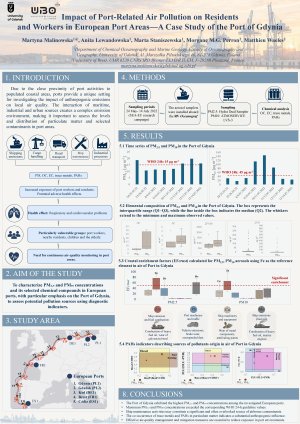
Port areas are important sources of atmospheric pollution due to their involvement in shipping, cargo handling, road transport and industrial activities. Exposure to particulate matter (PM) and associated contaminants may adversely affect the health of port workers and nearby residents. This study assessed PM₂.₅ and PM₁₀ concentrations and their chemical composition in the Port of Gdynia.
Atmospheric aerosol samples were collected during the SEA-EU research campaign (May–July 2022) in five European ports: Gdynia, Gdańsk, Kiel, Brest and Cádiz. PM₂.₅ and PM₁₀ were sampled on quartz fibre filters using low-volume samplers. Aerosol mass concentrations were determined gravimetrically, while organic carbon (OC), elemental carbon (EC), trace metals and polycyclic aromatic hydrocarbons (PAHs) were analysed using thermo-optical analysis, ICP-MS and HPLC, respectively.
Among all of the investigated ports, the Port of Gdynia exhibited the highest average PM₂.₅ and PM₁₀ concentrations, reaching 14.2 and 71.4 µg m⁻³, respectively. The maximum PM₁₀ concentrations ranged from 114.7 to 145.4 µg m⁻³, exceeding both the World Health Organization (WHO) 24-hour guideline value (45 µg m⁻³) and the European Union daily limit value (50 µg m⁻³). The maximum PM₂.₅ concentrations reached 19.7 µg m⁻³, exceeding the WHO 24-hour guideline value of 15 µg m⁻³.
The highest PM₂.₅ and PM₁₀ concentrations were observed during the vessel's stay in the Port of Gdynia, both before departure and after its return from the research cruise. These periods coincided with intensive technical activities conducted onboard the vessel, including painting, cleaning, maintenance and surface preparation works. Elevated concentrations of OC, EC, trace metals and PAHs were also recorded.
These findings indicate that ship maintenance operations may represent an important and often overlooked source of airborne contaminants in port environments, increasing the exposure of both port workers and nearby residents to pollutants associated with adverse respiratory and cardiovascular health effects.
Keywords
PM2.5
PM10
air quality
human health
trace metals
PAHs
port emissions
ship maintenance
Port of Gdynia
Poster
Martyna Malinowska.pdf
Cold-Air Pools and PM2.5 Exceedance Risk Across California
Characterization of Particulate Matter Emissions from Fuels Used in Beekeeping Smoking Practices