Event submissions
Published
This submission belongs to the session S1. Air Quality and Human Health of the event The 8th International Electronic Conference on Atmospheric Sciences
Published date
09 Oct, 2026
Academic Editor
'%3e%3cpath%20d='M12.6657%2010.9104C12.4185%2010.325%2012.0599%209.79327%2011.6097%209.34482C11.1609%208.89508%2010.6293%208.5365%2010.0442%208.28888C10.0389%208.28626%2010.0337%208.28495%2010.0285%208.28233C10.8446%207.69279%2011.3752%206.73249%2011.3752%205.64904C11.3752%203.8542%209.92103%202.39999%208.1262%202.39999C6.33136%202.39999%204.87715%203.8542%204.87715%205.64904C4.87715%206.73249%205.40774%207.69279%206.22393%208.28364C6.21869%208.28626%206.21345%208.28757%206.20821%208.29019C5.62129%208.5378%205.09463%208.89284%204.64265%209.34613C4.1929%209.79493%203.83432%2010.3266%203.58671%2010.9117C3.34345%2011.4845%203.21226%2012.0987%203.20023%2012.7209C3.19988%2012.7349%203.20233%2012.7488%203.20744%2012.7619C3.21255%2012.7749%203.22022%2012.7867%203.22998%2012.7968C3.23975%2012.8068%203.25142%2012.8147%203.26431%2012.8202C3.2772%2012.8256%203.29105%2012.8284%203.30504%2012.8284H4.09109C4.14874%2012.8284%204.19459%2012.7825%204.1959%2012.7262C4.2221%2011.7148%204.62823%2010.7676%205.34617%2010.0497C6.08899%209.30683%207.0755%208.89808%208.1262%208.89808C9.17689%208.89808%2010.1634%209.30683%2010.9062%2010.0497C11.6242%2010.7676%2012.0303%2011.7148%2012.0565%2012.7262C12.0578%2012.7838%2012.1037%2012.8284%2012.1613%2012.8284H12.9474C12.9613%2012.8284%2012.9752%2012.8256%2012.9881%2012.8202C13.001%2012.8147%2013.0126%2012.8068%2013.0224%2012.7968C13.0322%2012.7867%2013.0398%2012.7749%2013.0449%2012.7619C13.0501%2012.7488%2013.0525%2012.7349%2013.0522%2012.7209C13.0391%2012.0947%2012.9094%2011.4855%2012.6657%2010.9104ZM8.1262%207.9024C7.52486%207.9024%206.9589%207.6679%206.53312%207.24211C6.10733%206.81633%205.87283%206.25037%205.87283%205.64904C5.87283%205.0477%206.10733%204.48174%206.53312%204.05596C6.9589%203.63018%207.52486%203.39567%208.1262%203.39567C8.72753%203.39567%209.29349%203.63018%209.71927%204.05596C10.1451%204.48174%2010.3796%205.0477%2010.3796%205.64904C10.3796%206.25037%2010.1451%206.81633%209.71927%207.24211C9.29349%207.6679%208.72753%207.9024%208.1262%207.9024Z'%20fill='%235D1EE1'/%3e%3c/g%3e%3c/svg%3e) Daniele Contini
Daniele ContiniCitation
Magdalena Żurawka, Katarzyna Jaworek, Barbara Błaszczak, Kamila Widziewicz-Rzońca, Barbara Mathews, Krzysztof Słaby, Monika Błaszczak, Anna Smola-Dmochowska, Patrycja Rogula-Kopiec, Comparison of PM₁₀ oxidation potential determination methods: implications for air quality assessment within the AAQD framework, in Proceedings of The 8th International Electronic Conference on Atmospheric Sciences, 14 October–16 October 2026, MDPI: Basel, Switzerland
Share
Email
Facebook
Twitter
LinkedIn
Comparison of PM₁₀ oxidation potential determination methods: implications for air quality assessment within the AAQD framework
'%3e%3cpath%20d='M12.6647%2010.9104C12.4176%2010.325%2012.0589%209.7933%2011.6088%209.34485C11.16%208.89511%2010.6283%208.53653%2010.0432%208.28891C10.038%208.28629%2010.0327%208.28498%2010.0275%208.28236C10.8437%207.69282%2011.3743%206.73252%2011.3743%205.64907C11.3743%203.85423%209.92005%202.40002%208.12522%202.40002C6.33038%202.40002%204.87618%203.85423%204.87618%205.64907C4.87618%206.73252%205.40677%207.69282%206.22296%208.28367C6.21772%208.28629%206.21248%208.2876%206.20724%208.29022C5.62031%208.53783%205.09365%208.89287%204.64167%209.34616C4.19192%209.79496%203.83334%2010.3266%203.58573%2010.9117C3.34247%2011.4846%203.21128%2012.0987%203.19925%2012.721C3.1989%2012.735%203.20135%2012.7489%203.20646%2012.7619C3.21157%2012.7749%203.21924%2012.7868%203.22901%2012.7968C3.23877%2012.8068%203.25045%2012.8148%203.26334%2012.8202C3.27623%2012.8256%203.29007%2012.8284%203.30406%2012.8284H4.09012C4.14776%2012.8284%204.19362%2012.7825%204.19493%2012.7262C4.22113%2011.7148%204.62726%2010.7676%205.34519%2010.0497C6.08802%209.30686%207.07452%208.89811%208.12522%208.89811C9.17592%208.89811%2010.1624%209.30686%2010.9052%2010.0497C11.6232%2010.7676%2012.0293%2011.7148%2012.0555%2012.7262C12.0568%2012.7839%2012.1027%2012.8284%2012.1603%2012.8284H12.9464C12.9604%2012.8284%2012.9742%2012.8256%2012.9871%2012.8202C13%2012.8148%2013.0117%2012.8068%2013.0214%2012.7968C13.0312%2012.7868%2013.0389%2012.7749%2013.044%2012.7619C13.0491%2012.7489%2013.0515%2012.735%2013.0512%2012.721C13.0381%2012.0947%2012.9084%2011.4856%2012.6647%2010.9104ZM8.12522%207.90243C7.52388%207.90243%206.95792%207.66793%206.53214%207.24215C6.10636%206.81636%205.87185%206.2504%205.87185%205.64907C5.87185%205.04773%206.10636%204.48177%206.53214%204.05599C6.95792%203.63021%207.52388%203.3957%208.12522%203.3957C8.72655%203.3957%209.29252%203.63021%209.7183%204.05599C10.1441%204.48177%2010.3786%205.04773%2010.3786%205.64907C10.3786%206.2504%2010.1441%206.81636%209.7183%207.24215C9.29252%207.66793%208.72655%207.90243%208.12522%207.90243Z'%20fill='%235D1EE1'/%3e%3c/g%3e%3c/svg%3e)
Magdalena Żurawka 1
Katarzyna Jaworek 1
Barbara Błaszczak 1
Kamila Widziewicz-Rzońca 1
Barbara Mathews 1
Krzysztof Słaby 1
Monika Błaszczak 1
Anna Smola-Dmochowska 1

Patrycja Rogula-Kopiec 1
1. Institute of Environmental Engineering, Polish Academy of Sciences, Zabrze, Poland
Abstract
Introduction
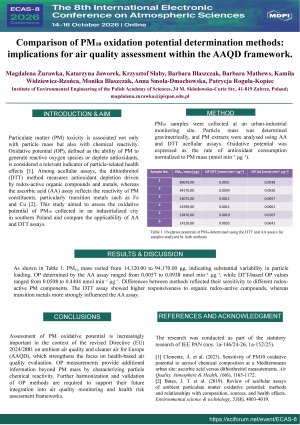
Particulate matter (PM) toxicity is associated not only with particle mass but also with chemical reactivity. Oxidative potential (OP), defined as the ability of PM to generate reactive oxygen species or deplete antioxidants, is considered a relevant indicator of particle-related health effects. Among acellular assays, the dithiothreitol (DTT) method measures antioxidant depletion driven by redox-active organic compounds and metals, whereas the ascorbic acid (AA) assay reflects the reactivity of PM constituents, particularly transition metals such as Fe and Cu. This study aimed to assess the oxidative potential of PM₁₀ collected in an industrialized city in southern Poland and compare the applicability of AA and DTT assays.
Methods
PM₁₀ samples were collected at an urban-industrial monitoring site. Particle mass was determined gravimetrically, and PM extracts were analysed using AA and DTT acellular assays. Oxidative potential was expressed as the rate of antioxidant consumption normalized to PM mass (nmol min⁻¹ μg⁻¹).
Results
PM₁₀ mass varied from 14,120.00 to 94,170.00 μg, indicating substantial variability in particle loading. OP determined by the AA assay ranged from 0.0057 to 0.0938 nmol min⁻¹ μg⁻¹, while DTT-based OP values ranged from 0.0508 to 0.4404 nmol min⁻¹ μg⁻¹. Differences between methods reflected their sensitivity to different redox-active PM components. The DTT assay showed higher responsiveness to organic redox-active compounds, whereas the AA assay was more influenced by transition metals.
Conclusions
Assessment of PM oxidative potential is increasingly important in the context of the revised Directive (EU) 2024/2881 on ambient air quality and cleaner air for Europe (AAQD), which strengthens the focus on health-based air quality evaluation. OP measurements provide additional information beyond PM mass by characterizing particle chemical reactivity. Further harmonization and validation of OP methods are required to support their future integration into air quality monitoring and health risk assessment frameworks.
Funding: The research was conducted as part of the statutory research of IEE PAN (nos. 1a-146/24-26, 1a-152/25).
Keywords
aerosols
PM10
AAQD
air polution
oxidation potential
Poster
Magdalena Żurawka ECAS-8.pdf
Data-Driven Atmospheric Modeling for Air Quality Assessment and Human Health Risk Analysis in Urban Environments
Campfire Smoke as a Source of PAH and BTEX Inhalation Exposure: Implications for Cancer Risk