Event submissions
Published
This submission belongs to the session S1. Air Quality and Human Health of the event The 8th International Electronic Conference on Atmospheric Sciences
Published date
09 Oct, 2026
Academic Editor
'%3e%3cpath%20d='M12.6657%2010.9104C12.4185%2010.325%2012.0599%209.79327%2011.6097%209.34482C11.1609%208.89508%2010.6293%208.5365%2010.0442%208.28888C10.0389%208.28626%2010.0337%208.28495%2010.0285%208.28233C10.8446%207.69279%2011.3752%206.73249%2011.3752%205.64904C11.3752%203.8542%209.92103%202.39999%208.1262%202.39999C6.33136%202.39999%204.87715%203.8542%204.87715%205.64904C4.87715%206.73249%205.40774%207.69279%206.22393%208.28364C6.21869%208.28626%206.21345%208.28757%206.20821%208.29019C5.62129%208.5378%205.09463%208.89284%204.64265%209.34613C4.1929%209.79493%203.83432%2010.3266%203.58671%2010.9117C3.34345%2011.4845%203.21226%2012.0987%203.20023%2012.7209C3.19988%2012.7349%203.20233%2012.7488%203.20744%2012.7619C3.21255%2012.7749%203.22022%2012.7867%203.22998%2012.7968C3.23975%2012.8068%203.25142%2012.8147%203.26431%2012.8202C3.2772%2012.8256%203.29105%2012.8284%203.30504%2012.8284H4.09109C4.14874%2012.8284%204.19459%2012.7825%204.1959%2012.7262C4.2221%2011.7148%204.62823%2010.7676%205.34617%2010.0497C6.08899%209.30683%207.0755%208.89808%208.1262%208.89808C9.17689%208.89808%2010.1634%209.30683%2010.9062%2010.0497C11.6242%2010.7676%2012.0303%2011.7148%2012.0565%2012.7262C12.0578%2012.7838%2012.1037%2012.8284%2012.1613%2012.8284H12.9474C12.9613%2012.8284%2012.9752%2012.8256%2012.9881%2012.8202C13.001%2012.8147%2013.0126%2012.8068%2013.0224%2012.7968C13.0322%2012.7867%2013.0398%2012.7749%2013.0449%2012.7619C13.0501%2012.7488%2013.0525%2012.7349%2013.0522%2012.7209C13.0391%2012.0947%2012.9094%2011.4855%2012.6657%2010.9104ZM8.1262%207.9024C7.52486%207.9024%206.9589%207.6679%206.53312%207.24211C6.10733%206.81633%205.87283%206.25037%205.87283%205.64904C5.87283%205.0477%206.10733%204.48174%206.53312%204.05596C6.9589%203.63018%207.52486%203.39567%208.1262%203.39567C8.72753%203.39567%209.29349%203.63018%209.71927%204.05596C10.1451%204.48174%2010.3796%205.0477%2010.3796%205.64904C10.3796%206.25037%2010.1451%206.81633%209.71927%207.24211C9.29349%207.6679%208.72753%207.9024%208.1262%207.9024Z'%20fill='%235D1EE1'/%3e%3c/g%3e%3c/svg%3e) Daniele Contini
Daniele ContiniCitation
Edyta Komisarczyk, Malwina Mainka, Anna Mainka, Annual PM2.5 Concentration Forecasts for the Silesian Voivodeship under the Recast CAFE Directive, in Proceedings of The 8th International Electronic Conference on Atmospheric Sciences, 14 October–16 October 2026, MDPI: Basel, Switzerland
Share
Email
Facebook
Twitter
LinkedIn
Annual PM2.5 Concentration Forecasts for the Silesian Voivodeship under the Recast CAFE Directive
'%3e%3cpath%20d='M12.6647%2010.9104C12.4176%2010.325%2012.0589%209.7933%2011.6088%209.34485C11.16%208.89511%2010.6283%208.53653%2010.0432%208.28891C10.038%208.28629%2010.0327%208.28498%2010.0275%208.28236C10.8437%207.69282%2011.3743%206.73252%2011.3743%205.64907C11.3743%203.85423%209.92005%202.40002%208.12522%202.40002C6.33038%202.40002%204.87618%203.85423%204.87618%205.64907C4.87618%206.73252%205.40677%207.69282%206.22296%208.28367C6.21772%208.28629%206.21248%208.2876%206.20724%208.29022C5.62031%208.53783%205.09365%208.89287%204.64167%209.34616C4.19192%209.79496%203.83334%2010.3266%203.58573%2010.9117C3.34247%2011.4846%203.21128%2012.0987%203.19925%2012.721C3.1989%2012.735%203.20135%2012.7489%203.20646%2012.7619C3.21157%2012.7749%203.21924%2012.7868%203.22901%2012.7968C3.23877%2012.8068%203.25045%2012.8148%203.26334%2012.8202C3.27623%2012.8256%203.29007%2012.8284%203.30406%2012.8284H4.09012C4.14776%2012.8284%204.19362%2012.7825%204.19493%2012.7262C4.22113%2011.7148%204.62726%2010.7676%205.34519%2010.0497C6.08802%209.30686%207.07452%208.89811%208.12522%208.89811C9.17592%208.89811%2010.1624%209.30686%2010.9052%2010.0497C11.6232%2010.7676%2012.0293%2011.7148%2012.0555%2012.7262C12.0568%2012.7839%2012.1027%2012.8284%2012.1603%2012.8284H12.9464C12.9604%2012.8284%2012.9742%2012.8256%2012.9871%2012.8202C13%2012.8148%2013.0117%2012.8068%2013.0214%2012.7968C13.0312%2012.7868%2013.0389%2012.7749%2013.044%2012.7619C13.0491%2012.7489%2013.0515%2012.735%2013.0512%2012.721C13.0381%2012.0947%2012.9084%2011.4856%2012.6647%2010.9104ZM8.12522%207.90243C7.52388%207.90243%206.95792%207.66793%206.53214%207.24215C6.10636%206.81636%205.87185%206.2504%205.87185%205.64907C5.87185%205.04773%206.10636%204.48177%206.53214%204.05599C6.95792%203.63021%207.52388%203.3957%208.12522%203.3957C8.72655%203.3957%209.29252%203.63021%209.7183%204.05599C10.1441%204.48177%2010.3786%205.04773%2010.3786%205.64907C10.3786%206.2504%2010.1441%206.81636%209.7183%207.24215C9.29252%207.66793%208.72655%207.90243%208.12522%207.90243Z'%20fill='%235D1EE1'/%3e%3c/g%3e%3c/svg%3e)
Edyta Komisarczyk 1
Malwina Mainka 2

Anna Mainka 3
1. Faculty of Energy and Environmental Engineering, Silesian University of Technology, Konarskiego 18, 44-100 Gliwice, Poland
2. Faculty of Biomedical Engineering, Silesian University of Technology, Roosevelta 40, 41-800 Zabrze, Poland
3. Department of Air Protection, Faculty of Energy and Environmental Engineering, Silesian University of Technology, Konarskiego 22B, 44-100 Gliwice, Poland
Abstract
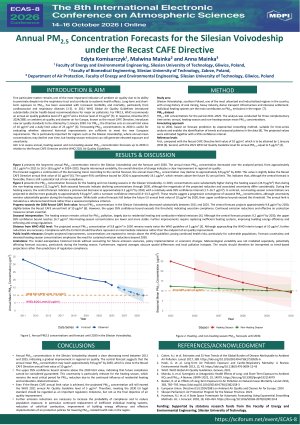
Silesian Voivodeship is one of Poland’s most urbanized and industrialized regions, and has historically recorded elevated concentrations of fine particulate matter (PM2.5). National air-quality assessments before 2020 relied on annual mean PM2.5 concentrations of 25 µg/m³ and 20 µg/m³ thereafter. Epidemiological evidence indicates that short-term increases in PM2.5 concentrations above 10 µg/m³ are associated with a higher number of hospital admissions and emergency department visits for respiratory and cardiovascular conditions. Long-term exposure is associated with premature mortality, cardiovascular and ischemic heart disease, chronic respiratory impairment, lung cancer, kidney disease, and potential adverse effects on neurological development and cognitive function. In response to these health concerns, the recast CAFE Directive, adopted in December 2024, introduced stricter PM2.5 requirements that will apply from 1 January 2030.
This study examines changes in PM2.5 concentrations in the Silesian Voivodeship between 2011 and 2025 and evaluates the likelihood of reaching the 2030 annual target concentration of 10 µg/m³. Separate time-series forecasts were developed for annual mean concentrations, heating and non-heating seasons. The three forecasts were estimated independently and should therefore be interpreted as complementary analytical perspectives rather than as mathematically aggregated components of one common model.
The historical analysis indicates a substantial reduction in annual PM2.5 concentrations, from 33.1 µg/m³ in 2011 to 18.6 µg/m³ in 2025. Concentrations declined from 47.5 to 24.9 µg/m³ during the heating season and from 18.6 to 12.3 µg/m³ outside that period. Central forecasts for 2030 suggest values of 9.8 µg/m³ annually, measuring 9.2 and 9.8 µg/m³ during the heating and non-heating seasons, respectively. Nevertheless, uncertainty intervals include values above the 10 µg/m³ threshold, particularly in the heating period. The results indicate that attainment of the 2030 target is possible but remains uncertain, and will depend primarily on further reductions in wintertime emissions and the occurrence of favorable meteorological conditions.
Keywords
PM2.5
Silesian Voivodeship
air quality forecasting
heating season
non-heating season
recast CAFE Directive
annual limit value
particulate matter exposure
public health risk
2030 air quality standards
Poster
wo_Komisarczyk et al_ECAS-8.pdf
Comprehensive Particulate Matter assessment using low-cost sensors: Spatial distribution, ecological risk and health risk of inhalation exposure in the agricultural setting of Akure, Nigeria
Multi-Resolution Wavelet Enhanced Hybrid Deep Learning Framework for Air Quality Index Prediction