Event submissions
Published
This submission belongs to the session S1. Air Quality and Human Health of the event The 8th International Electronic Conference on Atmospheric Sciences
Published date
09 Oct, 2026
Academic Editor
'%3e%3cpath%20d='M12.6657%2010.9104C12.4185%2010.325%2012.0599%209.79327%2011.6097%209.34482C11.1609%208.89508%2010.6293%208.5365%2010.0442%208.28888C10.0389%208.28626%2010.0337%208.28495%2010.0285%208.28233C10.8446%207.69279%2011.3752%206.73249%2011.3752%205.64904C11.3752%203.8542%209.92103%202.39999%208.1262%202.39999C6.33136%202.39999%204.87715%203.8542%204.87715%205.64904C4.87715%206.73249%205.40774%207.69279%206.22393%208.28364C6.21869%208.28626%206.21345%208.28757%206.20821%208.29019C5.62129%208.5378%205.09463%208.89284%204.64265%209.34613C4.1929%209.79493%203.83432%2010.3266%203.58671%2010.9117C3.34345%2011.4845%203.21226%2012.0987%203.20023%2012.7209C3.19988%2012.7349%203.20233%2012.7488%203.20744%2012.7619C3.21255%2012.7749%203.22022%2012.7867%203.22998%2012.7968C3.23975%2012.8068%203.25142%2012.8147%203.26431%2012.8202C3.2772%2012.8256%203.29105%2012.8284%203.30504%2012.8284H4.09109C4.14874%2012.8284%204.19459%2012.7825%204.1959%2012.7262C4.2221%2011.7148%204.62823%2010.7676%205.34617%2010.0497C6.08899%209.30683%207.0755%208.89808%208.1262%208.89808C9.17689%208.89808%2010.1634%209.30683%2010.9062%2010.0497C11.6242%2010.7676%2012.0303%2011.7148%2012.0565%2012.7262C12.0578%2012.7838%2012.1037%2012.8284%2012.1613%2012.8284H12.9474C12.9613%2012.8284%2012.9752%2012.8256%2012.9881%2012.8202C13.001%2012.8147%2013.0126%2012.8068%2013.0224%2012.7968C13.0322%2012.7867%2013.0398%2012.7749%2013.0449%2012.7619C13.0501%2012.7488%2013.0525%2012.7349%2013.0522%2012.7209C13.0391%2012.0947%2012.9094%2011.4855%2012.6657%2010.9104ZM8.1262%207.9024C7.52486%207.9024%206.9589%207.6679%206.53312%207.24211C6.10733%206.81633%205.87283%206.25037%205.87283%205.64904C5.87283%205.0477%206.10733%204.48174%206.53312%204.05596C6.9589%203.63018%207.52486%203.39567%208.1262%203.39567C8.72753%203.39567%209.29349%203.63018%209.71927%204.05596C10.1451%204.48174%2010.3796%205.0477%2010.3796%205.64904C10.3796%206.25037%2010.1451%206.81633%209.71927%207.24211C9.29349%207.6679%208.72753%207.9024%208.1262%207.9024Z'%20fill='%235D1EE1'/%3e%3c/g%3e%3c/svg%3e) Daniele Contini
Daniele ContiniCitation
Sofia Papadogiannaki, Dimitrios Melas, Serafim Kontos, Linking Pollen Phenology, Emissions and Transport at the Urban Scale, in Proceedings of The 8th International Electronic Conference on Atmospheric Sciences, 14 October–16 October 2026, MDPI: Basel, Switzerland
Share
Email
Facebook
Twitter
LinkedIn
Linking Pollen Phenology, Emissions and Transport at the Urban Scale

Sofia Papadogiannaki 1,2

Dimitrios Melas 1,2

Serafim Kontos 1,2
1. Laboratory of Atmospheric Physics, School of Physics, Aristotle University of Thessaloniki, 54124, Thessaloniki, Greece.
2. Center for Interdisciplinary Research and Innovation-Aristotle University of Thessaloniki (CIRI-AUTH), 57001 Thessaloniki, Greece.
Abstract
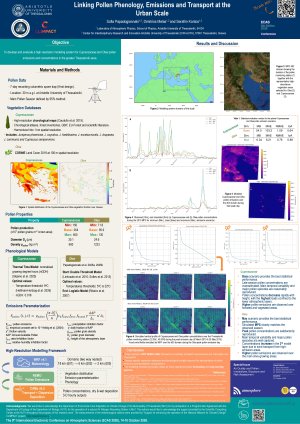
Airborne pollen exposure in Mediterranean cities is shaped by the interaction of heterogeneous vegetation, meteorology and species-specific phenology. This study presents an integrated high-resolution modelling framework for simulating the emissions and atmospheric transport of four major pollen taxa, Cupressaceae, Quercus spp., Pinaceae and Olea europaea L., in the greater Thessaloniki area, northern Greece. The system couples the WRF model with a modified natural emissions module, NEMO, and the CAMx chemistry-transport model operated in inert particle mode at 2 km spatial resolution. Species' annual pollen production values were combined with detailed vegetation distribution datasets and meteorological release functions to represent spatially varying source strength and hourly emission dynamics. Particular attention was also given to phenological timing, which controls the onset, duration and intensity of the pollen season. Modelled pollen concentrations were evaluated against ground-based aerobiological observations in Thessaloniki. The modelling system reproduced the temporal evolution and magnitude of airborne pollen concentrations with satisfactory agreement, with Index of Agreement values ranging from 0.64 to 0.81 across the simulated taxa. This system connects atmospheric modelling and aerobiological research with the practical management of pollen-related allergic diseases. These developments could support its future integration into a localized pollen early warning service, providing timely information for sensitized individuals and public health authorities.
Keywords
Quercus
Cupressaceae
Pinaceae
Olea
NEMO emissions model
WRF
CAMx
Poster
Poster_Pollen_ECAS_2026.pdf
Multi-Resolution Wavelet Enhanced Hybrid Deep Learning Framework for Air Quality Index Prediction
Long-Term Trends in PM10 Concentrations in a Transitioning Polish Industrial Municipality: Mitigation Strategies and Future Compliance