Event submissions
Published
This submission belongs to the session S1. Air Quality and Human Health of the event The 8th International Electronic Conference on Atmospheric Sciences
Published date
09 Oct, 2026
Academic Editor
'%3e%3cpath%20d='M12.6657%2010.9104C12.4185%2010.325%2012.0599%209.79327%2011.6097%209.34482C11.1609%208.89508%2010.6293%208.5365%2010.0442%208.28888C10.0389%208.28626%2010.0337%208.28495%2010.0285%208.28233C10.8446%207.69279%2011.3752%206.73249%2011.3752%205.64904C11.3752%203.8542%209.92103%202.39999%208.1262%202.39999C6.33136%202.39999%204.87715%203.8542%204.87715%205.64904C4.87715%206.73249%205.40774%207.69279%206.22393%208.28364C6.21869%208.28626%206.21345%208.28757%206.20821%208.29019C5.62129%208.5378%205.09463%208.89284%204.64265%209.34613C4.1929%209.79493%203.83432%2010.3266%203.58671%2010.9117C3.34345%2011.4845%203.21226%2012.0987%203.20023%2012.7209C3.19988%2012.7349%203.20233%2012.7488%203.20744%2012.7619C3.21255%2012.7749%203.22022%2012.7867%203.22998%2012.7968C3.23975%2012.8068%203.25142%2012.8147%203.26431%2012.8202C3.2772%2012.8256%203.29105%2012.8284%203.30504%2012.8284H4.09109C4.14874%2012.8284%204.19459%2012.7825%204.1959%2012.7262C4.2221%2011.7148%204.62823%2010.7676%205.34617%2010.0497C6.08899%209.30683%207.0755%208.89808%208.1262%208.89808C9.17689%208.89808%2010.1634%209.30683%2010.9062%2010.0497C11.6242%2010.7676%2012.0303%2011.7148%2012.0565%2012.7262C12.0578%2012.7838%2012.1037%2012.8284%2012.1613%2012.8284H12.9474C12.9613%2012.8284%2012.9752%2012.8256%2012.9881%2012.8202C13.001%2012.8147%2013.0126%2012.8068%2013.0224%2012.7968C13.0322%2012.7867%2013.0398%2012.7749%2013.0449%2012.7619C13.0501%2012.7488%2013.0525%2012.7349%2013.0522%2012.7209C13.0391%2012.0947%2012.9094%2011.4855%2012.6657%2010.9104ZM8.1262%207.9024C7.52486%207.9024%206.9589%207.6679%206.53312%207.24211C6.10733%206.81633%205.87283%206.25037%205.87283%205.64904C5.87283%205.0477%206.10733%204.48174%206.53312%204.05596C6.9589%203.63018%207.52486%203.39567%208.1262%203.39567C8.72753%203.39567%209.29349%203.63018%209.71927%204.05596C10.1451%204.48174%2010.3796%205.0477%2010.3796%205.64904C10.3796%206.25037%2010.1451%206.81633%209.71927%207.24211C9.29349%207.6679%208.72753%207.9024%208.1262%207.9024Z'%20fill='%235D1EE1'/%3e%3c/g%3e%3c/svg%3e) Anthony R. Lupo
Anthony R. LupoCitation
Anna Smola-Dmochowska, Barbara Błaszczak, Krzysztof Słaby, Monika Błaszczak, Barbara Mathews, Kamila Widziewicz-Rzońca, Magdalena Żurawka, Patrycja Rogula-Kopiec, Long-Term Trends in PM10 Concentrations in a Transitioning Polish Industrial Municipality: Mitigation Strategies and Future Compliance, in Proceedings of The 8th International Electronic Conference on Atmospheric Sciences, 14 October–16 October 2026, MDPI: Basel, Switzerland
Share
Email
Facebook
Twitter
LinkedIn
Long-Term Trends in PM10 Concentrations in a Transitioning Polish Industrial Municipality: Mitigation Strategies and Future Compliance
'%3e%3cpath%20d='M12.6647%2010.9104C12.4176%2010.325%2012.0589%209.7933%2011.6088%209.34485C11.16%208.89511%2010.6283%208.53653%2010.0432%208.28891C10.038%208.28629%2010.0327%208.28498%2010.0275%208.28236C10.8437%207.69282%2011.3743%206.73252%2011.3743%205.64907C11.3743%203.85423%209.92005%202.40002%208.12522%202.40002C6.33038%202.40002%204.87618%203.85423%204.87618%205.64907C4.87618%206.73252%205.40677%207.69282%206.22296%208.28367C6.21772%208.28629%206.21248%208.2876%206.20724%208.29022C5.62031%208.53783%205.09365%208.89287%204.64167%209.34616C4.19192%209.79496%203.83334%2010.3266%203.58573%2010.9117C3.34247%2011.4846%203.21128%2012.0987%203.19925%2012.721C3.1989%2012.735%203.20135%2012.7489%203.20646%2012.7619C3.21157%2012.7749%203.21924%2012.7868%203.22901%2012.7968C3.23877%2012.8068%203.25045%2012.8148%203.26334%2012.8202C3.27623%2012.8256%203.29007%2012.8284%203.30406%2012.8284H4.09012C4.14776%2012.8284%204.19362%2012.7825%204.19493%2012.7262C4.22113%2011.7148%204.62726%2010.7676%205.34519%2010.0497C6.08802%209.30686%207.07452%208.89811%208.12522%208.89811C9.17592%208.89811%2010.1624%209.30686%2010.9052%2010.0497C11.6232%2010.7676%2012.0293%2011.7148%2012.0555%2012.7262C12.0568%2012.7839%2012.1027%2012.8284%2012.1603%2012.8284H12.9464C12.9604%2012.8284%2012.9742%2012.8256%2012.9871%2012.8202C13%2012.8148%2013.0117%2012.8068%2013.0214%2012.7968C13.0312%2012.7868%2013.0389%2012.7749%2013.044%2012.7619C13.0491%2012.7489%2013.0515%2012.735%2013.0512%2012.721C13.0381%2012.0947%2012.9084%2011.4856%2012.6647%2010.9104ZM8.12522%207.90243C7.52388%207.90243%206.95792%207.66793%206.53214%207.24215C6.10636%206.81636%205.87185%206.2504%205.87185%205.64907C5.87185%205.04773%206.10636%204.48177%206.53214%204.05599C6.95792%203.63021%207.52388%203.3957%208.12522%203.3957C8.72655%203.3957%209.29252%203.63021%209.7183%204.05599C10.1441%204.48177%2010.3786%205.04773%2010.3786%205.64907C10.3786%206.2504%2010.1441%206.81636%209.7183%207.24215C9.29252%207.66793%208.72655%207.90243%208.12522%207.90243Z'%20fill='%235D1EE1'/%3e%3c/g%3e%3c/svg%3e)
Anna Smola-Dmochowska 1
Barbara Błaszczak 1
Krzysztof Słaby 1
Monika Błaszczak 1
Barbara Mathews 1
Kamila Widziewicz-Rzońca 1
Magdalena Żurawka 1

Patrycja Rogula-Kopiec 1
1. Institute of Environmental Engineering, Polish Academy of Sciences, Zabrze, Poland
Abstract
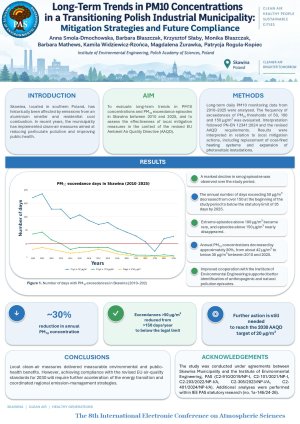
Introduction: The municipality of Skawina (Silesian–Kraków region, southern Poland), historically affected by emissions from an aluminium smelter and residential coal combustion, has experienced a substantial improvement in air quality. This study evaluates long-term trends in PM10 concentrations between 2010 and 2025 and assesses the effectiveness of local clean-air policies implemented in line with the Ambient Air Quality Directive (AAQD).
Methods: PM10 concentrations were assessed using long-term monitoring data, with detailed analyses based on daily measurements collected between 2010 and 2025. The frequency of exceedances of PM10 thresholds (50, 100, and 150 µg/m³) was evaluated according to PN-EN 12341:2024 and the revised AAQD requirements. Results were interpreted in the context of municipal mitigation measures, including the replacement of coal-fired heating systems and the expansion of photovoltaic installations.
Results: Data reveal a marked decline in smog episodes. The annual number of days exceeding the 50 µg/m³ threshold decreased from over 150 at the beginning of the study period to below the statutory limit of 35 days by 2025, while extreme episodes (>100 µg/m³) became rare. Annual PM10 concentrations decreased by approximately 30%, from 42 to below 30 µg/m³ between 2010 and 2025. This reduction confirms the effectiveness of municipal actions and significantly lowered population exposure to particulate matter. Cooperation with the Institute of Environmental Engineering of the Polish Academy of Sciences improved the identification of anthropogenic and natural pollution episodes, supporting evidence-based environmental management.
Conclusions: Local clean-air measures delivered measurable environmental and public-health benefits. However, achieving compliance with the revised EU air-quality standards for 2030 will require further acceleration of the energy transition and coordinated regional emission-management strategies.
Acknowledgements. The study was conducted under agreements between Skawina Municipality and the Institute of Environmental Engineering, PAS (C2-910/2019/NP-I, C2-101/2021/NP-I, C2-203/2022/NP-I/A, C2-305/2023/NP-I/A, C2-401/2024/NP-I/A). Additional analyses were performed within IEE PAS statutory research (no. 1a-146/24-26).
Keywords
PM10
Ambient Air Quality Directive (AAQD)
air-quality
Poster
Smola-Dmochowska poster.pdf
Linking Pollen Phenology, Emissions and Transport at the Urban Scale
Assessing the role of biogenic emissions and climate change on urban ozone formation: a modelling study in a Mediterranean city (Lecce, Italy)