Event submissions
Published
This submission belongs to the session S1. Air Quality and Human Health of the event The 8th International Electronic Conference on Atmospheric Sciences
Published date
09 Oct, 2026
Academic Editor
'%3e%3cpath%20d='M12.6657%2010.9104C12.4185%2010.325%2012.0599%209.79327%2011.6097%209.34482C11.1609%208.89508%2010.6293%208.5365%2010.0442%208.28888C10.0389%208.28626%2010.0337%208.28495%2010.0285%208.28233C10.8446%207.69279%2011.3752%206.73249%2011.3752%205.64904C11.3752%203.8542%209.92103%202.39999%208.1262%202.39999C6.33136%202.39999%204.87715%203.8542%204.87715%205.64904C4.87715%206.73249%205.40774%207.69279%206.22393%208.28364C6.21869%208.28626%206.21345%208.28757%206.20821%208.29019C5.62129%208.5378%205.09463%208.89284%204.64265%209.34613C4.1929%209.79493%203.83432%2010.3266%203.58671%2010.9117C3.34345%2011.4845%203.21226%2012.0987%203.20023%2012.7209C3.19988%2012.7349%203.20233%2012.7488%203.20744%2012.7619C3.21255%2012.7749%203.22022%2012.7867%203.22998%2012.7968C3.23975%2012.8068%203.25142%2012.8147%203.26431%2012.8202C3.2772%2012.8256%203.29105%2012.8284%203.30504%2012.8284H4.09109C4.14874%2012.8284%204.19459%2012.7825%204.1959%2012.7262C4.2221%2011.7148%204.62823%2010.7676%205.34617%2010.0497C6.08899%209.30683%207.0755%208.89808%208.1262%208.89808C9.17689%208.89808%2010.1634%209.30683%2010.9062%2010.0497C11.6242%2010.7676%2012.0303%2011.7148%2012.0565%2012.7262C12.0578%2012.7838%2012.1037%2012.8284%2012.1613%2012.8284H12.9474C12.9613%2012.8284%2012.9752%2012.8256%2012.9881%2012.8202C13.001%2012.8147%2013.0126%2012.8068%2013.0224%2012.7968C13.0322%2012.7867%2013.0398%2012.7749%2013.0449%2012.7619C13.0501%2012.7488%2013.0525%2012.7349%2013.0522%2012.7209C13.0391%2012.0947%2012.9094%2011.4855%2012.6657%2010.9104ZM8.1262%207.9024C7.52486%207.9024%206.9589%207.6679%206.53312%207.24211C6.10733%206.81633%205.87283%206.25037%205.87283%205.64904C5.87283%205.0477%206.10733%204.48174%206.53312%204.05596C6.9589%203.63018%207.52486%203.39567%208.1262%203.39567C8.72753%203.39567%209.29349%203.63018%209.71927%204.05596C10.1451%204.48174%2010.3796%205.0477%2010.3796%205.64904C10.3796%206.25037%2010.1451%206.81633%209.71927%207.24211C9.29349%207.6679%208.72753%207.9024%208.1262%207.9024Z'%20fill='%235D1EE1'/%3e%3c/g%3e%3c/svg%3e) Daniele Contini
Daniele ContiniCitation
Patrycja Rogula-Kopiec, Magdalena Żurawka, Barbara Mathews, Monika Błaszczak, Barbara Błaszczak, Kamila Widziewicz-Rzońca, Krzysztof Słaby, Anna Smola-Dmochowska, What’s in the Air? Carbonaceous Aerosols in Beauty Salons, in Proceedings of The 8th International Electronic Conference on Atmospheric Sciences, 14 October–16 October 2026, MDPI: Basel, Switzerland
Share
Email
Facebook
Twitter
LinkedIn
What’s in the Air? Carbonaceous Aerosols in Beauty Salons

Patrycja Rogula-Kopiec 1
'%3e%3cpath%20d='M12.6647%2010.9104C12.4176%2010.325%2012.0589%209.7933%2011.6088%209.34485C11.16%208.89511%2010.6283%208.53653%2010.0432%208.28891C10.038%208.28629%2010.0327%208.28498%2010.0275%208.28236C10.8437%207.69282%2011.3743%206.73252%2011.3743%205.64907C11.3743%203.85423%209.92005%202.40002%208.12522%202.40002C6.33038%202.40002%204.87618%203.85423%204.87618%205.64907C4.87618%206.73252%205.40677%207.69282%206.22296%208.28367C6.21772%208.28629%206.21248%208.2876%206.20724%208.29022C5.62031%208.53783%205.09365%208.89287%204.64167%209.34616C4.19192%209.79496%203.83334%2010.3266%203.58573%2010.9117C3.34247%2011.4846%203.21128%2012.0987%203.19925%2012.721C3.1989%2012.735%203.20135%2012.7489%203.20646%2012.7619C3.21157%2012.7749%203.21924%2012.7868%203.22901%2012.7968C3.23877%2012.8068%203.25045%2012.8148%203.26334%2012.8202C3.27623%2012.8256%203.29007%2012.8284%203.30406%2012.8284H4.09012C4.14776%2012.8284%204.19362%2012.7825%204.19493%2012.7262C4.22113%2011.7148%204.62726%2010.7676%205.34519%2010.0497C6.08802%209.30686%207.07452%208.89811%208.12522%208.89811C9.17592%208.89811%2010.1624%209.30686%2010.9052%2010.0497C11.6232%2010.7676%2012.0293%2011.7148%2012.0555%2012.7262C12.0568%2012.7839%2012.1027%2012.8284%2012.1603%2012.8284H12.9464C12.9604%2012.8284%2012.9742%2012.8256%2012.9871%2012.8202C13%2012.8148%2013.0117%2012.8068%2013.0214%2012.7968C13.0312%2012.7868%2013.0389%2012.7749%2013.044%2012.7619C13.0491%2012.7489%2013.0515%2012.735%2013.0512%2012.721C13.0381%2012.0947%2012.9084%2011.4856%2012.6647%2010.9104ZM8.12522%207.90243C7.52388%207.90243%206.95792%207.66793%206.53214%207.24215C6.10636%206.81636%205.87185%206.2504%205.87185%205.64907C5.87185%205.04773%206.10636%204.48177%206.53214%204.05599C6.95792%203.63021%207.52388%203.3957%208.12522%203.3957C8.72655%203.3957%209.29252%203.63021%209.7183%204.05599C10.1441%204.48177%2010.3786%205.04773%2010.3786%205.64907C10.3786%206.2504%2010.1441%206.81636%209.7183%207.24215C9.29252%207.66793%208.72655%207.90243%208.12522%207.90243Z'%20fill='%235D1EE1'/%3e%3c/g%3e%3c/svg%3e)
Magdalena Żurawka 1
Barbara Mathews 1
Monika Błaszczak 1
Barbara Błaszczak 1
Kamila Widziewicz-Rzońca 1
Krzysztof Słaby 1
Anna Smola-Dmochowska 1
1. Institute of Environmental Engineering, Polish Academy of Sciences, Zabrze, Poland
Abstract
Abstract
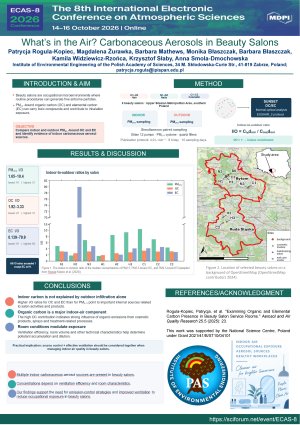
This study assessed indoor and outdoor concentrations of elemental carbon (EC) and organic carbon (OC) associated with the PM2.5 fraction in nine beauty salons. Attention was given to identifying potential indoor sources of carbonaceous aerosols generated during cosmetic procedures. Carbon-containing particles may carry toxic compounds that can adversely affect the health of salon employees and customers, making their characterization important for occupational exposure assessment.
Methods
PM2.5 samples were collected simultaneously indoors and outdoors on quartz fiber filters and analyzed for OC and EC content using a Sunset Laboratory thermal-optical OC/EC analyzer. The investigated salons were categorized according to their primary activity into three groups: hairdressing (H1–H3), nail styling (N1–N3), and cosmetic treatment salons (C1–C3). All sampling sites were located within the Upper Silesian Metropolitan Area (southern Poland). Aerosol sampling was performed using Gilian 12 personal air sampling pumps equipped with PM2.5 cyclone separators.
Results
The PM2.5 concentration indoor outdoor ratios (I/Oratio) ranged from 1.65 for site H1 to 10.4 for site C1, OC from 1.92 for H1 to 3.33 for C1, and EC ranged from 0.139 to 79.9 for H1 and N2 respectively. However, all the ratios were higher than 1 except EC at H1. A higher I/Oratio for OC and EC than for PM indicates that the carbon in indoor environments is not only accumulation of outdoor air indoors but predominantly contribution of internal sources.
Conclusions
The results indicate the presence of numerous indoor air pollution sources. Their levels are determined by the technical conditions of the facilities, particularly the ventilation used and other room parameters. The high organic carbon content confirms its significant role in shaping indoor air quality. The results emphasize the need to improve measures to reduce pollutant emissions and conduct research into their sources and impact on the health of salon users.
Keywords
PM2.5
beauty salon
organic carbon
elemental carbon
Poster
Patrycja Rogula-Kopiec MDPI.pdf
Assessing the role of biogenic emissions and climate change on urban ozone formation: a modelling study in a Mediterranean city (Lecce, Italy)
Monoterpene Oxidation and Air Quality: Kinetics and Formation Pathways of Citronellol with OH Radical