Event submissions
Published
This submission belongs to the session S1. Air Quality and Human Health of the event The 8th International Electronic Conference on Atmospheric Sciences
Published date
09 Oct, 2026
Academic Editor
'%3e%3cpath%20d='M12.6657%2010.9104C12.4185%2010.325%2012.0599%209.79327%2011.6097%209.34482C11.1609%208.89508%2010.6293%208.5365%2010.0442%208.28888C10.0389%208.28626%2010.0337%208.28495%2010.0285%208.28233C10.8446%207.69279%2011.3752%206.73249%2011.3752%205.64904C11.3752%203.8542%209.92103%202.39999%208.1262%202.39999C6.33136%202.39999%204.87715%203.8542%204.87715%205.64904C4.87715%206.73249%205.40774%207.69279%206.22393%208.28364C6.21869%208.28626%206.21345%208.28757%206.20821%208.29019C5.62129%208.5378%205.09463%208.89284%204.64265%209.34613C4.1929%209.79493%203.83432%2010.3266%203.58671%2010.9117C3.34345%2011.4845%203.21226%2012.0987%203.20023%2012.7209C3.19988%2012.7349%203.20233%2012.7488%203.20744%2012.7619C3.21255%2012.7749%203.22022%2012.7867%203.22998%2012.7968C3.23975%2012.8068%203.25142%2012.8147%203.26431%2012.8202C3.2772%2012.8256%203.29105%2012.8284%203.30504%2012.8284H4.09109C4.14874%2012.8284%204.19459%2012.7825%204.1959%2012.7262C4.2221%2011.7148%204.62823%2010.7676%205.34617%2010.0497C6.08899%209.30683%207.0755%208.89808%208.1262%208.89808C9.17689%208.89808%2010.1634%209.30683%2010.9062%2010.0497C11.6242%2010.7676%2012.0303%2011.7148%2012.0565%2012.7262C12.0578%2012.7838%2012.1037%2012.8284%2012.1613%2012.8284H12.9474C12.9613%2012.8284%2012.9752%2012.8256%2012.9881%2012.8202C13.001%2012.8147%2013.0126%2012.8068%2013.0224%2012.7968C13.0322%2012.7867%2013.0398%2012.7749%2013.0449%2012.7619C13.0501%2012.7488%2013.0525%2012.7349%2013.0522%2012.7209C13.0391%2012.0947%2012.9094%2011.4855%2012.6657%2010.9104ZM8.1262%207.9024C7.52486%207.9024%206.9589%207.6679%206.53312%207.24211C6.10733%206.81633%205.87283%206.25037%205.87283%205.64904C5.87283%205.0477%206.10733%204.48174%206.53312%204.05596C6.9589%203.63018%207.52486%203.39567%208.1262%203.39567C8.72753%203.39567%209.29349%203.63018%209.71927%204.05596C10.1451%204.48174%2010.3796%205.0477%2010.3796%205.64904C10.3796%206.25037%2010.1451%206.81633%209.71927%207.24211C9.29349%207.6679%208.72753%207.9024%208.1262%207.9024Z'%20fill='%235D1EE1'/%3e%3c/g%3e%3c/svg%3e) Daniele Contini
Daniele ContiniCitation
Poliana Dutra-Maia, Artur Moraes Amorim, Jeane Grasyelle Silva Chaves, Roberto Ventura Santos, Isotopic Signatures of Neodymium and Strontium in PM10 from the Distrito Federal, Central Brazil, in Proceedings of The 8th International Electronic Conference on Atmospheric Sciences, 14 October–16 October 2026, MDPI: Basel, Switzerland
Share
Email
Facebook
Twitter
LinkedIn
Isotopic Signatures of Neodymium and Strontium in PM10 from the Distrito Federal, Central Brazil
'%3e%3cpath%20d='M12.6647%2010.9104C12.4176%2010.325%2012.0589%209.7933%2011.6088%209.34485C11.16%208.89511%2010.6283%208.53653%2010.0432%208.28891C10.038%208.28629%2010.0327%208.28498%2010.0275%208.28236C10.8437%207.69282%2011.3743%206.73252%2011.3743%205.64907C11.3743%203.85423%209.92005%202.40002%208.12522%202.40002C6.33038%202.40002%204.87618%203.85423%204.87618%205.64907C4.87618%206.73252%205.40677%207.69282%206.22296%208.28367C6.21772%208.28629%206.21248%208.2876%206.20724%208.29022C5.62031%208.53783%205.09365%208.89287%204.64167%209.34616C4.19192%209.79496%203.83334%2010.3266%203.58573%2010.9117C3.34247%2011.4846%203.21128%2012.0987%203.19925%2012.721C3.1989%2012.735%203.20135%2012.7489%203.20646%2012.7619C3.21157%2012.7749%203.21924%2012.7868%203.22901%2012.7968C3.23877%2012.8068%203.25045%2012.8148%203.26334%2012.8202C3.27623%2012.8256%203.29007%2012.8284%203.30406%2012.8284H4.09012C4.14776%2012.8284%204.19362%2012.7825%204.19493%2012.7262C4.22113%2011.7148%204.62726%2010.7676%205.34519%2010.0497C6.08802%209.30686%207.07452%208.89811%208.12522%208.89811C9.17592%208.89811%2010.1624%209.30686%2010.9052%2010.0497C11.6232%2010.7676%2012.0293%2011.7148%2012.0555%2012.7262C12.0568%2012.7839%2012.1027%2012.8284%2012.1603%2012.8284H12.9464C12.9604%2012.8284%2012.9742%2012.8256%2012.9871%2012.8202C13%2012.8148%2013.0117%2012.8068%2013.0214%2012.7968C13.0312%2012.7868%2013.0389%2012.7749%2013.044%2012.7619C13.0491%2012.7489%2013.0515%2012.735%2013.0512%2012.721C13.0381%2012.0947%2012.9084%2011.4856%2012.6647%2010.9104ZM8.12522%207.90243C7.52388%207.90243%206.95792%207.66793%206.53214%207.24215C6.10636%206.81636%205.87185%206.2504%205.87185%205.64907C5.87185%205.04773%206.10636%204.48177%206.53214%204.05599C6.95792%203.63021%207.52388%203.3957%208.12522%203.3957C8.72655%203.3957%209.29252%203.63021%209.7183%204.05599C10.1441%204.48177%2010.3786%205.04773%2010.3786%205.64907C10.3786%206.2504%2010.1441%206.81636%209.7183%207.24215C9.29252%207.66793%208.72655%207.90243%208.12522%207.90243Z'%20fill='%235D1EE1'/%3e%3c/g%3e%3c/svg%3e)
Poliana Dutra-Maia 1
Artur Moraes Amorim 2
Jeane Grasyelle Silva Chaves 2
Roberto Ventura Santos 2
1. Faculty of Planaltina, University of Brasília, Área Universitária N.1, Vila Nossa Senhora de Fátima 73300-000, Planaltina, Brazil
2. Laboratory of Geochronology, Institute of Geosciences, University of Brasilia 70910-000, Brasília, Brazil
Abstract
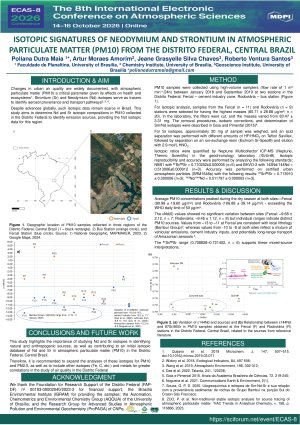
Changes in urban air quality are widely documented, with atmospheric particulate matter (PM10) being a critical parameter due to its effects on health and ecosystems. Strontium (Sr) and Neodymium (Nd) isotopes serve as tracers to identify aerosol provenance and transport pathways. Despite advances globally, such isotopic data remain scarce in Brazil. This study aims to determine Nd and Sr isotopic compositions in PM10 collected in the Distrito Federal to identify emission sources, providing the first isotopic data for this region. PM10 samples were collected using High-Vol samplers between January 2018 and September 2019 at two sites: Fercal (cement industry area; n = 11) and Rodoviária (bus terminal; n = 9). Twenty samples with the highest PM₁₀ masses (80.71 ± 28.88 μg/m³) were selected. Analytical procedures followed Goia and Pimentel (2015). Isotopic ratios were measured via MC-ICP-MS (Neptune) at IG/UnB, with accuracy confirmed by international standards (NBS1, BHVO-2, and SRM 1648a). Average PM10 concentrations peaked during the dry season at both sites—Fercal (90.98 ± 19.60 µg/m³) and Rodoviária (106.88 ± 39.14 µg/m³)—exceeding the WHO daily limit of 50 µg/m³.
The εNd(0) values showed no significant variation between sites (Fercal: –9.68 ± 2.12, n = 7; Rodoviária: –9.45 ± 1.12, n = 8) but individual ranges indicate distinct PM10 sources. εNd(0) values from –13 to –11 at Fercal are consistent with local lithology (Bambuí Group), whereas values from -10 to -8 at both sites reflect a mixture of vehicular emissions, cement industry inputs, and potentially long-range transport of Amazonian aerosols. The ⁸⁷Sr/⁸⁶Sr range (0.708828–0.721402, n = 6) supports these mixed-source interpretations.
Keywords
Nd and Sr isotopes
atmospheric particulate matter
PM10
Distrito Federal
Central Brazil
Poster
8th ECAS_Dutra-Maia_2026.pdf
Monoterpene Oxidation and Air Quality: Kinetics and Formation Pathways of Citronellol with OH Radical
From Air to Earth: Quantifying Pesticide Aerosol Dispersion Using UAV-Assisted Atmospheric Monitoring and Life Cycle Analysis