Event submissions
Published
This submission belongs to the session S1. Air Quality and Human Health of the event The 8th International Electronic Conference on Atmospheric Sciences
Published date
09 Oct, 2026
Academic Editor
'%3e%3cpath%20d='M12.6657%2010.9104C12.4185%2010.325%2012.0599%209.79327%2011.6097%209.34482C11.1609%208.89508%2010.6293%208.5365%2010.0442%208.28888C10.0389%208.28626%2010.0337%208.28495%2010.0285%208.28233C10.8446%207.69279%2011.3752%206.73249%2011.3752%205.64904C11.3752%203.8542%209.92103%202.39999%208.1262%202.39999C6.33136%202.39999%204.87715%203.8542%204.87715%205.64904C4.87715%206.73249%205.40774%207.69279%206.22393%208.28364C6.21869%208.28626%206.21345%208.28757%206.20821%208.29019C5.62129%208.5378%205.09463%208.89284%204.64265%209.34613C4.1929%209.79493%203.83432%2010.3266%203.58671%2010.9117C3.34345%2011.4845%203.21226%2012.0987%203.20023%2012.7209C3.19988%2012.7349%203.20233%2012.7488%203.20744%2012.7619C3.21255%2012.7749%203.22022%2012.7867%203.22998%2012.7968C3.23975%2012.8068%203.25142%2012.8147%203.26431%2012.8202C3.2772%2012.8256%203.29105%2012.8284%203.30504%2012.8284H4.09109C4.14874%2012.8284%204.19459%2012.7825%204.1959%2012.7262C4.2221%2011.7148%204.62823%2010.7676%205.34617%2010.0497C6.08899%209.30683%207.0755%208.89808%208.1262%208.89808C9.17689%208.89808%2010.1634%209.30683%2010.9062%2010.0497C11.6242%2010.7676%2012.0303%2011.7148%2012.0565%2012.7262C12.0578%2012.7838%2012.1037%2012.8284%2012.1613%2012.8284H12.9474C12.9613%2012.8284%2012.9752%2012.8256%2012.9881%2012.8202C13.001%2012.8147%2013.0126%2012.8068%2013.0224%2012.7968C13.0322%2012.7867%2013.0398%2012.7749%2013.0449%2012.7619C13.0501%2012.7488%2013.0525%2012.7349%2013.0522%2012.7209C13.0391%2012.0947%2012.9094%2011.4855%2012.6657%2010.9104ZM8.1262%207.9024C7.52486%207.9024%206.9589%207.6679%206.53312%207.24211C6.10733%206.81633%205.87283%206.25037%205.87283%205.64904C5.87283%205.0477%206.10733%204.48174%206.53312%204.05596C6.9589%203.63018%207.52486%203.39567%208.1262%203.39567C8.72753%203.39567%209.29349%203.63018%209.71927%204.05596C10.1451%204.48174%2010.3796%205.0477%2010.3796%205.64904C10.3796%206.25037%2010.1451%206.81633%209.71927%207.24211C9.29349%207.6679%208.72753%207.9024%208.1262%207.9024Z'%20fill='%235D1EE1'/%3e%3c/g%3e%3c/svg%3e) Daniele Contini
Daniele ContiniCitation
Ioannis Logothetis, Dimitrios-Sotirios Kourkoumpas, Adamantios Mitsotakis, Panagiotis Grammelis, Stavros Kyzalas, Mary Papandreou, Evangelos Bekiaris, Air Quality in the Port of Chalki Island: Assessing the Role of Traffic and Atmospheric Circulation during the First Half of 2025, in Proceedings of The 8th International Electronic Conference on Atmospheric Sciences, 14 October–16 October 2026, MDPI: Basel, Switzerland
Share
Email
Facebook
Twitter
LinkedIn
Air Quality in the Port of Chalki Island: Assessing the Role of Traffic and Atmospheric Circulation during the First Half of 2025

Ioannis Logothetis 1,2
'%3e%3cpath%20d='M12.6647%2010.9104C12.4176%2010.325%2012.0589%209.7933%2011.6088%209.34485C11.16%208.89511%2010.6283%208.53653%2010.0432%208.28891C10.038%208.28629%2010.0327%208.28498%2010.0275%208.28236C10.8437%207.69282%2011.3743%206.73252%2011.3743%205.64907C11.3743%203.85423%209.92005%202.40002%208.12522%202.40002C6.33038%202.40002%204.87618%203.85423%204.87618%205.64907C4.87618%206.73252%205.40677%207.69282%206.22296%208.28367C6.21772%208.28629%206.21248%208.2876%206.20724%208.29022C5.62031%208.53783%205.09365%208.89287%204.64167%209.34616C4.19192%209.79496%203.83334%2010.3266%203.58573%2010.9117C3.34247%2011.4846%203.21128%2012.0987%203.19925%2012.721C3.1989%2012.735%203.20135%2012.7489%203.20646%2012.7619C3.21157%2012.7749%203.21924%2012.7868%203.22901%2012.7968C3.23877%2012.8068%203.25045%2012.8148%203.26334%2012.8202C3.27623%2012.8256%203.29007%2012.8284%203.30406%2012.8284H4.09012C4.14776%2012.8284%204.19362%2012.7825%204.19493%2012.7262C4.22113%2011.7148%204.62726%2010.7676%205.34519%2010.0497C6.08802%209.30686%207.07452%208.89811%208.12522%208.89811C9.17592%208.89811%2010.1624%209.30686%2010.9052%2010.0497C11.6232%2010.7676%2012.0293%2011.7148%2012.0555%2012.7262C12.0568%2012.7839%2012.1027%2012.8284%2012.1603%2012.8284H12.9464C12.9604%2012.8284%2012.9742%2012.8256%2012.9871%2012.8202C13%2012.8148%2013.0117%2012.8068%2013.0214%2012.7968C13.0312%2012.7868%2013.0389%2012.7749%2013.044%2012.7619C13.0491%2012.7489%2013.0515%2012.735%2013.0512%2012.721C13.0381%2012.0947%2012.9084%2011.4856%2012.6647%2010.9104ZM8.12522%207.90243C7.52388%207.90243%206.95792%207.66793%206.53214%207.24215C6.10636%206.81636%205.87185%206.2504%205.87185%205.64907C5.87185%205.04773%206.10636%204.48177%206.53214%204.05599C6.95792%203.63021%207.52388%203.3957%208.12522%203.3957C8.72655%203.3957%209.29252%203.63021%209.7183%204.05599C10.1441%204.48177%2010.3786%205.04773%2010.3786%205.64907C10.3786%206.2504%2010.1441%206.81636%209.7183%207.24215C9.29252%207.66793%208.72655%207.90243%208.12522%207.90243Z'%20fill='%235D1EE1'/%3e%3c/g%3e%3c/svg%3e)
Dimitrios-Sotirios Kourkoumpas 1
Adamantios Mitsotakis 1

Panagiotis Grammelis 1
Stavros Kyzalas 3
Mary Papandreou 3

Evangelos Bekiaris 3
1. Centre for Research and Technology Hellas, Chemical Process and Energy Resources Institute, Thermi, GR 57001 Thessaloniki, Greece
2. Laboratory of Atmospheric Physics, Department of Physics, Faculty of Sciences, Aristotle University of Thessaloniki, GR 54124 Thessaloniki, Greece
3. Centre for Research and Technology Hellas, Hellenic Institute of Transport, Thermi, GR 57001 Thessaloniki, Greece
Abstract
Traffic in insular tourist areas is one of the most significant factors which affects ambient air quality. This study investigates the influence of traffic emissions on PM2.5 concentration variability within the port area of Chalki Island (located in the southeastern Aegean Sea). The analysis was employed during the period from February 13 to June 17, 2025. For the analysis, the Air Quality Index (AQI) was calculated utilizing hourly average PM2.5 concentration records from a mobile calibrated air quality monitoring system (AQ-Mesh). To study the impact of low-tropospheric circulation on pollution variability, wind speed data from the ERA5 reanalysis dataset were employed. Furthermore, to evaluate the effect of traffic on air quality in the port area, a traffic index that expresses traffic density (considering daily-scale traffic variation) was calculated, incorporating the total number of vehicles, vessels, and passengers (as provided by local authorities). The results indicated that air quality at the beginning of summer period degrades by 45% compared to the winter period (January, 2025). During June, the monthly mean AQI was equal to 38.5±4.5 (classified as 'Good' air quality class). Correspondingly, the traffic index shows a relative increase of approximately 74% during the summer period (relative to winter, 2025). The calculation of the correlation coefficients between the AQI and wind speed (for each grid point over an extended area of the Aegean basin), shows that low atmospheric circulation acts as a driver for the variation of PM2.5 concentrations. The increased wind speed over southeastern Aegean is related to an improved air quality in Chalki’s port area. The results provide critical insights into the environmental pressures faced by small Mediterranean ports, highlighting the urgency for continuous monitoring and the development of sustainable transport frameworks for insular areas
Keywords
traffic
insular areas
Aegean Sea
Air Quality
Air Pollution
"NHSOS" Project
Poster
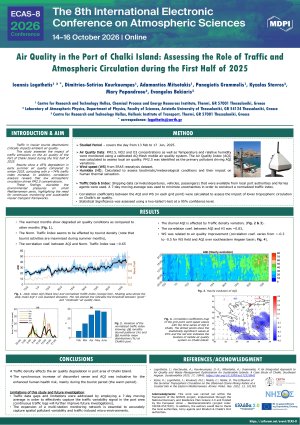
Poster_Traffic_and_AirQuality_NHSOS.pdf
From Air to Earth: Quantifying Pesticide Aerosol Dispersion Using UAV-Assisted Atmospheric Monitoring and Life Cycle Analysis
The Link Between Climate Change and Health: Air Pollution